Home / DNP Preceptor
Doctoral placementHow to Find a DNP Preceptor and Project Site at Capella
The Capella Doctor of Nursing Practice requires a minimum of 1,000 supervised practicum hours, and Capella states that "learners are responsible for finding an appropriate preceptor." Unlike the NP specialties, a DNP placement is built around a project: you need a professional site that will host your practice change initiative and a qualified leader there to precept it. Here is exactly who qualifies, what the site must do, and how the placement gets approved.
Last updated: June 28, 2026 · Reviewed by the Capella Preceptor placement team
What is a DNP preceptor, and why is it different?
A DNP preceptor is the experienced professional at your practice site who oversees your doctoral practicum and mentors the practice change initiative at the center of your DNP project. That is the key difference from a Family Nurse Practitioner or Psychiatric-Mental Health NP preceptor. An NP preceptor supervises direct patient care so you accumulate clinical contact hours in a defined patient population. A DNP preceptor supervises an organizational or systems-level project, so the fit is about the work and the site, not just a patient panel.
Capella describes the practicum environment as "a professional site at which learners, with the support of program faculty and their on-site preceptors, design and participate in a practice change initiative such as a pilot study, program evaluation, quality improvement project, evaluation of a new practice model, or consulting project." In plain terms, your preceptor is the person inside that organization who has the authority and the experience to back your project and sign off on your hours.
Because the placement is project-shaped, finding a DNP preceptor is really two tasks at once: securing a site that can host your initiative and securing a qualified leader there to precept it. Most students who stall are stuck on one half or the other. The sections below take them in order.
Does Capella find your DNP preceptor for you?
No. Capella is explicit: "Learners are responsible for finding an appropriate preceptor to oversee the practicum experience." The university supports you with program faculty and a practicum management system, but it does not assign your preceptor or your project site, and it does not maintain a roster of preceptors it hands out. You identify both, then submit them for Capella's own review.
That is the whole reason this gap exists. A doctoral student who has finished most of the coursework can still be blocked from starting the practicum because nobody at a suitable site has agreed to precept the project. We source, vet, and confirm preceptors and sites that meet Capella's published requirements and submit them for Capella's own approval. We never describe a preceptor as "Capella approved" before the university has reviewed them, because that approval is Capella's to give.
Who qualifies to be a DNP preceptor?
A DNP preceptor is a qualified, experienced professional whose role lets them mentor your specific practice change initiative. Because DNP projects vary widely, the right preceptor is not always an advanced practice nurse. The fit follows the project. Common qualified preceptors include:
- A DNP-prepared nurse or APRN leading the unit, service line, or program your project touches.
- A nurse executive or nurse manager, such as a director of nursing, CNO, or quality director, when the project is a program evaluation or system change.
- A physician or other licensed provider when the initiative is a clinical pilot or a new practice model.
- A quality, safety, or informatics leader when the project is a quality improvement, data, or workflow initiative.
- A public health or population health leader for a community or policy-focused project.
Across all of these, the baseline is the same: the preceptor holds an active, unrestricted license or credential appropriate to their role, has the experience and the standing at the site to support your project, and is willing to take on the mentoring and the hour sign-offs. Capella reviews the proposed preceptor for fit before the practicum is approved, so the goal is a preceptor who clearly meets Capella's published requirements and survives that review, not one we can promise in advance.
What makes a site an approvable DNP project site?
The site is where your practice change initiative actually happens, so it has to be able to host the project, not just observe you. Capella lists the acceptable project shapes directly: a pilot study, a program evaluation, a quality improvement project, an evaluation of a new practice model, or a consulting project. A site is approvable when it can support one of those and provide a qualified preceptor. In practice that includes:
Health systems and hospitals
A unit, service line, or department running a measurable improvement, with a nurse leader or director to precept.
Clinics and primary care groups
A practice piloting a protocol, screening tool, or new care model, precepted by a provider or practice lead.
Public and community health
A health department, clinic, or community organization hosting a population-health or policy initiative.
Your own employer
Your current organization, with a qualified leader there as preceptor. Common and often the fastest route to approval.
Whichever site you use, Capella requires a signed affiliation agreement between the university and the organization before the practicum begins, and the proposed site and preceptor have to be submitted for approval. Using your own workplace does not skip those steps; it usually just makes the relationship and the access easier to establish.
How many hours does the DNP practicum require?
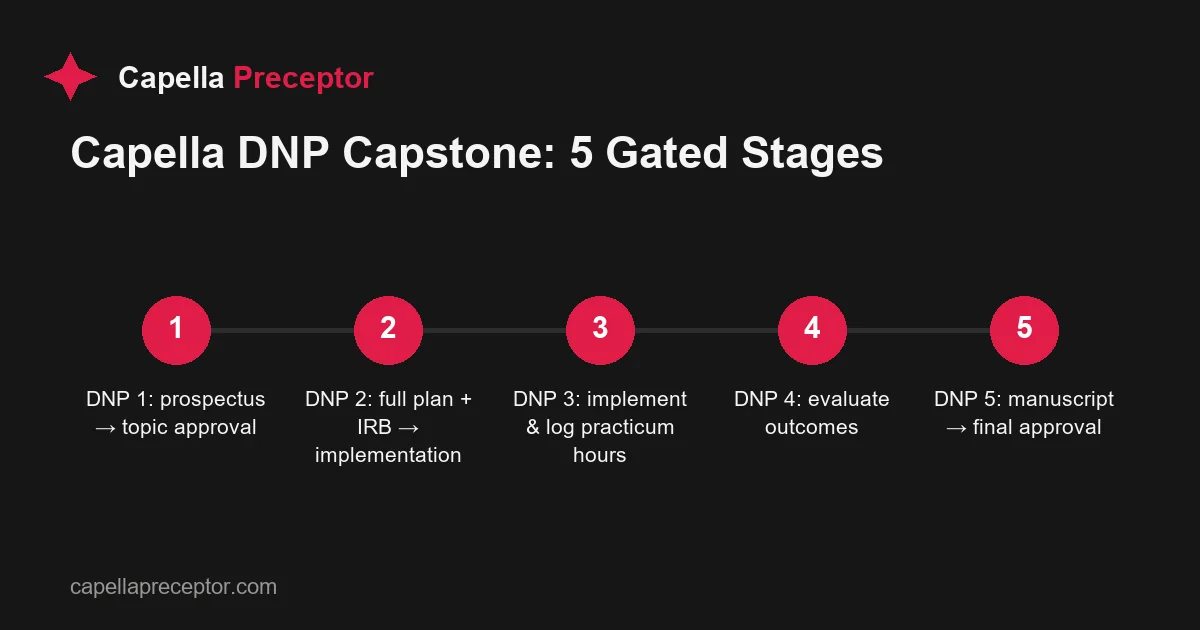
Capella requires a minimum of 1,000 supervised practicum hours to complete the Doctor of Nursing Practice, within at least 52 quarter credits. The hours are embedded across the program and the DNP project rather than logged in a single block, and they are supervised at your professional project site by your on-site preceptor. Capella also notes that partial completion of the practicum requirement cannot be verified for licensure or transfer of credits, so the placement needs to be solid enough to carry all 1,000 hours, not just the first term.
| Requirement | Capella DNP | What it means for the placement |
|---|---|---|
| Supervised practicum hours | 1,000 minimum (post-baccalaureate) | The site and preceptor must hold for the full count, not one term |
| Quarter credits | At least 52 | Practicum runs alongside the DNP project across the program |
| Preceptor | Secured by the learner | You find them; we source and submit for Capella's approval |
| Project | A practice change initiative | The site must be able to host the project, not just host you |
Hour and credit figures are Capella's published DNP requirements; always confirm against your current course room and program version. For the full hour and capstone breakdown, see our Capella DNP hours and capstone guide.
How do you get the DNP preceptor and site approved?
Securing the preceptor is the start, not the finish. The placement only counts once Capella has reviewed it and the paperwork clears. Capella manages practicum applications, site and preceptor approval, compliance documents, and the hours log in CORE ELMS, its online practicum system. The sequence is consistent:
- Identify the site and preceptor. Confirm the organization can host your practice change initiative and that a qualified leader there will precept it.
- Verify the credentials. Confirm an active, unrestricted license or credential and that the preceptor and site meet Capella's published requirements for your project.
- Submit in CORE ELMS. File the site and preceptor for Capella's review, with the compliance documents the system requires.
- Sign the affiliation agreement. The agreement between Capella and the organization must be in place before the practicum starts. This is usually the slowest step because it needs signatures on both sides.
- Clear the background check. Capella requires a background check through its third-party vendor, CastleBranch, completed within the program's deadline.
- Start logging hours. Once approved, you record practicum hours in CORE ELMS and your preceptor approves them inside the system as you go.
For a closer look at the practicum portal itself, see our Capella affiliation agreement and CORE ELMS walkthrough. The order matters: the affiliation agreement and the approvals have to land before your DNP practicum course opens, which is why starting the site and preceptor search early is the single biggest thing within your control.
DNP preceptor vs NP preceptor: a quick comparison
If you have placed an NP rotation before, the DNP search will feel different. Here is the side-by-side so you target the right thing.
| Factor | DNP preceptor | NP preceptor (FNP, PMHNP, AGPCNP) |
|---|---|---|
| What they supervise | A practice change project at a professional site | Direct patient care in a defined population |
| Who can precept | DNP, APRN, physician, nurse executive, quality or informatics leader | A licensed provider in the matching specialty |
| Hours | 1,000 supervised, project-based | 750 direct patient care hours (MSN NP specialties) |
| Site fit driver | Can the site host the project? | Does the site see the right patients? |
| Where to read more | This page | FNP, PMHNP, AGPCNP |
What students say about their DNP placement
"My QI project was set, but I had no one at a site to precept it. They found a nursing director at a system near me who fit the project, and handled the affiliation agreement and CORE ELMS submission. I started my 1,000 hours on schedule."
Renata Voss, DNP, Ohio
"I wanted to run my practice change initiative at my own hospital but did not know if it would be approved. They confirmed my workplace fit, lined up a quality leader as preceptor, and pushed the agreement to signature. Saved me a full term."
Devon Asher, DNP student, Texas
Illustrative student experiences. Read more on our reviews page.
FAQ
Does Capella assign a DNP preceptor for me?
No. Capella states that learners are responsible for finding an appropriate preceptor to oversee the practicum experience. The university provides faculty support and a practicum management system, but it does not assign your preceptor or your project site. You secure both, then submit them for Capella's own review and approval.
Who qualifies to be a DNP preceptor at Capella?
A DNP preceptor is an experienced clinical or organizational leader at your professional project site who can mentor a practice change initiative, such as a DNP-prepared nurse, a physician, a nurse executive, a quality or informatics leader, or another qualified professional whose role aligns with your project. Capella reviews the proposed preceptor and site for fit before approving the practicum. We confirm the credentials and submit the preceptor for Capella's own approval; we never represent anyone as school approved in advance.
How many practicum hours does the Capella DNP require?
Capella requires a minimum of 1,000 supervised practicum hours to complete the Doctor of Nursing Practice degree, within at least 52 quarter credits. The hours are embedded across the program and the DNP project rather than concentrated in one course, and they are supervised at your professional project site by your on-site preceptor.
What kind of site counts as a DNP project site?
Capella describes the practicum environment as a professional site at which learners, with the support of program faculty and their on-site preceptors, design and participate in a practice change initiative such as a pilot study, program evaluation, quality improvement project, evaluation of a new practice model, or consulting project. A hospital unit, clinic, health system department, public health agency, or your own workplace can qualify when it can host that project and provide a qualified preceptor.
Can I use my own employer as my DNP project site?
Often, yes. Many DNP students run their practice change initiative inside their current organization, with a qualified leader there serving as preceptor. It still has to be submitted and approved, and a signed affiliation agreement between Capella and the organization is required before the practicum begins. We help confirm whether your workplace fits and handle that paperwork.
Sources
- Capella University, DNP courses (1,000 practicum hours, preceptor responsibility, practice change initiative)
- Capella University Catalog, Doctor of Nursing Practice (1,000 supervised hours, at least 52 quarter credits, NURS9000 to NURS9040 capstone)
- Capella University, PMHNP program (CastleBranch background check requirement)
Get your DNP preceptor and project site secured
You now know what a DNP placement actually requires: a site that can host your practice change initiative, a qualified leader there to precept it, and a clean path through CORE ELMS and the affiliation agreement before your practicum course opens. That is exactly the work students hand to us. One free consult and we map your project fit, source a preceptor who meets Capella's published requirements, and submit it for Capella's own approval.
- A project-fit preceptor sourced and submitted for Capella's approval
- Affiliation agreement and CORE ELMS paperwork handled
- No payment until you are matched
Find your DNP preceptor, the right way
Free consult. We map your project, source a qualified preceptor, and handle the approval paperwork before your practicum opens.
Get my free consult →