Preceptors, hours, CORE ELMS, agreements, IRB, costs, and timing, answered straight, with sources you can check.
Capella runs its practicum the same way for almost every nursing program: you secure your own preceptor and site, a signed agreement goes on file, and your hours are logged and approved in CORE ELMS before they count. Below are the answers students ask most, grouped by topic. Where a number or rule comes from Capella, we link the source.
Preceptors and placement
What is a preceptorship at Capella?
A preceptorship is the supervised clinical part of your nursing program: practice hours completed at an approved site under a licensed clinician (the preceptor) who oversees and verifies your work. At Capella, the application, agreements, hour logs, and evaluations are all managed in CORE ELMS. The clinical work is yours to do; the paperwork around it is what overwhelms most students, and that is the part we handle.
Does Capella University find preceptors for students?
No. Capella's DNP courses page states plainly that "learners are responsible for finding an appropriate preceptor to oversee the practicum experience" (Capella, DNP courses), and the same expectation runs across the nurse practitioner programs (Capella, MSN-NP program). Capella offers support resources and may point you toward organizations that already hold an affiliation agreement, but it does not assign or guarantee a preceptor. That gap is exactly why this service exists: we find, verify, and manage the preceptor and all of the paperwork for you.
What credentials does a Capella preceptor need?
An active, unrestricted license in the state where you complete hours, board certification appropriate to the role and specialty (for NP students, that usually means an NP, a physician, or another qualified provider in the right specialty), and relevant clinical experience. The preceptor also activates a CORE ELMS account so they can approve your submitted hours and complete the required evaluations. Every preceptor we provide is verified against these criteria before you begin.
Can my employer be my preceptor?
Sometimes. It depends on your role at the organization, whether a qualified clinician can supervise you in a capacity distinct from your normal job duties, and whether the site will sign an affiliation agreement with Capella. We assess whether the arrangement will satisfy Capella's rules, and if it will not qualify, we place you elsewhere.
What happens if Capella rejects my preceptor or site?
We re-match you with a compliant preceptor at no extra cost. That is the point of the guarantee: you are not paying for a name on a form, you are paying for a placement Capella will actually approve.
How long does it take to get matched with a preceptor?
We guarantee a match within 7 days, and many students start sooner. The one variable outside our control is site-side compliance (background checks, onboarding, immunization review), which can add a few days; we track those steps so nothing gets lost.
Hours by program
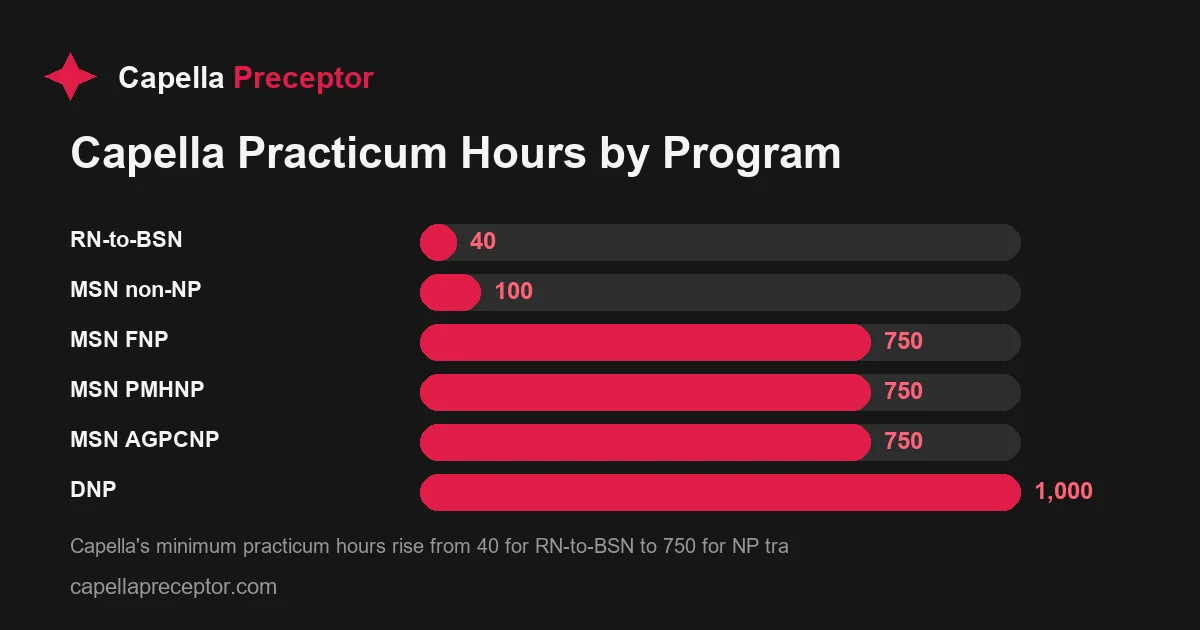
Practicum hour requirements are set by program, not by learning format: FlexPath and GuidedPath students complete the same number of hours. Here are the current Capella minimums.
Program
Minimum practicum hours
Where they sit
RN-to-BSN
40
Capstone (NURS4905 / NURS-FPX4905)
MSN, non-NP (e.g. Care Coordination, Nursing Education)
~100
Across practicum-bearing courses
MSN FNP
750
6 clinical courses, 125 hours each
MSN PMHNP
750
Practicum I, V, 150 hours each
MSN AGPCNP
750
125+125+125+125+250 (Transition to Practice)
DNP
1,000
Post-baccalaureate hours, inclusive of the DNP project
How many practicum hours does Capella RN-to-BSN require?
40 practicum hours, completed in the capstone course (NURS4905 in GuidedPath, NURS-FPX4905 in FlexPath). Capella's own courses page states "students are required to complete 40 practicum hours," and notes that all practicum paperwork must have final approval before you are cleared to proceed (Capella, RN-to-BSN courses). You may see "9 hours" or "NURS-FPX4900" quoted on third-party sites; the figure Capella publishes for the capstone is 40 hours under the 4905 code.
How many clinical hours do the MSN nurse practitioner tracks require?
A minimum of 750 hours for each NP track. FNP spreads them across six clinical courses at 125 hours each (Capella, FNP courses). PMHNP uses five practicums at 150 hours each (Capella, PMHNP courses). AGPCNP runs 125+125+125+125 plus a 250-hour Transition to Practice (Capella, AGPCNP courses).
How many practicum hours does the Capella DNP require?
A minimum of 1,000 post-baccalaureate practicum hours, inclusive of the DNP project (Capella, DNP courses). The capstone is a sequence of stage-gated project courses, and as with every program, you are responsible for securing the preceptor who oversees those hours.
How do I log and track my hours at Capella?
Hours are recorded and approved in CORE ELMS: you enter your practice experiences, your preceptor approves the submitted hours, and you can export an hours log for your records. We keep that log current and submit it correctly so nothing stalls at the end of the term.
Paperwork, agreements, and CORE ELMS
What is CORE ELMS?
CORE ELMS is the online clinical-placement system (built on CORE ELMS from CORE Higher Education Group) that Capella uses to manage practicum from application through completion (Capella, ELM portal). It is where you propose a site and preceptor, submit your requirements, log and export hours, and capture preceptor evaluations. We complete and monitor every step inside it for you.
What documents does Capella require before I can start practicum?
A proposed site and preceptor, a signed affiliation agreement between Capella and the site, your CV, license and board-certification verification, liability insurance, and any site-specific compliance such as a background check, drug screen, immunizations, and HIPAA training. Everything is submitted and approved in CORE ELMS. For the RN-to-BSN capstone in particular, Capella requires that all practicum paperwork have final approval before you are cleared (Capella, RN-to-BSN courses). We prepare and file every one.
What is the affiliation agreement at Capella?
It is the formal agreement between Capella and your clinical organization that must be signed and on file before your hours can count. Capella enters these agreements with sites as a matter of record (executed Capella affiliation agreements appear in public board packets, for example a signed Capella affiliation agreement). One thing students miss: an active agreement does not by itself guarantee a placement. The site still has to accept you and assign a preceptor. We handle the full agreement workflow through CORE ELMS.
What is the difference between FlexPath and GuidedPath for practicum?
FlexPath is self-paced, with flat-rate tuition every 12-week billing session and competency-based evaluation (faculty assess your mastery rather than awarding letter grades). GuidedPath runs on 10-week quarters with per-course tuition and traditional letter grades (Capella, compare learning formats). The practicum hour requirements are identical in both formats; only the pacing and billing differ. Either way, your placement paperwork and approvals run through CORE ELMS.
Virtual, IRB, and special cases
Can I do my Capella practicum virtually?
It depends on your program and what the specific assignment allows. Direct-care NP clinical hours generally require an in-person setting because they involve hands-on patient care, while some BSN and non-NP MSN project hours can include telehealth or remote-supervised components. We match you to a placement that fits your program's rules and log every hour in CORE ELMS, so you are never guessing whether an hour will count.
What is IRB and do I need it for my DNP?
IRB is Capella's Institutional Review Board, which reviews DNP scholarly projects to decide whether they constitute human-subjects research. Submissions go through IRBManager using the DNP IRB Application, and most capstone projects receive a "not human subjects research" determination (Capella, IRB human-subjects determination; Capella, IRBManager and the DNP IRB Application). We handle the application, the supporting documents (consent, site permission), and the review process with you start to finish.
Cost, coverage, and other schools
How much does placement cost?
Less than the four-figure minimums some competitors require before they will even start matching. You pay nothing until you are matched, and if a placement falls through, we re-match at no extra cost. Bring your program and timeline to the free consult and we will give you an exact number.
Do you serve students from other schools?
Yes. We work with students from Walden, Chamberlain, GCU, Purdue Global, Herzing, Aspen, WGU, and more. Capella is our primary focus, which is why we are strongest on Capella-specific paperwork, but the placement process is similar across schools.
What states do you cover?
All 50 states, for both in-person placements and remote-supervised hours where your program allows them.
The rules above are Capella's, and they do not change: you secure the preceptor, the agreement goes on file, and the hours are logged in CORE ELMS. What changes is who does the work. We find and verify a Capella-compliant preceptor, prepare and file every form, and keep your hours logged and submitted so the placement clears.
Verified preceptor matched in 7 days
Every CORE ELMS form prepared and filed
Hours logged and submitted for you, no payment until matched