Placement service vs self-placement: which route fits your Capella practicum?
Capella states that "learners are responsible for finding an appropriate preceptor to oversee the practicum experience." That leaves two honest paths: find the preceptor yourself, or pay a service to do the search. This is a side-by-side on what genuinely differs, cost, time, who vets the preceptor, who handles CORE ELMS, and the risk on each side.
Last updated 2026-06-28 · Reviewed by the Capella Preceptor placement team
What is the same no matter which route you pick?
Before the differences, the constant. For every Capella nurse practitioner specialization, the student secures the preceptor and the site. Capella's official courses pages state plainly that "learners are responsible for finding an appropriate preceptor to oversee the practicum experience." Capella reviews and approves what you submit, it does not assign you a placement. The MSN FNP, PMHNP, and AGPCNP specializations each require a minimum of 750 documented practicum hours, completed at an approved site under an on-site preceptor, and all of it is tracked in CORE ELMS, the system Capella's School of Nursing uses for site and preceptor approval, the affiliation agreement, license verification, and the hours log.
So the question is never "does someone find me a preceptor for free." It is "who does the searching and the paperwork, how fast, at what cost, and with what risk." Self-placement and a placement service answer that question differently. Neither changes Capella's requirements or who gives final approval.
The side-by-side, at a glance
This table compares the two routes on the axes that genuinely differ. Figures are market ranges from published NP placement-service pricing and from clinical-placement guidance, not Capella figures; verify any specific quote in writing.
| Axis | Self-placement (find your own) | Placement service (paid) |
|---|---|---|
| Out-of-pocket cost | Often little to none for the introduction; sometimes professional-network or directory membership fees, and some preceptors request an honorarium | Roughly $10 to $17 per clinical hour, many services set a minimum near $1,000 per rotation, or a flat per-rotation fee advertised near $1,995 |
| Time to a confirmed preceptor | Commonly weeks to months of cold outreach; no fixed timeline | Typically a set window once you engage; services advertise turnarounds measured in days to about two weeks for the match |
| Your effort | High: you build the list, send the emails, follow up, and handle every rejection | Low to moderate: the service runs the search; you supply documents and attend interviews |
| Who vets the preceptor | You confirm license, specialty fit, and that the setting matches your course population | The service screens license and specialty fit before presenting a candidate; you still confirm fit |
| CORE ELMS paperwork | You file the Site Prospector proposal and compliance documents yourself | A full-service provider prepares and files them for you |
| Affiliation agreement | You coordinate it and wait on both signatures | The service initiates and chases it, but timing still depends on the site and Capella |
| Final approval | Capella, in CORE ELMS, for both routes | |
| Main risk | A slow or failed search; a missed term if no one says yes in time | Cost; dependence on the service's pipeline; a guarantee that may not bind to your start date |
Cost and timeline ranges reflect publicly advertised NP placement-service pricing and general clinical-placement guidance current as of June 2026. They are illustrative market figures, not a Capella requirement or a quote from us.
How much does each route really cost?
Self-placement is usually framed as the free option, and the preceptor introduction itself often is. In practice it is rarely zero. Many students pay for professional-network or directory access to reach providers, those memberships can run up to several hundred dollars, and some preceptors ask for an honorarium for their teaching time. The real cost of self-placement is the time and the uncertainty, not a line item.
A placement service is a clear, upfront expense. Published national rates run roughly $10 to $17 per clinical hour, with a common per-rotation minimum near $1,000, and some services advertise a flat all-inclusive fee near $1,995 with payment plans. Because Capella's NP specializations total a minimum of 750 hours across multiple rotations, the total you pay depends on how a service prices each rotation rather than a single sticker price. The honest takeaway: get the exact figure and the refund terms in writing before you commit, and compare like for like. Our own informational guide to what a clinical preceptor costs breaks down these ranges in more detail.
How long does each route take?
Time is where the two routes diverge most. Students who self-place commonly describe weeks, and sometimes months, of cold outreach before a provider agrees, because the same primary-care and psych preceptors are being asked by many programs at once. There is no fixed timeline; the search ends when someone says yes.
A placement service compresses that into a defined window. Services advertise turnarounds measured in days to about two weeks for the preceptor match once you engage. That timeline covers the match, not full clearance: the affiliation agreement still has to clear, and a clinical affiliation agreement can take anywhere from a few weeks to two or three months depending on the site's legal review. That is why placement guidance consistently says to start three to six months before your term, on either route.
Who vets the preceptor and the site?
A Capella-compliant preceptor must hold an active, unrestricted license in your state, practice in a specialty and setting that match your course's patient population, and meet Capella's qualification rules for your program. On a primary-care practicum that means an FNP or AGPCNP-credentialed provider; on a psychiatric practicum it means a PMHNP. The vetting standard is identical regardless of route, because Capella applies it during approval either way.
What differs is who does the vetting before submission. Self-placing, you verify the license and the specialty fit yourself and decide whether the setting works for your hours. A placement service screens license and specialty fit before it presents a candidate, which is part of what you are paying for, though you should still confirm the fit matches your specific course. Whoever vets first, Capella's own review in CORE ELMS is the gate that actually decides whether the placement is approved.
Who handles CORE ELMS and the affiliation agreement?
CORE ELMS is where a Capella practicum is approved or stalls. The Site Prospector proposal, the compliance documents, the background-check and health records handled through Capella's vendor (CastleBranch, via DISA Healthcare on the myCB platform), and the affiliation agreement all live in that system, and Capella requires every requirement to be completed and approved before you are cleared to enroll and begin hours.
- Self-placement: you prepare and submit the Site Prospector proposal, upload your compliance documents, and coordinate the affiliation agreement yourself, then wait on the site and Capella to sign.
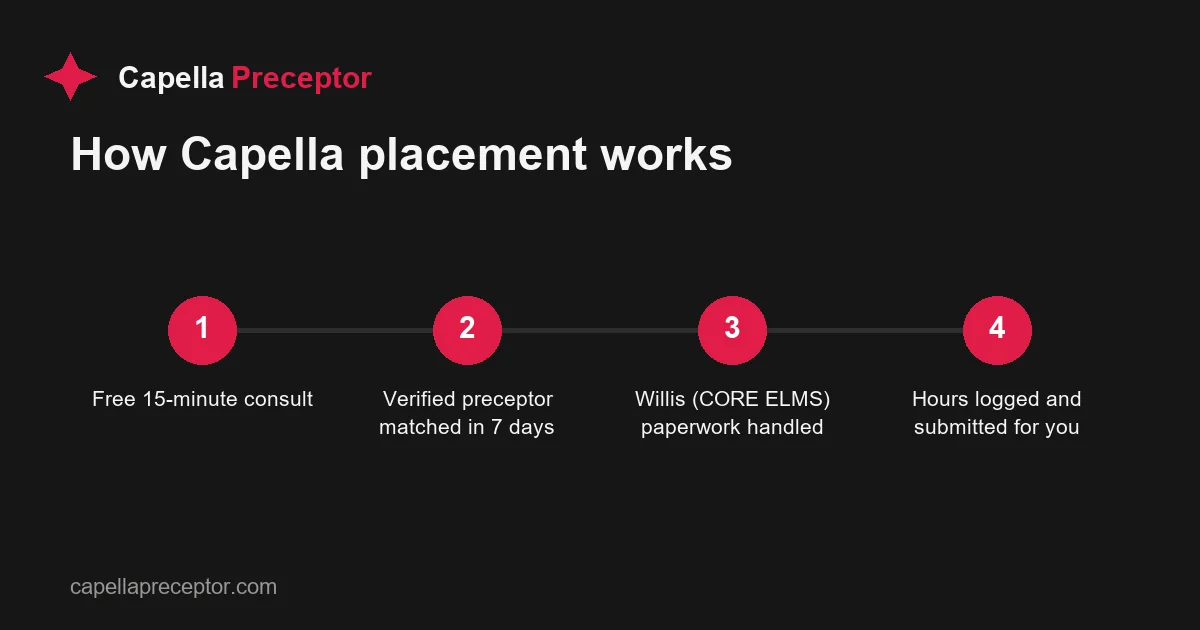
- Placement service (full-service): the provider prepares and files those documents for you and initiates and chases the affiliation agreement to signature.
- Either way: Capella, not the service, gives the final approval to enroll. No service can sign on Capella's behalf.
Not every service is full-service, some only introduce a preceptor and leave the paperwork to you, so if document handling is the reason you are paying, confirm in writing that CORE ELMS filing and the affiliation agreement are included. For the full document list and order of operations, see how the placement process works step by step.
What is the risk on each side?
Both routes carry real risk; they are just different risks.
| Risk | Self-placement | Placement service |
|---|---|---|
| Search fails or runs long | Higher: no provider may say yes before your term opens | Lower for the search itself; many services offer a refund if they cannot place you |
| Money lost | Low out-of-pocket, but lost time has a cost | You pay a fee; protect yourself with written refund terms |
| Missed start date | Real if the search or agreement runs late | Possible too: the affiliation agreement and Capella approval are outside any service's control |
| Mismatch with the preceptor | You absorb it and restart | A reputable service should re-match; confirm that policy first |
The honest line on guarantees: a service can guarantee its own effort, and many guarantee a refund if they fail to match you, but no service can guarantee Capella's approval or a signed affiliation agreement by a fixed date, because those steps are Capella's and the site's. Treat any claim of guaranteed results with that limit in mind, and read the terms.
So which one should you choose?
There is no universally right answer; it depends on your situation. Self-placement tends to fit students who have a strong local clinical network, a flexible timeline, and the hours to run the outreach. A placement service tends to fit students who have contacted many providers without a yes, who are short on time, whose specialty or state is hard to staff, or whose term is close. Many Capella students start by self-placing and switch to a service only when the calendar gets tight, which is a reasonable plan as long as you switch before, not after, the deadline passes.
Whichever route you take, the deciding factors are the same: confirm the preceptor is Capella-compliant, start the affiliation agreement early, and get every CORE ELMS requirement in before the practicum course opens.
Frequently asked questions
Does Capella place me with a preceptor, or do I have to find my own?
Capella states that learners are responsible for finding an appropriate preceptor to oversee the practicum experience. The student secures the preceptor and the clinical site; Capella reviews and approves what is submitted in CORE ELMS but does not assign the placement. That is true whether you self-place or use a placement service.
Is self-placement free?
The preceptor introduction itself is usually free, but self-placement is rarely zero-cost in practice. Many students join professional networks or directories that carry membership fees, and some preceptors ask for an honorarium. The larger cost of self-placement is time: the search commonly runs weeks to months, which is the main reason students weigh a paid service.
How much does a placement service cost?
Published rates from national NP placement services run roughly $10 to $17 per clinical hour, with many services setting a minimum around $1,000 per rotation, or a flat per-rotation fee that has been advertised near $1,995 all-inclusive. Capella's 750-hour NP specializations are completed across multiple rotations, so total cost depends on how a service prices each rotation. Always confirm the exact figure and refund policy in writing before you pay.
Who handles the CORE ELMS paperwork and the affiliation agreement?
With self-placement, you prepare and submit your own Site Prospector proposal, compliance documents, and the affiliation agreement coordination in CORE ELMS, and you wait on the site and Capella to sign. A full-service placement service prepares and files those documents for you and chases the affiliation agreement to signature. In both cases Capella, not the service, gives the final approval to enroll.
Which option is lower risk?
Each route carries different risk. Self-placement risks a slow or failed search and a missed term if no provider says yes in time. A placement service shifts the search effort off you and many offer a refund if they cannot place you, but a service still depends on Capella's own approval and on the affiliation agreement clearing, so no honest service can guarantee enrollment by a fixed date. Read the guarantee terms carefully.
Sources
- Capella University, MSN AGPCNP courses (learner-responsible preceptor statement, 750 practicum hours)
- Capella University, MSN FNP courses (750 hours, on-site preceptor model)
- Capella University, MSN PMHNP program (background check through CastleBranch)
- CORE Higher Education Group, CORE ELMS (site and preceptor approval, affiliation agreements, hours log)
- NPHub, Find preceptors yourself vs. agencies (self-placement timeline, per-hour pricing, paperwork)
- NPHub, Pricing (per-clinical-hour rate and per-rotation minimum)
Deciding between the two?
If you have read this far, you know the trade-off: self-placement costs time, a placement service costs money, and Capella's requirements and final approval are the same either way. We are a placement service for Capella NP students, and a free consult will give you a straight answer on your specialty, your state, and your timeline, including whether self-placing still makes sense for you. No payment until you are matched.
- Preceptors who meet Capella's published requirements, submitted for Capella's own approval
- CORE ELMS paperwork and the affiliation agreement handled for you
- See exact figures on the pricing page and the cost guide
Get a straight answer for your situation
A free consult maps your specialty, state, hours, and timeline, then tells you honestly whether to self-place or let us handle it.
Get my free consult →