Home / IRB for Nursing Students
GuideIRB for Nursing Students: What It Is and When You Need It
An Institutional Review Board (IRB) reviews studies that involve people to make sure participants are protected. Whether your project needs IRB review, and at what level, depends on what you are doing with human participants and their data.
Last updated: June 21, 2026 · Reviewed by the Capella Preceptor placement team
What an IRB actually is
An Institutional Review Board is a committee that reviews research involving human participants before it starts. Its job is set by federal regulation (the Common Rule, 45 CFR 46): protect the rights, safety, and welfare of the people in a study. The board checks that risks are minimized, that participants give informed consent, that privacy and data are handled properly, and that vulnerable groups are protected. For a nursing student, the IRB is the gate you pass through before you may recruit anyone, hand out a survey, or pull patient records for a study.
Two federal definitions decide whether the IRB even applies to your project. "Research" is a systematic investigation designed to produce generalizable knowledge. A "human subject" is a living person about whom you obtain data through intervention or interaction, or whose identifiable private information you use. If your project meets both definitions, it is human subjects research and needs IRB review. If it meets neither, it usually does not. The board, not the student, makes that call.
When IRB review is required (and when it is not)
The dividing line for most nursing students is research versus quality improvement (QI) or evidence-based practice (EBP). A study that collects data from people to create new, generalizable knowledge is research and needs review. A QI or EBP project that applies known evidence to improve care at one site, with no intent to generalize, often does not. The wording is subtle, so confirm with your IRB before you collect anything.
A practical rule: get the determination in writing before you touch a single participant or record. Beginning data collection without an IRB decision is the mistake that stalls projects, because data gathered before approval may not be usable.
Exempt vs expedited vs full board review
When a project does count as human subjects research, the IRB assigns one of three review levels based on risk. The key threshold is "minimal risk," which means the probability and magnitude of harm are no greater than what people ordinarily encounter in daily life or routine exams (University of Pittsburgh HRPO, Exempt, Expedited and Full Board Review). Note that "exempt" does not mean "no IRB." The board still decides the category; the project is exempt only from some federal requirements, not from review itself.
Common federal exempt categories that nursing projects fall into include research in established educational settings, anonymous surveys, interviews, or observation of public behavior where participants cannot be identified, benign behavioral interventions with adults, and secondary research on existing de-identified data or specimens. If a study cannot be placed in one of those categories and is no more than minimal risk, it is usually a candidate for expedited review. Anything above minimal risk goes to the full board.
How IRB works at Capella
Capella doctoral learners conducting a dissertation or capstone with human participants must obtain IRB approval before any research-related interaction with participants or their records (Capella, How do I complete the IRB Application?). Submissions are made through IRBManager, where the application is built as an online form (an xForm). You attach your approved research plan, recruitment materials, an informed consent form built from Capella's template, any site permission letters, and your data collection tools such as interview protocols or surveys (Capella, Where can I find IRB forms and templates?).
Before a full application, the Capella IRB makes a formal determination of whether a project constitutes human subjects research. Most capstone projects receive a "Not Human Subjects Research" designation, which means the project can proceed without a full IRB protocol but still must clear the screening step first (Capella, How does the IRB determine if a project is human subjects research?). Questions about your specific project go to the IRB office at irb@capella.edu.
The IRB process step by step
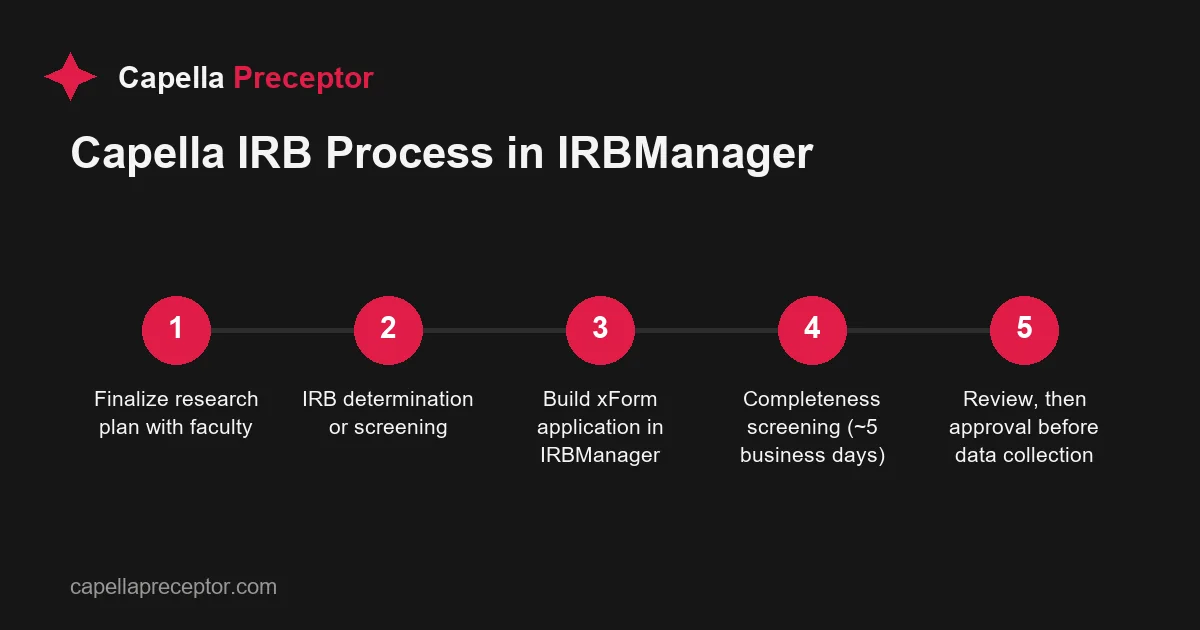
The path is similar across nursing programs. At Capella the sequence runs through IRBManager:
- Get your plan approved first. Your research plan or proposal is finalized with your mentor or faculty before you open the IRB application.
- Determination or screening. The IRB decides whether your project is human subjects research. Many capstones are designated Not Human Subjects Research at this stage.
- Build the application in IRBManager. Complete the xForm and upload consent forms, recruitment materials, site permission letters, and data collection tools.
- Completeness screening. The IRB office checks the submission for missing items and returns it with notes if anything is incomplete.
- Review at the assigned level. The board reviews under exempt, expedited, or full board, depending on risk, and may request revisions.
- Approval, then data collection. Once approved, you may begin recruiting and collecting data. Not before.
How long IRB review takes
At Capella, the stated target for initial review is 7 to 10 days once an application is deemed ready, after a completeness screening that runs within about 5 business days (Capella, How long does the IRB review process take?). That window covers a clean submission. The total time depends on how many revisions the board asks for.
Two things slow the clock that students forget: review volume rises near quarter deadlines, and the IRB pauses during quarter breaks. Plan submission so your approval lands before the term in which you need to collect data, not during it.
What slows IRB approval down
- An incomplete submission. A missing consent form, site letter, or data tool sends the whole package back at the screening step.
- Consent language that does not match the protocol. The consent form must describe exactly what participants will do, the risks, and how data is protected.
- No site permission. If your project happens at a clinical site, the board expects written permission from that organization before approval.
- Underestimating risk. Sensitive topics or identifiable data can push a study from expedited to full board, which adds weeks.
- Submitting near a deadline or break. Volume and quarter-break pauses extend turnaround when you have the least room.
FAQ
Does my Capella DNP capstone need IRB review?
Every Capella doctoral capstone goes through the IRB, but that does not mean every project counts as human subjects research. You submit a screening or application in IRBManager and the IRB makes a formal determination. Most capstone projects receive a Not Human Subjects Research designation, while projects that collect new data from participants need approval before any participant contact begins.
What is the difference between exempt, expedited, and full board review?
Exempt review is for minimal-risk studies that fit a defined federal category, such as anonymous surveys or secondary use of existing de-identified data. Expedited review is for minimal-risk studies that need ongoing oversight and is handled by a single reviewer rather than a full meeting. Full board review is for studies above minimal risk or involving vulnerable populations and is voted on by the convened committee.
How long does Capella IRB review take?
Capella states an initial review target of 7 to 10 days once an application is deemed ready, after a completeness screening that runs within about 5 business days. The total time is longer if revisions are required, during high-volume periods, or across quarter breaks when reviews pause. Higher-risk projects can take several months.
Do MSN students at Capella need IRB approval?
Most MSN practicum and quality-improvement work is project-based rather than research, so it often does not require IRB approval. If your MSN work involves systematic data collection from human participants intended to produce generalizable knowledge, it may need IRB review. The IRB makes the determination, so confirm before you collect any data.
What do I need to submit to the Capella IRB?
You complete the application as an xForm inside IRBManager and attach your approved research plan, recruitment materials, an informed consent form built from Capella's template, any site permission letters, and your data collection tools such as interview protocols or surveys. The system asks for additional documents based on your answers.
Sources
- Capella University FAQs, How does the IRB determine if a project is human subjects research?
- Capella University FAQs, How do I complete the IRB Application?
- Capella University FAQs, How long does the IRB review process take?
- Capella University FAQs, Where can I find IRB forms and templates?
- University of Pittsburgh HRPO, Exempt, Expedited and Full Board Review
How Capella Preceptor helps
Knowing the rules is the easy part; assembling a clean submission is where projects lose weeks. We help structure your project so the determination is clear, prepare the consent, privacy, and protocol documents to Capella's standards, and complete the IRBManager application correctly the first time, so you clear review without the back-and-forth.
- Proposal and IRBManager application completed correctly the first time
- Consent, privacy, and protocol documentation to Capella standards
- Practicum side handled too: verified preceptor matched in 7 days
Want your IRB handled for you?
Free 15-minute consult. No payment until matched. We map your entire practicum plan.
Get my free consult →