Home / DNP
ProgramCapella DNP: practicum hours and the capstone project
The Capella DNP requires a minimum of 1,000 post-baccalaureate practicum hours and a five-course scholarly capstone that links your practice hours to an IRB-reviewed project.
Last updated: June 21, 2026 · Reviewed by the Capella Preceptor placement team
How many practicum hours does the Capella DNP require?
The Capella Doctor of Nursing Practice requires a minimum of 1,000 practicum hours, counted as post-baccalaureate practice hours and inclusive of the work you do on your DNP project (Capella, DNP courses). If you bring documented post-baccalaureate hours from a prior graduate program, those can count toward the total, so the number you complete inside the DNP depends on what you arrive with. The hours are practice experiences directly tied to your project and your DNP competencies, not generic shift time.
All of those hours are proposed, tracked, and signed off in your practicum management system, branded here as CORE ELMS. You record practice experiences against your plan, your preceptor approves submitted hours, and you export an hours log for your faculty. Because the count is a floor and not a target, build in buffer: a few unapproved or mis-logged entries are the difference between clearing the requirement on time and stalling at the final gate.
The DNP capstone: a five-course sequence
At Capella the DNP project runs through a capstone sequence of five courses, Doctor of Nursing Practice 1 through 5. In GuidedPath they are NURS9000, NURS9010, NURS9020, NURS9030, and NURS9040; in FlexPath they are NURS-FPX9000 through NURS-FPX9040 (Capella, DNP courses). The sequence is graded Satisfactory / Not Satisfactory rather than with letter grades, which means each course is a checkpoint you either clear or repeat, not something you can average your way through.
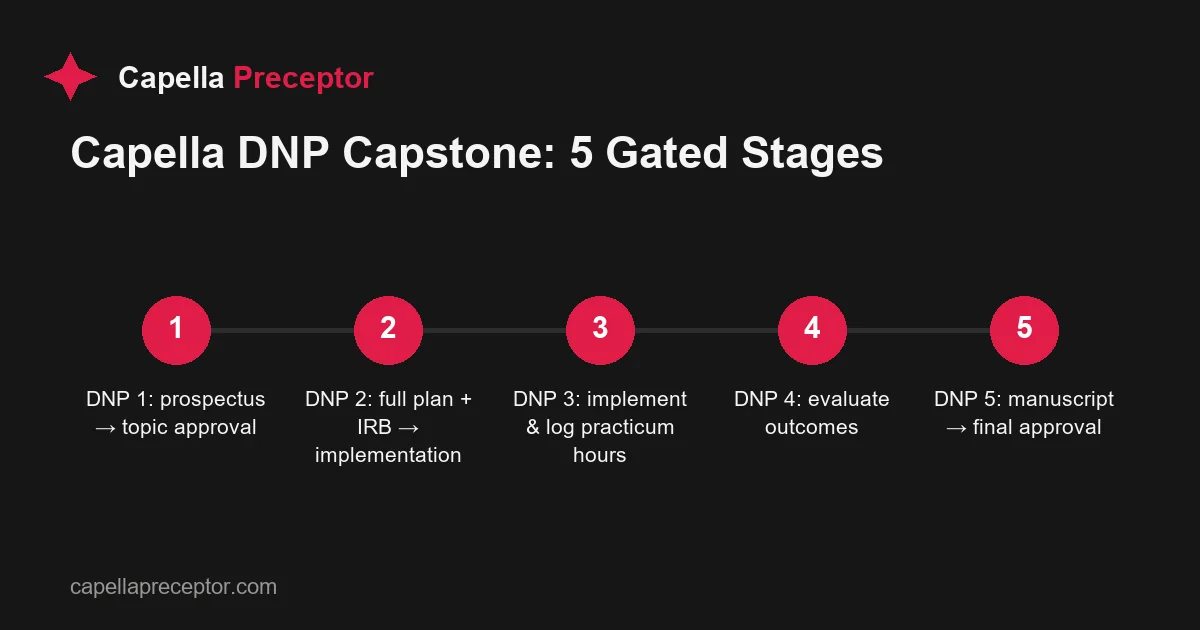
The five courses are not five papers. They are stages of one continuous project, and Capella gates the move from one stage to the next with formal approvals. You cannot start building until your plan is approved, and you cannot finish until your written manuscript is approved.
These stage gates (prospectus approval, implementation approval, manuscript approval) are the reason DNP timelines slip. Each gate is a faculty and committee review, and a gate that bounces back sends you into revision before you can advance. Treat the approvals, not the course count, as your real schedule.
GuidedPath vs FlexPath for the DNP
The DNP runs in both Capella learning formats, and the difference changes how the capstone feels day to day (Capella, Compare learning formats).
- GuidedPath runs on set 10-week quarters with fixed weekly deadlines and per-course tuition each quarter. The structure paces your capstone for you.
- FlexPath is self-paced with flat-rate tuition each 12-week billing session. You set your own deadlines, so moving faster can lower total cost, but the capstone gates and your site's real-world calendar still bound how fast the project itself can move.
In both formats the practicum-hour requirement, the capstone gates, and the IRB review are identical. FlexPath gives you speed on the coursework, not a shortcut around the project's approvals or your clinical site's timeline.
Does Capella find your DNP preceptor?
No. Capella states plainly that "Learners are responsible for finding an appropriate preceptor to oversee the practicum experience" (Capella, DNP courses). The university provides support resources and may point you toward organizations it already holds agreements with, but securing the preceptor and the project site is your responsibility, not the school's.
For a DNP this is harder than for a master's practicum, because your preceptor is not just signing hours. They are sponsoring a quality-improvement or evidence-based project inside their organization: granting access, supporting data collection, and standing behind an intervention you will implement on their unit. A doctorally prepared or appropriately qualified preceptor who fits your project topic, plus an organization willing to host the work, is the single hardest piece of the DNP to line up. Start it early, before DNP 1, so a missing preceptor never becomes the thing that holds your prospectus.
How the capstone links to the IRB
Every Capella DNP project passes through the Institutional Review Board, the body that protects human participants in research. You submit through IRBManager, Capella's online IRB system, and DNP learners use the DNP IRB Application path when they file (Capella, How do I complete the IRB Application?). The IRB then "makes a formal determination on whether or not a capstone project constitutes human subjects research" under the federal definition (Capella, How does the IRB determine if a project is human subjects research?).
Most DNP quality-improvement projects receive a determination that they are not human-subjects research, which is the common and expected outcome. That determination is not optional or automatic: you still file, the IRB still reviews, and you still need its sign-off before you implement. The timing matters because the IRB sits directly on the critical path between your plan and your data.
- Your project plan is approved through the capstone gate in DNP 1 and DNP 2.
- You submit the DNP IRB Application in IRBManager and the IRB makes its determination.
- You obtain the IRB's clearance before you begin implementing the project at your site.
- You implement, collect data and practicum hours, then evaluate and write the manuscript.
If you start collecting data before the IRB clears you, that data can be unusable, which is one of the most expensive mistakes a DNP student can make. The IRB contact for questions on forms and determinations is irb@capella.edu (Capella, IRB resources).
How DNP practicum hours are documented
Hours are logged and approved in CORE ELMS, the practicum management system Capella uses for application, in-progress tracking, and completion documentation. The workflow on a DNP project looks like this:
- Propose your site and preceptor for review, with a signed affiliation agreement between Capella and the organization in place before practicum begins.
- Clear compliance (background check, health and immunization records) through Capella's third-party compliance vendor before you set foot on site.
- Log hours as you go, tied to your project activities, and have your preceptor approve each submission.
- Export the hours log at each stage so your faculty can confirm you are on pace toward the 1,000-hour minimum.
The single point that trips DNP students is treating the hours as an afterthought to the project. They are the same work seen two ways: every approved practicum hour should map to a project activity, and the project's data and the hours log should tell one consistent story by the time you reach the manuscript.
A realistic DNP timeline
No two DNP projects move at the same speed, but the order is fixed. Use this as a planning frame, then map it onto your own format's quarters or billing sessions.
Before DNP 1 -> secure preceptor + site, signed affiliation agreement, compliance cleared
DNP 1 -> practice problem + prospectus -> topic prospectus approval
DNP 2 -> full plan + DNP IRB Application in IRBManager -> implementation approval
DNP 3 -> implement at site, log practicum hours, collect data
DNP 4 -> evaluate outcomes against your aims
DNP 5 -> write manuscript -> manuscript approval -> complete
The two items most often underestimated are at the very start: finding the right preceptor and getting the affiliation agreement signed. Both sit outside your control and on someone else's calendar, which is exactly why they belong before DNP 1 rather than inside it.
FAQ
How many practicum hours does the Capella DNP require?
A minimum of 1,000 post-baccalaureate practicum hours, inclusive of the work on your DNP project. Documented post-baccalaureate hours from a prior graduate program can count toward that total.
How many courses is the DNP capstone?
Five: Doctor of Nursing Practice 1 through 5 (NURS9000 to NURS9040 in GuidedPath, NURS-FPX9000 to NURS-FPX9040 in FlexPath), graded Satisfactory / Not Satisfactory, with stage gates between them.
Does my DNP project need IRB review?
Yes. Every project is submitted through IRBManager using the DNP IRB Application, and the IRB makes a formal determination of whether it is human-subjects research. Most quality-improvement projects are determined not to be human-subjects research, but you still need IRB clearance before you implement.
Does Capella find my preceptor for the DNP?
No. Capella states learners are responsible for finding an appropriate preceptor to oversee the practicum experience. The school offers support resources, but securing the preceptor and project site is your responsibility.
Where are DNP practicum hours logged?
In CORE ELMS, Capella's practicum management system. You record practice experiences, your preceptor approves submitted hours, and you export an hours log for faculty.
Sources
- Capella University, DNP courses (practicum hours, capstone sequence, preceptor responsibility)
- Capella University FAQs, How do I complete the IRB Application?
- Capella University FAQs, How does the IRB determine if a project is human subjects research?
- Capella University FAQs, IRB resources and contact
- Capella University, Compare learning formats (GuidedPath and FlexPath)
How Capella Preceptor helps
The scholarship is yours, and the steps above map the whole DNP path. Where students stall is the clinical foundation the capstone sits on: the preceptor who will sponsor your project, the affiliation agreement, the compliance, and the hours that have to be logged correctly. That part we handle, so the preceptor is never the reason your prospectus waits.
- Verified, project-fit preceptor matched in 7 days
- Affiliation agreement and every CORE ELMS form prepared and filed
- IRB submission support and hours logged and submitted for you
Available nationwide
Get placed for your DNP practicum
Free 15-minute consult. No payment until matched. We map your entire practicum plan.
Get my free consult →