Home / North Carolina
StateCapella Practicum and Preceptors in North Carolina
North Carolina is a restricted practice state for nurse practitioners, which means an NP here works under a written collaborative practice agreement with a physician and holds an Approval to Practice issued jointly by two state boards. That status shapes the clinical environment you will train in. This page explains what it means for a Capella student lining up a preceptor, then how we secure that placement for you.
Last updated: June 21, 2026 · Reviewed by the Capella Preceptor placement team
NP practice authority in North Carolina
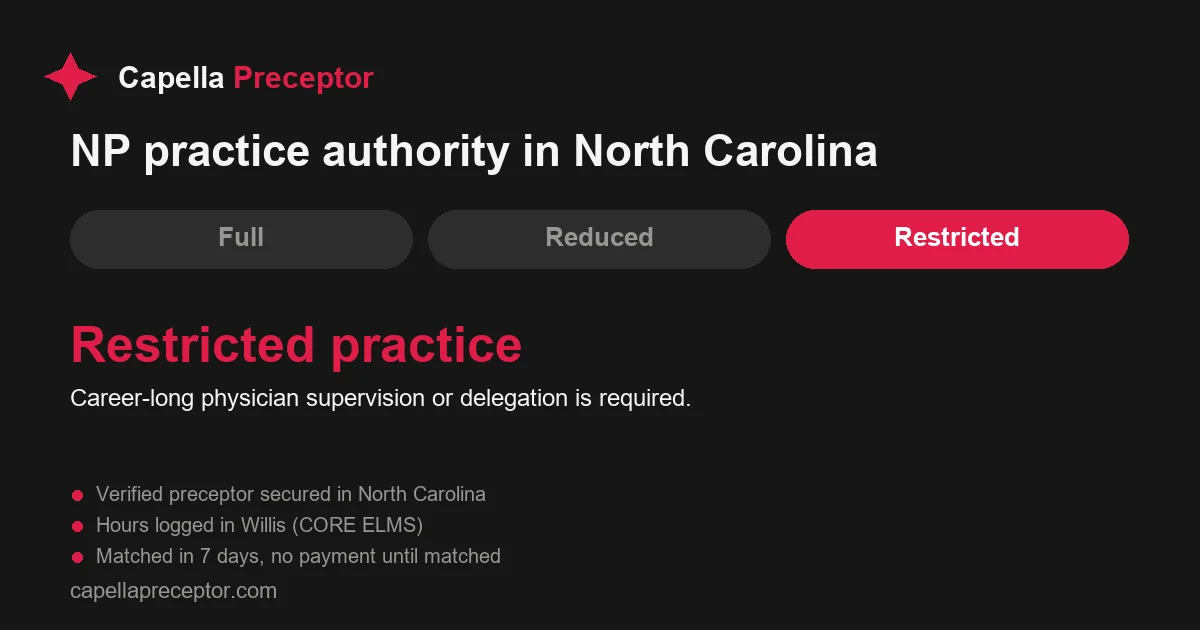
The American Association of Nurse Practitioners places North Carolina in the restricted practice category, its most regulated tier (AANP, State Practice Environment). In plain terms, a North Carolina NP cannot practice independently. State rules require a nurse practitioner to maintain a collaborative practice agreement with a physician and to be approved before performing any medical acts. North Carolina has debated full practice authority for years, and as of mid-2026 the restricted framework remains in place (North Carolina Health News).
For you as a Capella practicum student, the practical effect is about the setting, not your own license. You are not yet a practicing NP, so the Approval to Practice rules do not bind you directly. They do describe the clinics you will rotate through. Most North Carolina practices already operate with an NP-physician collaborative arrangement, so your preceptors are clinicians who understand supervised, team-based care, which is the environment your future employer will expect.
What restricted means here. A North Carolina NP must have a named primary supervising physician who stays continuously available for consultation, collaboration, and review of care. The agreement spells out what the NP may prescribe and how the two clinicians stay in contact. This is different from full practice states, where an NP can evaluate, diagnose, and prescribe on their own authority.
The North Carolina Board of Nursing and joint NP regulation
Nurse practitioners in North Carolina are regulated by two bodies working together: the North Carolina Board of Nursing (NCBON) and the North Carolina Medical Board (NCMB). They review and grant NP authority through a Nurse Practitioner Joint Subcommittee (NCBON, NP scope of practice; NCMB, Subchapter 32M rules). State rule defines Approval to Practice as authorization by the joint subcommittee for an NP to practice within their educational preparation and certification under a collaborative practice agreement with a physician licensed by the Medical Board.
License verification is straightforward and free. The NCBON publishes a real-time online verification service for registered nurses and advanced practice nurses, and it is the primary source for confirming a North Carolina nursing credential (NCBON, Verify a NC License). When we match you, this is one of the checks we run on your preceptor's RN and NP credentials before any paperwork moves.
Finding a preceptor and clinical site in North Carolina
Here is the part Capella leaves entirely to the student. Capella does not assign a preceptor or a clinical site. The university expects each learner to secure their own qualified preceptor in their local community, and then to route that placement through Capella for approval. In a restricted state with a finite pool of practices already running collaborative agreements, that search can stall a North Carolina student for weeks. We do it for you.
Our network reaches across North Carolina's major population centers and the counties around them, so we can usually match you close to home:
Charlotte, Concord, Gastonia, and the surrounding Mecklenburg and Cabarrus county practices.
Raleigh, Durham, Cary, Chapel Hill, and the wider Wake and Durham county clinics.
Greensboro, Winston-Salem, and High Point family and primary care sites.
Wilmington, Jacksonville, and the Cape Fear region.
Fayetteville, Greenville, and the eastern North Carolina counties.
Asheville, Hendersonville, and the mountain communities where local preceptors are scarce.
Where a rural North Carolina county simply has no available preceptor in your specialty, the virtual option below keeps you on track instead of waiting out another term.
Practicum clearance, done in North Carolina
Once you have a preceptor and a site, there is a clearance sequence to complete before you can log a single hour. Capella handles practicum application, site and preceptor approval, hour logging, and evaluations inside its practicum management system, which we track in our workflow as CORE ELMS. The hour totals differ by program, from the RN-to-BSN capstone practicum to the 750-hour MSN-FNP sequence and DNP project hours, so check your exact requirement on our hours breakdown and your specialty page.
- Submit the North Carolina site and preceptor in CORE ELMS for Capella review and approval.
- Get the affiliation agreement signed between Capella and your North Carolina clinical site before practicum begins.
- Clear third-party compliance through Capella's background-check and health-records vendor, such as CastleBranch (confirm the current vendor with your program).
- Log and submit hours in CORE ELMS, where your preceptor signs off on what you record.
We prepare these forms for you, chase the signatures, and keep the timeline moving so a slow affiliation agreement does not push your start date into the next quarter.
In-person or virtual practicum for North Carolina students
Best if you live near Charlotte, the Triangle, the Triad, or Wilmington, where clinical sites are dense. You train on site with a North Carolina-licensed preceptor and build local references for after graduation.
Built for students in rural or western North Carolina counties where a local match is hard to find. You complete supervised telehealth-based hours with a verified preceptor, tracked the same way in CORE ELMS.
Either way the preceptor is credential-verified and the documentation is identical, so your hours count toward the same Capella requirements.
North Carolina FAQ
Is North Carolina a full practice authority state for nurse practitioners?
No. The AANP classifies North Carolina as a restricted practice state. An NP must hold an Approval to Practice issued jointly by the North Carolina Board of Nursing and the North Carolina Medical Board and must work under a written collaborative practice agreement with a primary supervising physician.
Does the collaborative practice agreement requirement affect my Capella practicum?
It shapes who can precept you. Your preceptor is a licensed, practicing clinician, and in North Carolina many NP preceptors already work under their own collaborative practice agreement. Your practicum approval still runs through Capella in CORE ELMS, not through the state Approval to Practice process, which applies once you are licensed and employed as an NP.
Which North Carolina cities and regions do you place students in?
We place across Charlotte, Raleigh, Durham, Greensboro, Winston-Salem, Fayetteville, Cary, Wilmington, Asheville, and surrounding counties, plus rural eastern and western North Carolina through our virtual option.
Do you cover rural North Carolina?
Yes. Where local options are thin, our virtual practicum keeps you on schedule with hours tracked in CORE ELMS.
Sources
- AANP, State Practice Environment (North Carolina, restricted)
- North Carolina Board of Nursing, NP scope of practice
- North Carolina Board of Nursing, Verify a NC License
- North Carolina Medical Board, Subchapter 32M, Approval of Nurse Practitioners
- North Carolina Health News, on the status of full practice authority efforts
How Capella Preceptor helps in North Carolina
You now know the landscape: a restricted state, joint board oversight, and a preceptor search Capella leaves to you. That search is where North Carolina students lose the most time. We find a verified, Capella-compliant preceptor whose setting fits your program, prepare every CORE ELMS form and affiliation agreement, and keep your hours logged and submitted on schedule.
- Verified North Carolina preceptor matched in 7 days, in person or virtual
- Every CORE ELMS form and affiliation agreement handled
- No payment until you are matched, with your exact quote at the free consult
On the family nurse practitioner track? See Capella FNP preceptor requirements in North Carolina for FNP-specific practicum hours, North Carolina board rules, and local clinical settings.
Get a Capella preceptor in North Carolina
Free 15-minute consult. No payment until matched. We map your entire practicum plan.
Get my free consult →