Home / MSN-FNP / North Carolina
FNP · North CarolinaFinding a Capella FNP Preceptor in North Carolina
A Capella MSN-FNP preceptor in North Carolina has to cover a 750-hour, six-course practicum across the lifespan, in a state the AANP classifies as restricted, where a working nurse practitioner holds an Approval to Practice granted jointly by the North Carolina Board of Nursing and the Medical Board. This page explains what that means for your FNP placement, then how we secure it.
Last updated: June 28, 2026 · Reviewed by the Capella Preceptor placement team
What does a Capella FNP preceptor in North Carolina have to cover?
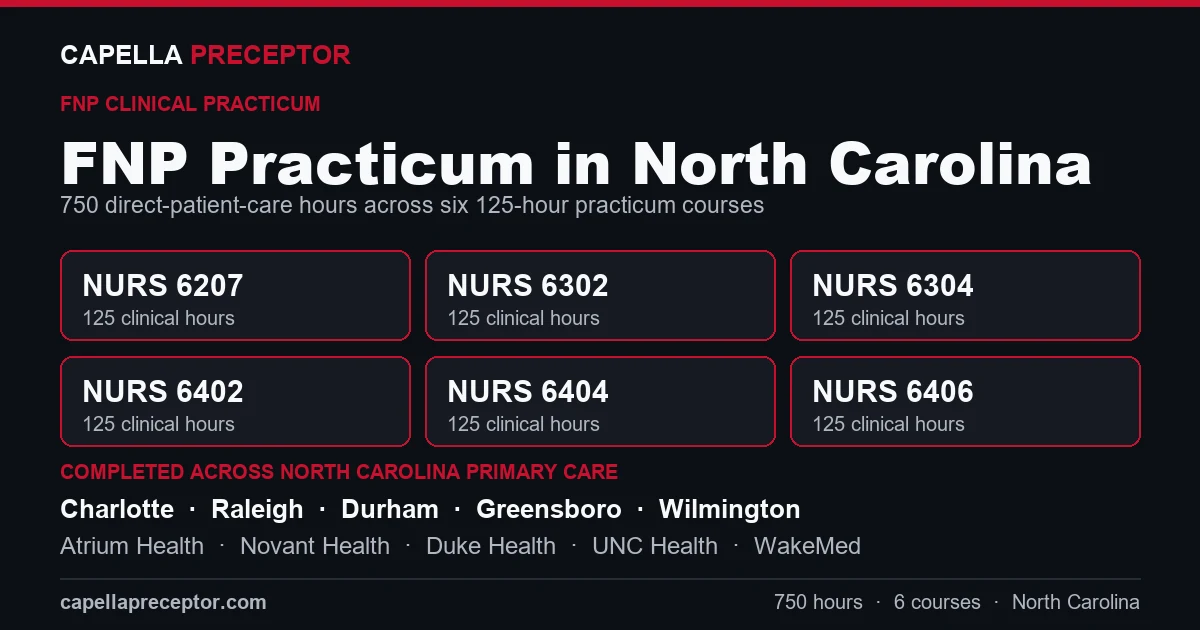
A Capella FNP preceptor in North Carolina has to support a minimum of 750 practicum hours, and those hours are not earned in one place. They are split across six clinical practicum courses that each carry 125 hours (Capella, MSN-FNP courses). Because the FNP is a family, primary care credential, those hours have to span the lifespan: adult and older-adult primary care, pediatrics, and reproductive or women's health. The full program breakdown lives on our Capella FNP page; this page is about lining that sequence up inside North Carolina specifically.
The practical consequence in North Carolina is that one preceptor rarely covers everything. A busy family medicine practice in Cary or Gastonia may carry adults and children but send obstetric care elsewhere, so many FNP students here pair a primary preceptor with a second site for pediatrics or women's health. Mapping that coverage before your first practicum course opens is the single most useful thing you can do, because each 125-hour course has to be logged and signed off before it closes.
FlexPath learners see the same sequence as NURS-FPX codes; confirm the exact numbering on your own program map, since your enrollment date governs which version applies.
How does North Carolina's restricted practice status affect an FNP placement?
The American Association of Nurse Practitioners places North Carolina in the restricted category, its most regulated tier, meaning a nurse practitioner here cannot practice independently (AANP, State Practice Environment). Before performing medical acts, a North Carolina NP must hold an Approval to Practice, defined in state rule as authorization by the Joint Subcommittee of the Medical Board and the Board of Nursing to practice within the NP's educational preparation and certification under a collaborative practice agreement with a supervising physician (NC Medical Board, Subchapter 32M rules).
For you, the FNP student, the effect is about the environment, not your own license. You are not yet a practicing NP, so the Approval to Practice rules do not bind you directly. They describe the clinic you will rotate through. A North Carolina FNP preceptor is, by definition, a clinician already operating inside a collaborative, physician-supervised model, which is exactly the team-based primary care setting your future North Carolina employer will run. That makes North Carolina a useful place to train, even though it adds a layer of structure other states do not.
The North Carolina collaboration rule, in plain terms. Under 21 NCAC 32M, the supervising physician and the NP must be "continuously available to each other for consultation by direct communication or telecommunication," they must meet monthly during the first six months of a new agreement and at least every six months after that, and the agreement is reviewed at least yearly and kept on file at each site (21 NCAC 32M .0110, quality assurance standards). Your FNP preceptor works inside that cadence, which is why their schedule and physician backup matter to your placement.
Why would a North Carolina NP agree to precept a Capella FNP student?
This is the question most FNP students never ask, and in North Carolina there is a concrete answer. The North Carolina Board of Nursing allows an NP to apply up to 30 precepting hours toward the 50 contact hours of continuing education required every two years to keep an Approval to Practice (NCBON, NP continuing competence). Precepting a student is not just goodwill in North Carolina; it directly offsets a renewal requirement the NP already has to meet. When we approach a North Carolina preceptor on your behalf, that incentive is part of why a busy clinician says yes.
It also tells you what a qualified North Carolina FNP preceptor looks like. They hold an active North Carolina RN and NP credential, carry their own Approval to Practice, and are board certified in a population that matches your course, typically family or primary care. Before any Capella paperwork moves, we verify that license status through the North Carolina Board of Nursing's free online verification service.
Where do FNP students actually find primary care preceptors in North Carolina?
North Carolina has real depth in outpatient primary care, which is the setting your 750 FNP hours need. The state's large systems, Atrium Health and Novant Health in and around Charlotte, Duke Health, UNC Health, and WakeMed across the Triangle, and ECU Health in the east, run extensive family and internal medicine networks, and Duke Primary Care alone lists more than 60 locations (Duke Health, Primary Care; WakeMed, Primary Care). Independent groups such as Avance Care add primary care sites across Charlotte, Raleigh-Durham, and Wilmington (Avance Care). The catch is that system-employed providers often cannot precept without institutional sign-off, so the practical search frequently lands on independent and smaller practices, which is where a placement service moves faster than a student cold-calling clinics.
Our network reaches the population centers and the counties around them, so we can usually match you close to home and within the FNP populations your courses require:
Charlotte, Concord, and Gastonia family medicine and pediatric clinics across Mecklenburg and Cabarrus counties.
Raleigh, Durham, Cary, and Chapel Hill primary care and women's health practices for the FNP lifespan mix.
Greensboro, Winston-Salem, and High Point internal medicine and family practice sites.
Wilmington and the Cape Fear region, where pediatric and OB rotations round out the family scope.
Fayetteville, Greenville, and the eastern counties served by ECU Health primary care.
Asheville and Hendersonville, where local family-practice preceptors are scarcer and the virtual option fills gaps.
Where a rural North Carolina county has no available FNP preceptor in a needed population, our virtual option keeps your hour clock running instead of forcing you to wait out another term.
What clearance comes before your North Carolina FNP hours count?
Once you have a preceptor and a site, there is a clearance sequence before you can log a single FNP hour. Capella manages practicum application, site and preceptor approval, hour logging, and evaluations inside its practicum management system, which we track in our workflow as CORE ELMS. None of this is the state Approval to Practice process; that applies to you later, once you are licensed and employed as an NP in North Carolina.
- Submit the North Carolina site and FNP preceptor in CORE ELMS for Capella review and approval.
- Execute the affiliation agreement between Capella and your North Carolina clinical site before practicum begins.
- Clear compliance through Capella's background-check and health-records vendor, CastleBranch (via the myCB platform); confirm the current requirements with your program.
- Log and submit hours per course in CORE ELMS, where your North Carolina preceptor signs off on what you record.
We prepare these forms, verify your preceptor's North Carolina credentials, chase the affiliation-agreement signatures, and keep the timeline moving so a slow document does not push your FNP start into the next quarter. The deeper before-you-start checklist is on the FNP program page, and the statewide board detail is on our North Carolina page.
In-person or virtual FNP practicum for North Carolina students
Best if you live near Charlotte, the Triangle, the Triad, or Wilmington, where family medicine, pediatric, and women's health sites are dense. You train on site with a North Carolina-licensed FNP preceptor and build local references for after graduation.
Built for students in rural or western North Carolina counties where a local FNP match is hard to find. You complete supervised telehealth-based primary care hours with a verified preceptor, tracked the same way in CORE ELMS.
Either way the preceptor is credential-verified against the North Carolina Board of Nursing and the documentation is identical, so your hours count toward the same Capella FNP requirements.
North Carolina FNP preceptor FAQ
How many hours does a Capella FNP preceptor in North Carolina need to cover?
The Capella MSN-FNP requires a minimum of 750 practicum hours across six clinical courses that each carry 125 hours. In North Carolina that means lining up preceptors whose panels cover adult-gerontology, pediatric, and reproductive or women's health, since the family role spans the lifespan.
Does North Carolina's restricted practice status affect my FNP practicum?
It shapes the setting, not your student paperwork. North Carolina is a restricted-practice state, so a working NP holds an Approval to Practice jointly granted by the North Carolina Board of Nursing and the Medical Board under a collaborative practice agreement with a supervising physician. Your preceptor is one of those clinicians. Your Capella practicum is still submitted and approved in CORE ELMS, not through the state Approval to Practice process.
Can my North Carolina FNP preceptor get anything for precepting me?
Yes. The North Carolina Board of Nursing lets an NP apply up to 30 precepting hours toward the 50 contact hours of continuing education required every two years to keep an Approval to Practice. That is a concrete reason a North Carolina NP may agree to take on a Capella FNP student.
Which North Carolina settings count for FNP primary care hours?
Outpatient primary care: family medicine, internal medicine, pediatric clinics, and women's health practices. North Carolina has dense options in the Charlotte metro, the Research Triangle, and the Triad through systems like Atrium Health, Novant Health, Duke Health, UNC Health, and WakeMed, plus independent groups, with our virtual option covering rural eastern and western counties.
How fast can you place an FNP student in North Carolina?
We match a verified, Capella-compliant FNP preceptor in North Carolina in 7 days, in person or virtual, and there is no payment until you are matched.
Sources
- Capella University, MSN Family Nurse Practitioner courses (750 hours, six courses)
- AANP, State Practice Environment (North Carolina, restricted)
- North Carolina Medical Board, Subchapter 32M, Approval of Nurse Practitioners
- 21 NCAC 32M .0110, collaborative practice agreement quality assurance standards
- North Carolina Board of Nursing, NP continuing competence (30 precepting hours toward 50)
- Duke Health, Primary Care (network scope in North Carolina)
How Capella Preceptor helps FNP students in North Carolina
You now know the landscape: 750 hours across six courses, a restricted state with joint board oversight, a precepting-CE incentive that helps preceptors say yes, and a search Capella leaves entirely to you. That search is where North Carolina FNP students lose the most time. We find a verified preceptor who meets Capella's published requirements and whose primary care panel fits your courses, verify their North Carolina credentials, prepare every CORE ELMS form and affiliation agreement, and keep your hours logged and submitted on schedule.
- Verified North Carolina FNP preceptor matched in 7 days, in person or virtual
- Primary care panels mapped to all six FNP courses, plus every CORE ELMS form handled
- No payment until you are matched, with your exact quote at the free consult
Get a Capella FNP preceptor in North Carolina
Free 15-minute consult. No payment until matched. We map your full 750-hour FNP practicum across North Carolina.
Get my free consult →