Free vs paid preceptor: an honest comparison.
Free preceptor routes exist and work for many students. They cost time, not money. Paying a placement service to find and coordinate a qualified preceptor is a different thing from paying a preceptor for a grade or for hours you did not work, and only the second is prohibited. Here is the full comparison, with real numbers.
Last updated: July 11, 2026 · Reviewed by the Capella Preceptor placement team
The short answer, in two lines
A free preceptor is one you secure yourself through your employer, faculty, network, or cold outreach. It costs nothing but your time, and the time can be substantial. A paid placement service charges a fee to source, vet, and coordinate a preceptor for you, typically reported at $10 to $12 or more per clinical hour, or roughly $3,000 to $5,000 for a single rotation. Paying that fee is allowed and ethical when it buys coordination and supervision; it is not allowed when it buys a grade or hours you never worked.
This matters at Capella specifically because Capella does not assign your preceptor. Capella's own policy states that "learners are responsible for finding an appropriate preceptor to oversee the practicum experience." So whichever route you choose, the work of securing the preceptor sits with you or with someone you hire. An MSN nurse practitioner specialization at Capella requires a minimum of 750 documented practicum hours, which is a long time to leave a placement unsecured.
Free vs paid, side by side
The two routes differ on four axes that genuinely matter: who finds the preceptor, how long it takes, who verifies the license and handles the paperwork, and what it costs. Everything else (the supervision, the hours, the CORE ELMS approval) is identical, because both routes still have to satisfy the same Capella requirements.
| Factor | Free (self-secured) | Paid placement service |
|---|---|---|
| Out-of-pocket cost | $0 | ~$10 to $12+ per hour, often $3,000 to $5,000 per rotation |
| Who finds the preceptor | You | The service |
| Typical time to secure | Weeks to months; many students start 6 to 12 months ahead | Days to a few weeks once you engage |
| License and specialty vetting | You verify it yourself | Service verifies it before you commit |
| Paperwork (site agreement, CORE ELMS) | You coordinate it | Service prepares and files it |
| Failure / decline rate | High for cold outreach; cited at dozens of clinics per match | Lower, but you still need school approval |
| Who carries the risk if it falls through | You | Depends on the contract; pay only after a real match is safest |
Cost figures are published market ranges, not Capella figures. Confirm any quote in writing and confirm your program's placement policy with Capella before you sign.
How do I find a free preceptor?
Start free. Most students who place themselves use one of four routes, in this rough order of success. Warm introductions land far more often than cold outreach to strangers, so work your closest contacts first.
1. Your current healthcare employer
If you already work in a clinic, hospital, or practice, this is usually the fastest free route. A provider who knows your work is far more likely to precept you, and Capella explicitly lists your current healthcare employer as an acceptable practicum site. Ask your manager who on staff holds the right credential for your specialty (an FNP-credentialed provider for primary care, a PMHNP for psychiatric hours) and whether the site will host a student.
2. Faculty, alumni, and your program's support team
Ask your course faculty which local providers have precepted Capella students before, and reach the alumni network on LinkedIn. Capella also runs a dedicated support team that helps connect learners with practicum site opportunities, and approved sites can include Capella's partner Optum. Use it. None of this guarantees a match, but a name from faculty beats a cold email every time.
3. Your personal and professional network
Former preceptors, clinical instructors, classmates a term ahead of you, and providers you have worked alongside are all warm leads. A short, specific ask ("I am a Capella FNP student needing 125 practicum hours in primary care, starting in the fall term") gives a contact something concrete to act on or forward.
4. Cold outreach to clinics
If your network is exhausted, build a list of 30 to 50 clinics inside the distance you can realistically drive, and contact each one with your school name, rotation type, exact required hours, and your dates. Follow up politely every 7 to 10 days; clinicians are busy, not hostile, and the third message is often the one that gets read. Smaller independent practices and telehealth settings receive fewer requests than large hospital systems and can be easier to reach. Be aware that cold outreach has a high decline rate, which is the single biggest reason students eventually consider paying.
What is the real cost of a "free" preceptor?
Free is never zero. The cost is time and risk, and for a student on a term deadline that can be the expensive part:
- Search time. Self-placement commonly takes weeks to months. Many students begin 6 to 12 months before their practicum term to leave room for declines.
- Decline rate. Cold outreach often means contacting dozens of clinics for one yes, which is demoralizing and slow when a term is approaching.
- Paperwork you run yourself. You verify the preceptor's license and specialty fit, secure the site agreement, and file the CORE ELMS requirements, all of which must be approved before you can begin hours.
- The cost of a lost term. If the search runs past your enrollment date, the practical price of "free" can be a delayed graduation and another term of tuition.
For students with time and a strong network, free is the right call and we will say so. For students who are close to a term start with no leads, the math changes, and that is where a paid service earns its fee by buying back time.
Is it allowed to pay for a preceptor?
This is the question behind most searches, so here is the factual line, drawn carefully. There are two very different transactions that the word "paying" gets used for:
| Transaction | What you are buying | Status |
|---|---|---|
| Paying a placement service | Sourcing, license verification, and coordination of a qualified preceptor who then supervises your real hours | A legitimate service fee |
| Paying a preceptor for a grade or for unworked hours | A passing evaluation, or a signed log for hours you did not complete | Prohibited; this is academic fraud |
Paying a service to find and coordinate a preceptor is a coordination fee, the same way you might pay any specialist to handle a search and a stack of paperwork you do not have time for. The preceptor still does the real work: they supervise genuine clinical encounters and they approve only the hours you actually log in CORE ELMS. What is never acceptable, on any route, is paying anyone to inflate hours, falsify a log, or guarantee a grade. That is fraud, it puts your license at risk, and no honest service offers it.
One important step: programs set their own rules on how a placement may be arranged, so confirm Capella's current policy with your faculty or practicum office before you engage any service. The supervision and the hours are non-negotiable either way; what a school can restrict is the arrangement around them. Asking first protects you.
Is it ethical to pay for a preceptor?
Ethically, the field is split, and it is worth understanding why so you can decide for yourself. Precepting was historically done for free, as senior clinicians paying it forward, and some argue that putting a price on it turns required education into a pay-to-progress system that disadvantages students with less cash. That concern is real and reasonable.
The counterargument is labor reality. Precepting takes time, paperwork, and supervision, and it often slows a clinician's own patient throughput. A documented national preceptor shortage means many qualified students cannot find a placement through outreach alone, and PA programs and medical schools frequently pay clinical sites, which leaves NP students competing at a disadvantage. Within that context, paying for coordination is widely treated as a defensible response to a structural gap, not exploitation.
The ethical test is simple and worth holding any service to: are you paying for an outcome, or for work? Paying to be matched with a qualified preceptor who supervises real hours is paying for work. Paying for a guaranteed grade or for hours you did not complete is paying for an outcome, and that is the line that turns a service into fraud. A legitimate service shows transparent pricing, a clear vetting process, defined student protections, and never sells a grade.
How much does a paid placement actually cost?
Published market figures give a realistic range so you are not quoted blind:
- Per hour: commonly reported at $10 to $12 or more per clinical hour. One national service lists pricing starting at $12.75 per hour.
- Per rotation: a single rotation often totals $3,000 to $5,000, with minimums around $1,000 reported in the market.
- What moves the price: specialty, location, how hard the placement is to source, and any rush timeline. Service and rush fees can be added on top.
Two rules protect you. First, get a written, itemized quote, with the fee, what it includes, and any add-ons spelled out. Second, prefer to pay only once a real, confirmed match exists, because if you pay before there is a match, you carry the risk if it never materializes. Our own pricing follows that second rule: you are not charged until you are matched. You can see the full breakdown on our pricing page.
Which route is right for you?
A quick way to decide, without anyone selling you anything:
- Go free if you have 6 or more months of runway, an employer or faculty contact who can precept you, and the time to run outreach and paperwork yourself.
- Consider paying if your term is close, your network is exhausted, you have been declined repeatedly, or you simply cannot spend more weeks on the search.
- Whichever you choose, the preceptor must hold an active license matching your specialty, the site must fit your course's patient population, and everything must clear in CORE ELMS, including the background check handled through Capella's CastleBranch (myCB) vendor, before you log hours.
FAQ
Is it allowed to pay for a preceptor?
Paying a placement service to find, vet, and coordinate a preceptor is different from paying a preceptor for a grade or for signing off hours you did not work, which is prohibited. The service fee covers sourcing, license verification, and paperwork. The preceptor still supervises real clinical hours and approves only hours you actually complete. Confirm your program's policy with Capella before you sign anything, because a school can restrict how a placement is arranged.
Is it ethical to pay for a preceptor?
It is ethical when the money pays for coordination and supervision, not for an outcome. The line is straightforward: paying to be matched with a qualified preceptor who oversees genuine clinical hours is a service fee, while paying anyone to inflate hours, fake a log, or guarantee a passing grade is fraud. A legitimate service has transparent pricing, a clear vetting process, and never sells a grade or unworked hours.
How do I find a free preceptor for my Capella practicum?
The four free routes are your current healthcare employer, your faculty and alumni network, your personal and professional contacts, and cold outreach to clinics. Capella's own support team can also help connect you with practicum site opportunities. Free routes work for many students; they cost time rather than money, and warm introductions succeed far more often than cold outreach to strangers.
Does Capella find a preceptor for me?
No. Capella states that learners are responsible for finding an appropriate preceptor to oversee the practicum experience. A dedicated Capella support team helps connect learners with practicum site opportunities, and approved sites can include Capella's partner Optum, your current employer, or other approved primary care organizations, but the responsibility to secure the preceptor sits with you.
How much does a paid preceptor placement cost?
Published market figures put paid placement around $10 to $12 or more per clinical hour, with a single rotation often totaling $3,000 to $5,000. One national service lists pricing starting at $12.75 per hour with a $1,000 minimum. Price varies by specialty, location, and how hard the placement is to source, so get a written, itemized quote before you commit.
Is using a service cheating?
No, because nothing academic changes hands. A matching service finds a qualified clinician and runs logistics, the same way a recruiter finds a job or an agent finds a rental; you still attend every shift, see every patient, and complete every assignment yourself. Capella still vets the preceptor and site through its own approval process, and the preceptor still evaluates you independently and signs only the hours you actually worked. Cheating would be fabricated hours, an unearned sign-off, or a bought evaluation, none of which a legitimate service touches. If your program has specific rules about third-party arrangements, your faculty adviser can confirm them in writing.
Sources
- Capella University, MSN courses (750 practicum hours, "learners are responsible for finding an appropriate preceptor")
- Capella University, MSN FNP program (placement support, current-employer and Optum partner sites)
- Nursology, paid preceptorship and the NP preceptor shortage (the ethical dilemma, historical free precepting)
- NPHub, finding free preceptors and clinical sites (employer, faculty, network, cold outreach to 30 to 50 clinics)
- American Association of Nurse Practitioners, NP Preceptor Knowledge Center (preceptor education resources)
How Capella Preceptor helps
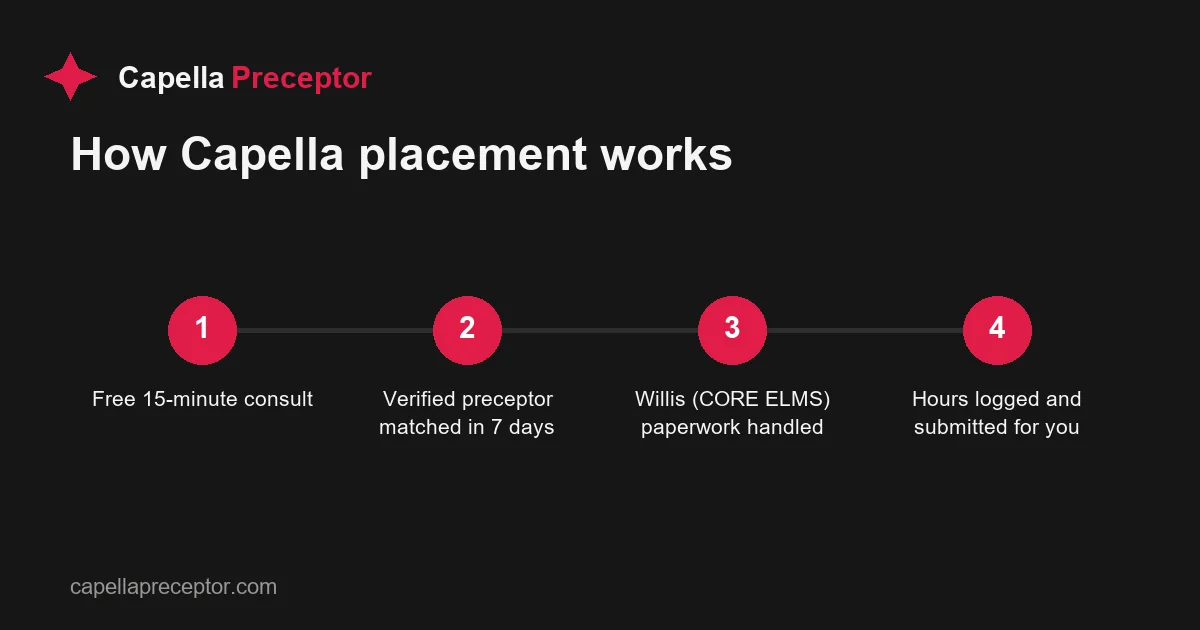
If the free routes are working for you, use them; you do not need us. We are for the student whose term is close and whose leads have run dry. We source a preceptor who meets Capella's published requirements, submitted for Capella's own approval, verify the license and specialty fit, and prepare the CORE ELMS paperwork, so the search stops being your job. Pricing is transparent and you are not charged until you are matched.
- A qualified preceptor sourced and vetted, matched in 7 days
- License and specialty fit verified before you commit
- Transparent pricing, no payment until matched
See the full breakdown on the pricing page, or talk to a placement coordinator about your specific term and specialty.
Not sure which route fits your term?
Tell us your program, specialty, state, and term start. We will tell you honestly whether to keep going free or let us take it over. No payment until matched.
Get my free placement plan →