Home / Hours Breakdown
ReferenceCapella practicum hours by program
Capella's RN-to-BSN requires 40 practicum hours in the capstone (NURS4905 / NURS-FPX4905); the non-NP MSN tracks require 500 documented hours; the FNP, PMHNP, and AGPCNP tracks each require a minimum of 750 hours; and the DNP requires a minimum of 1,000 practice hours. This page breaks down the totals, the per-course splits, and how hours are counted and logged.
Last updated: June 21, 2026 · Reviewed by the Capella Preceptor placement team
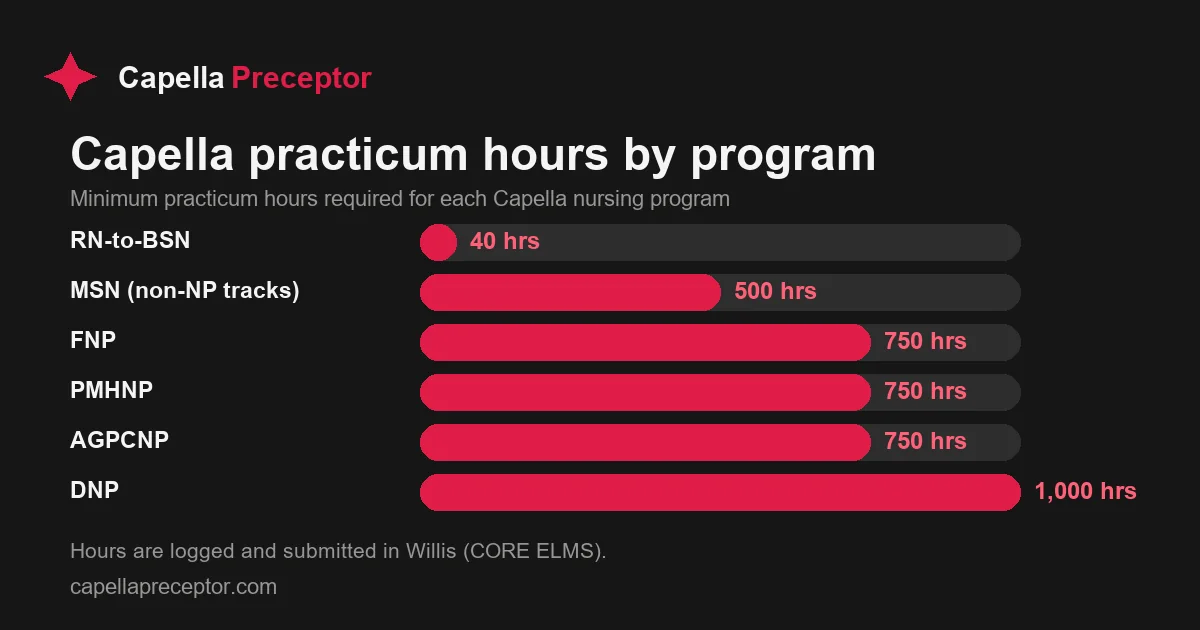
Hour totals at a glance
Required practicum hours rise with the degree level. The table below is the quick reference; each program is broken out by course further down. The hour counts come straight from Capella's published course pages.
"Minimum" means Capella sets a floor; your specialization, state board, or certifying body may push the actual number higher. Always confirm the count in your own course catalog and courseroom.
RN-to-BSN: 40 hours in the capstone
The RN-to-BSN completion track carries a single practicum requirement: 40 practicum hours, completed in the capstone course. The course is NURS4905 on GuidedPath and NURS-FPX4905 on FlexPath, and both course descriptions state the same thing: "Students are required to complete 40 practicum hours" (Capella, RN-to-BSN Courses). If you have seen "9 hours" or the code NURS-FPX4900 attached to this requirement online, that does not match the current official courses page. The 40 hours map to the 4905 capstone.
One scheduling note that catches students off guard: you must complete all practicum paperwork and receive final practicum approval before you are cleared to enroll in the capstone (Capella, RN-to-BSN Courses). Securing a site and preceptor and getting the affiliation paperwork through is therefore a gate on starting, not something you sort out mid-course.
MSN non-NP tracks: 500 hours
The non-nurse-practitioner MSN specializations, including Nursing Education and Care Coordination, require 500 documented practicum hours. The page wording is direct: learners "are required to complete 500 documented hours of hands-on practicum experience" (Capella, MSN Nursing Education Courses). The hours are spread across the specialization's didactic-practicum courses plus two dedicated practicum courses that every non-NP track shares.
The course numbers carrying the four 50-hour blocks differ by specialization (Care Coordination uses NURS6620, NURS6622, NURS6624, NURS6626; Nursing Education uses NURS6100, NURS6108, NURS6112, NURS6116), but the structure is the same: four 50-hour courses feed into the 100-hour NURS6080 and the 200-hour NURS6085 capstone (Capella, MSN Care Coordination Courses). Because the hours start accruing in early specialization courses, your site and preceptor need to be in place well before the 6080/6085 capstone, not just at the end.
MSN-NP tracks: 750 hours minimum
The nurse practitioner specializations carry the heaviest clinical load at the master's level: a minimum of 750 practicum hours each, completed in the student's local community, with the student responsible for securing the preceptor and site. How the 750 is split depends on the track.
Family Nurse Practitioner (FNP)
FNP states a minimum of 750 hours, distributed across the clinical practicum sequence, with each practicum course stating "This course requires 125 practicum hours" (Capella, FNP Courses). The practicum courses are NURS6207, NURS6302, NURS6304, NURS6402, NURS6404, and NURS6406, spanning adult-gerontology, pediatric, reproductive, and a final transition-to-practice rotation.
Psychiatric Mental Health NP (PMHNP)
PMHNP also requires a minimum of 750 hours, completed across Practicum I through V (NURS6502, NURS6504, NURS6506, NURS6508, NURS6510), with each practicum course stating 150 clinical hours in a psychiatric setting (Capella, PMHNP Courses). Early practicums cover adult and older-adult populations; later practicums add younger patients under PMHNP supervision.
Adult-Gerontology Primary Care NP (AGPCNP)
AGPCNP requires a minimum of 750 hours, but the split is uneven: NURS6207, NURS6302, NURS6304, and NURS6306 carry 125 hours each, and the final NURS6308 "Transition to Practice" carries 250 hours (Capella, AGPCNP Courses). That 250-hour capstone rotation is the single largest clinical block in any MSN-NP track and needs a preceptor who can commit the time.
DNP: 1,000 hours plus the project
The Doctor of Nursing Practice requires a minimum of 1,000 practicum hours (post-baccalaureate practice hours), inclusive of the DNP project (Capella, DNP Courses). The capstone runs as a five-course sequence (NURS9000-NURS9040 on GuidedPath, NURS-FPX9000-NURS-FPX9040 on FlexPath), graded satisfactory / non-satisfactory, with stage gates at topic prospectus approval, implementation approval, and manuscript approval.
Two points matter for placement. First, Capella states plainly that "learners are responsible for finding an appropriate preceptor to oversee the practicum experience" (Capella, DNP Courses). Second, if your project involves human subjects, it routes through Capella's IRB via IRBManager, where the board makes a formal human-subjects-research determination (most capstone projects receive a "not human subjects research" designation) (Capella, IRB / IRBManager).
FlexPath vs GuidedPath: same hours, different clock
The practicum hour requirement does not change between formats. A 40-hour RN-to-BSN capstone is 40 hours whether you are in GuidedPath or FlexPath; the same is true at every level. What changes is the pacing and billing of the courses those hours live in (Capella, Compare Learning Formats).
The practical difference for clinical hours: in FlexPath you can move through didactic competencies quickly, but practicum hours are real clock hours in a real setting, so a preceptor's availability, not your reading speed, sets the floor on how fast a practicum course can close.
How hours are counted and logged
Practicum hours are direct, supervised clock hours in your clinical setting. Capella manages the whole practicum lifecycle, from proposing a site and preceptor to logging hours to capturing evaluations, in CORE ELMS, its online practicum management system (Capella, CORE ELMS). The basic flow looks like this:
- Propose your site and preceptor in CORE ELMS and submit your compliance requirements (background check, health records, and similar) through Capella's third-party compliance vendor.
- Get the affiliation agreement signed between Capella and your clinical site before practicum starts.
- Log your hours as you complete them, recording date, setting, and activity, so the running total is auditable.
- Have your preceptor verify and approve the submitted hours in the system; approved hours are what count toward the requirement.
- Export the hours log at the end of the course as your record of the completed requirement.
For the RN-to-BSN, this matters before you even begin: final practicum approval is a prerequisite to enrolling in the 4905 capstone (Capella, RN-to-BSN Courses). At the NP and DNP level, the volume (750 to 1,000 hours) means logging is continuous across multiple courses rather than a single end-of-program push.
Does Capella find your preceptor? No.
This is the load-bearing fact behind every hour count above: Capella does not find or assign your preceptor. The DNP courses page says so outright, and the same responsibility holds across the NP tracks, where practicum is completed in the student's local community (Capella, DNP Courses; Capella, MSN-NP Program). Capella provides support resources and may share organizations that already hold affiliation agreements, but securing a qualified preceptor and getting the site approved is on you. That is the work that turns a known hour requirement into hours you can actually start logging.
FAQ
How many practicum hours does the Capella RN-to-BSN require?
40 practicum hours, completed in the capstone course NURS4905 (GuidedPath) or NURS-FPX4905 (FlexPath). Both course descriptions state students are required to complete 40 practicum hours.
How many practicum hours does a Capella MSN require?
The non-NP MSN specializations, including Nursing Education and Care Coordination, require 500 documented practicum hours: four 50-hour specialization courses plus a 100-hour practicum (NURS6080) and a 200-hour capstone practicum (NURS6085).
How many clinical hours do Capella NP tracks require?
FNP, PMHNP, and AGPCNP each require a minimum of 750 hours, spread across the practicum sequence: 125 hours per FNP course, 150 hours per PMHNP course, and 125+125+125+125+250 for AGPCNP.
How many practicum hours does the Capella DNP require?
A minimum of 1,000 post-baccalaureate practice hours, inclusive of the DNP project completed across the five-course capstone sequence.
Where do my hours get logged?
In CORE ELMS, verified by your preceptor, and reflected on your Capella Campus portal in real time.
Sources
- Capella University, RN-to-BSN Completion Courses
- Capella University, MSN Nursing Education Courses
- Capella University, MSN Care Coordination Courses
- Capella University, FNP Courses
- Capella University, PMHNP Courses
- Capella University, AGPCNP Courses
- Capella University, DNP Courses
- Capella University, Compare Learning Formats
- Capella University, IRB via IRBManager
How Capella Preceptor helps
Now you know exactly how many hours your program demands. The hard part is the same at every level: finding a qualified, Capella-compliant preceptor, getting the site and affiliation paperwork approved, and logging the hours correctly so they count. That is the part we handle.
- Verified preceptor matched in 7 days
- Every CORE ELMS form prepared and filed
- Hours logged live and submitted for you
Get my hour breakdown, free
Free 15-minute consult. No payment until matched. We map your entire practicum plan.
Get my free consult →