Home / Michigan
StateCapella Practicum and Preceptors in Michigan
Michigan is a restricted practice state for nurse practitioners, so your preceptor works under a physician collaboration, the same supervised arrangement your Capella practicum is designed around. This page explains what that means for lining up a placement here, how the Michigan Board of Nursing fits in, and the cities where we secure verified preceptors for Capella students.
Last updated: June 21, 2026 · Reviewed by the Capella Preceptor placement team
NP practice authority in Michigan
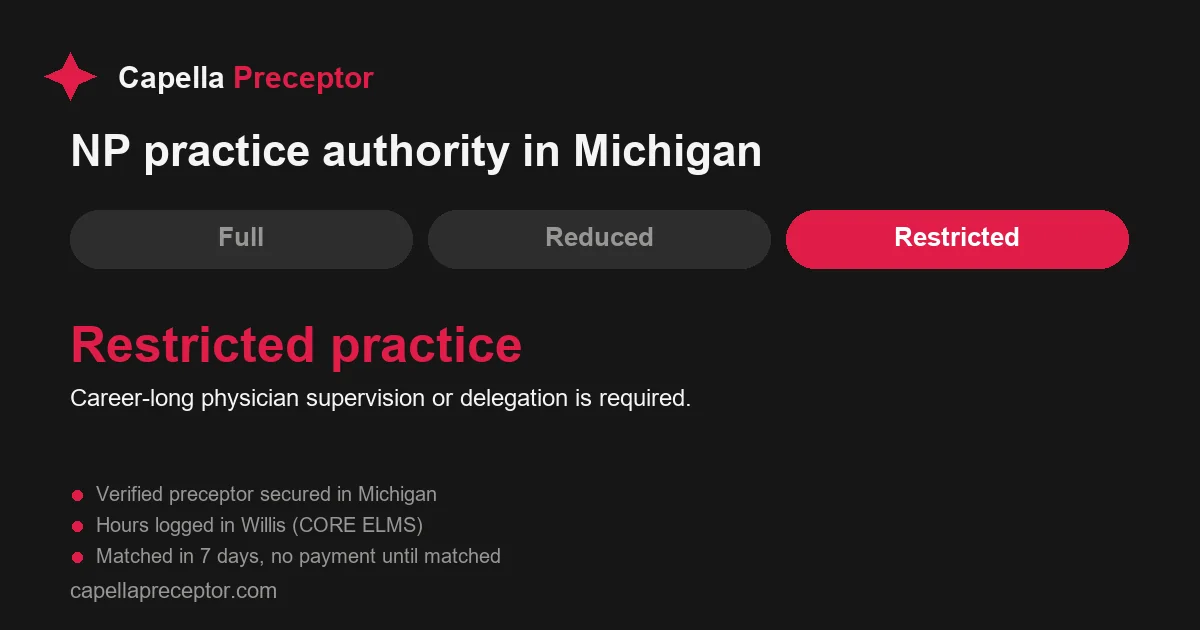
The American Association of Nurse Practitioners places Michigan in the restricted practice category on its State Practice Environment map (AANP, Michigan; AANP, State Practice Environment). Restricted means a nurse practitioner cannot practice or prescribe entirely on their own. State law ties at least one element of NP practice to physician supervision, delegation, or a collaborative relationship for the life of the career. Michigan goes further than most: it does not set out a separate, freestanding NP scope, and NPs are recognized through a specialty certification rather than a distinct advanced-practice license.
For a Capella student, this is less of an obstacle than it sounds. Practicum is supervised work by definition. Your preceptor observes, signs off, and takes responsibility for your clinical activity, which lines up cleanly with Michigan's collaborative model. The practical task is not the legal framework, it is finding a Michigan-licensed clinician who will commit the hours and complete the paperwork.
The Michigan Board of Nursing
Nursing in Michigan is regulated by the Michigan Board of Nursing, which sits inside the Department of Licensing and Regulatory Affairs, known as LARA (Michigan Board of Nursing, LARA). Rather than issuing a stand-alone APRN license, Michigan grants a specialty certification built on an active RN license, graduate education, and national certification from an approved body such as the AANPCB or ANCC (NursingLicensure.org, Michigan NP requirements).
When you evaluate a potential preceptor, the board's public license verification is the fastest confirmation that a clinician is in good standing and certified in the right role. You can run that lookup through LARA before you commit to anyone. We verify every preceptor's Michigan license and certification ourselves before we introduce them, so you never have to chase a credential that does not check out.
- Regulator: Michigan Board of Nursing under LARA.
- Recognition: NPs are state-certified by specialty (the state certifies NPs and clinical nurse specialists the same way).
- Verify: use the LARA license lookup to confirm a clinician's status.
Finding a preceptor and clinical site in Michigan
Here is the part Capella does not solve for you. The university is explicit that the student is responsible for securing their own preceptor and clinical site, and it does not assign one. That places the entire search, the outreach, the credential checks, and the agreement chase, on the student. In a restricted state where many practices already operate inside tight physician-collaboration arrangements, cold outreach can stall for weeks.
That is the gap we close. We secure a verified, Capella-compliant preceptor for you across Michigan's population centers and beyond. We place students in metro Detroit and the surrounding suburbs, Grand Rapids and the West Michigan corridor, Ann Arbor, Lansing and East Lansing, Flint, the Kalamazoo and Battle Creek area, Saginaw and the Tri-Cities, Traverse City in the north, and the Marquette region in the Upper Peninsula. If you are in a rural county or the U.P. where in-person options are genuinely thin, our virtual preceptorship keeps you on schedule.
Detroit, Dearborn, Warren, Ann Arbor, and the Oakland and Macomb suburbs.
Grand Rapids, Kalamazoo, Battle Creek, and Holland.
Lansing, Flint, Saginaw, Traverse City, and Marquette in the U.P.
What has to clear before you log an hour
Once a Michigan preceptor and site are identified, Capella runs every placement through its practicum system, which we track in our workflow as CORE ELMS. Nothing counts until that workflow is complete, and a signed affiliation agreement between Capella and the Michigan site plus third-party compliance are part of it. Hour totals differ by program (the RN-to-BSN capstone practicum, the 750-hour MSN-FNP spread across six 125-hour courses, other NP tracks, and DNP project hours), so check your exact requirement on our hours breakdown and your specialty page.
- Propose the site and preceptor in CORE ELMS for Capella review and approval.
- Execute an affiliation agreement between Capella and the Michigan clinical site before day one.
- Clear compliance through a third-party background and health-records vendor such as CastleBranch.
- Log and submit hours in CORE ELMS, where your preceptor approves what you record.
Virtual or in-person for Michigan students
Michigan's geography drives this choice. A student in the dense southeast corridor usually has in-person sites within a short drive, while a student in the northern Lower Peninsula or the Upper Peninsula may have very few primary care practices accepting practicum students. Both routes log into the same CORE ELMS record.
Best when you are near Detroit, Grand Rapids, Ann Arbor, Lansing, or another metro with clinics that accept students. Hands-on hours under a local preceptor.
Best for rural counties and the U.P., or when in-person sites are full. Supervised telehealth hours that keep your course timeline intact.
Michigan FAQ
Is Michigan a full practice authority state for nurse practitioners?
No. The AANP classifies Michigan as a restricted practice state, which means a nurse practitioner works under physician supervision and delegation through a collaborative relationship rather than practicing independently. For a Capella student, the day-to-day effect is that your preceptor signs off on your clinical work, which is exactly the supervised model practicum is built around.
Does Capella assign a preceptor to Michigan students?
No. Capella requires the student to secure their own preceptor and clinical site; the university does not assign one. Capella Preceptor secures a verified, Michigan-licensed preceptor for you and prepares the CORE ELMS paperwork.
How do I verify a Michigan preceptor's license?
Michigan licenses and specialty certifications are issued by the Michigan Board of Nursing under the Department of Licensing and Regulatory Affairs (LARA), and you can confirm a clinician's status through the LARA license verification lookup. Every preceptor we match is verified before you are introduced.
Sources
- AANP, Michigan state advocacy page (restricted practice)
- AANP, State Practice Environment
- Michigan Board of Nursing, LARA
- NursingLicensure.org, Michigan nurse practitioner requirements
How Capella Preceptor helps in Michigan
You now know the lay of the land: a restricted state, a specialty-certification board under LARA, and a search Capella leaves entirely to you. We secure a verified, Michigan-licensed preceptor whose setting matches your specialty, complete every CORE ELMS form and affiliation agreement, and keep your hours logged on schedule, in person across the metros or virtually for the rural counties and the U.P.
- Verified Michigan preceptor matched in 7 days, no payment until matched
- Every CORE ELMS form, affiliation agreement, and compliance step handled
- In-person across Michigan metros or fully virtual for rural counties and the U.P.
On the family nurse practitioner track? See Capella FNP preceptor requirements in Michigan for FNP-specific practicum hours, Michigan board rules, and local clinical settings.
Get a Capella preceptor in Michigan
Free 15-minute consult. No payment until matched. We map your entire practicum plan.
Get my free consult →