Capella FNP Preceptor in Michigan
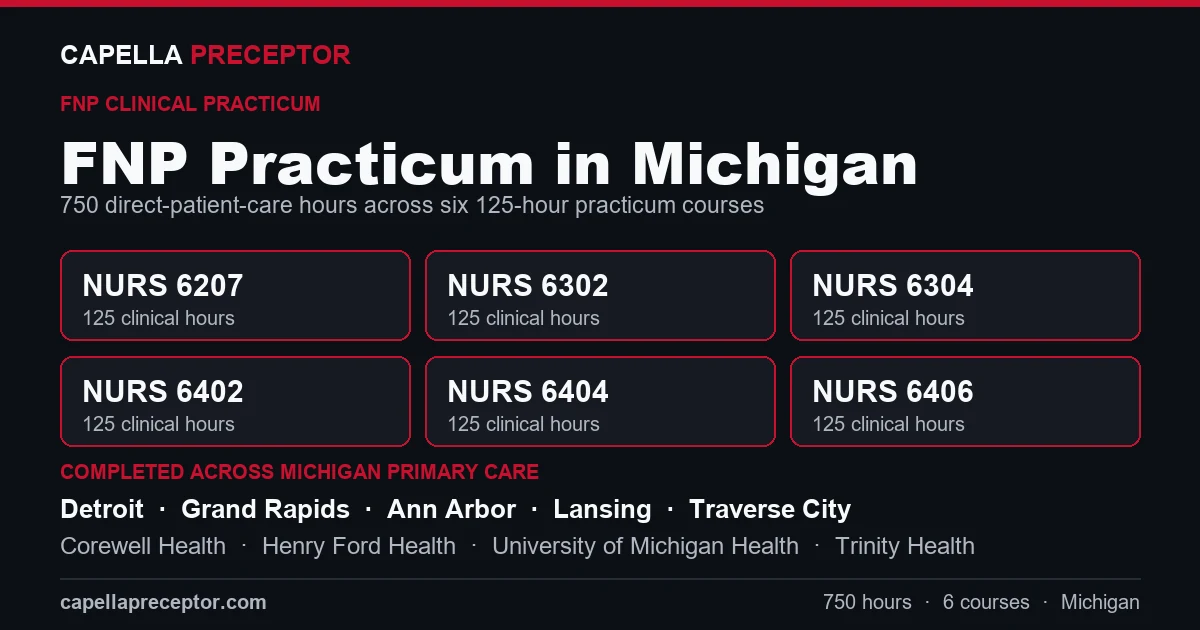
The Capella MSN-FNP needs 750 practicum hours across six courses spanning the whole lifespan, and you secure the preceptor yourself. In Michigan that search runs inside a restricted practice state: your FNP preceptor prescribes controlled substances only under a physician's written authorization. This page maps both halves, the FNP requirement and the Michigan board rules, and where we place Capella students across the state.
Last updated: June 28, 2026 · Reviewed by the Capella Preceptor placement team
What the Capella FNP requires, and what Michigan adds
The hour requirement does not change by state. The Capella MSN-FNP specialization requires a minimum of 750 practicum hours, spread across six clinical courses that each carry 125 hours, completed in your local community while coursework stays online (Capella, MSN-FNP courses). A Capella FNP student in Detroit logs the same 750 hours as one in Phoenix or Tampa. What Michigan changes is the supervision framework around those hours and the kind of clinician who can serve as your preceptor.
Michigan is a restricted practice state on the AANP State Practice Environment map (AANP, State Practice Environment). It is one of a shrinking group that still ties an element of NP practice to physician supervision or delegation rather than allowing fully independent practice. For practicum that is a clean fit, because clinical hours are supervised by definition. The friction is not legal; it is finding a Michigan-licensed clinician who matches the FNP scope and will commit across all six courses.
Because the FNP spans adults, children, and women's health, a single Michigan family medicine panel can often cover most of it, but pediatrics and reproductive health are the two that send students chasing a second site mid-program. The full course-by-course breakdown lives on our FNP requirements page; this page focuses on doing it inside Michigan.
How does Michigan recognize and regulate nurse practitioners?
Michigan does something most states do not: it does not issue a stand-alone advanced-practice license. Instead, the Michigan Board of Nursing, under the Department of Licensing and Regulatory Affairs (LARA), licenses an NP as a registered nurse and adds a state specialty certification on top, built on graduate education and national certification from an approved body such as the AANPCB or ANCC (NursingLicensure.org, Michigan NP requirements; Michigan Board of Nursing, LARA). For a family track, AANPCB certifies the Family Nurse Practitioner role specifically, which is the credential most Michigan FNP preceptors carry.
This matters when you vet a preceptor. You are not looking for an "APRN license number" in the usual sense; you are confirming an active RN license plus the matching NP specialty certification through the LARA license verification lookup. We run that check on every preceptor before we introduce them, so you never commit hours to a credential that does not hold up.
- Regulator: Michigan Board of Nursing under LARA.
- Recognition: RN license plus a state NP specialty certification, not a separate APRN license.
- Certification bodies: AANPCB (Family NP), ANCC, and other LARA-approved boards.
What does restricted practice mean for an FNP preceptor relationship?
Here is the concrete version, not the label. In Michigan an NP can prescribe nonscheduled prescription drugs on their own, but prescribing controlled substances in Schedules 2 to 5 is a delegated act that requires a physician's written authorization, the Michigan name for the collaborative arrangement (MCL 333.17211a; Mich. Admin. Code R. 338.2411). That written authorization names both clinicians and their license numbers, lists any limits, must be reviewed annually, and lets a physician authorize up to a 90-day supply of a Schedule 2 medication. It is why "restricted" is more than a word in Michigan.
For your practicum, this shapes who can precept you and how prescribing is handled at the site. A family medicine physician is a clean FNP preceptor. An experienced FNP can precept you too, as long as their own controlled-substance prescribing runs under a collaborating physician's written authorization. Either way, during practicum the prescriptive activity you observe and participate in stays under your preceptor's authority, which is exactly how the clinical hours are supposed to work.
Where do Capella FNP students find clinical sites in Michigan?
Michigan's care is concentrated in a few large systems, and family medicine, internal medicine, pediatrics, and women's health clinics inside them are the natural FNP rotations. The state's biggest systems are Corewell Health, which anchors Grand Rapids and the Southfield and Detroit suburbs, Henry Ford Health in metro Detroit, and University of Michigan Health, known as Michigan Medicine, in Ann Arbor, alongside Trinity Health sites across the state (Michigan Health and Hospital Association, hospitals by system). Their outpatient primary care offices are where most in-person FNP hours get logged.
We secure verified, Capella-compliant FNP preceptors across Michigan's population centers and beyond: metro Detroit, Dearborn, and the Oakland and Macomb suburbs; Grand Rapids and the West Michigan corridor; Ann Arbor, Lansing, and East Lansing; Flint, Kalamazoo, Battle Creek, and Saginaw; and the northern reach toward Traverse City and Marquette in the Upper Peninsula.
Detroit, Dearborn, Ann Arbor, and the Oakland and Macomb suburbs, dense with family medicine and women's health for the FNP populations.
Grand Rapids, Kalamazoo, Battle Creek, Lansing, and East Lansing, strong on primary care and pediatric clinics.
Traverse City, Flint, Saginaw, and Marquette, where in-person sites thin out and virtual placement keeps you on track.
Why is finding an FNP preceptor harder in parts of Michigan?
Two things compound here. First, Capella does not solve placement for you: the university states that learners are responsible for securing their own preceptor and clinical site, and it does not assign one (Capella, MSN-NP program). The entire search, the outreach, the credential checks, and the agreement chase land on the student. Second, Michigan has roughly 288 primary care health professional shortage areas, with about 2.7 million residents living in a designated shortage area and the worst gaps in the northern Lower Peninsula and the Upper Peninsula (Michigan Department of Health and Human Services, HPSA). Where physicians are scarce, the delegated-prescribing model means fewer practices can take on an NP, let alone a student, so cold outreach in those counties can stall for weeks.
That is the gap we close. We hold relationships with primary care, family medicine, pediatric, and women's health clinics across Michigan, verify each preceptor against LARA, confirm the site can support the FNP populations your courses require, and prepare the CORE ELMS paperwork. In the metros that usually means an in-person placement within a short drive; in the rural counties and the U.P. it often means a supervised virtual preceptorship so a shortage area does not cost you a term.
What has to clear before you log an FNP hour in Michigan?
Once a Michigan preceptor and site are identified, Capella runs every placement through its practicum management system, which we track in our workflow as CORE ELMS (Capella, CORE ELMS). Nothing counts until that workflow is complete: a signed affiliation agreement between Capella and the Michigan site and third-party compliance are part of it, and the 750 hours are tied to specific courses, so you log and get each course's hours approved before that course closes.
- Propose the site and preceptor in CORE ELMS for Capella review and approval.
- Execute an affiliation agreement between Capella and the Michigan clinical site before day one.
- Clear compliance through a third-party background and health-records vendor such as CastleBranch.
- Log and submit hours per course in CORE ELMS, where your Michigan preceptor approves what you record.
Michigan FNP FAQ
What does a Capella FNP preceptor in Michigan have to be able to do?
Hold an active Michigan license, be certified in a role that matches family primary care across the lifespan, and practice in an outpatient primary care setting. Because Michigan is a restricted practice state, an NP preceptor prescribes controlled substances only under a physician's written authorization, so a family medicine physician or an experienced FNP working under a collaborating physician both fit the Capella FNP scope.
Is Michigan a full practice authority state for nurse practitioners?
No. The AANP classifies Michigan as a restricted practice state, one of a small group that still ties at least one element of NP practice to physician supervision or delegation. For a Capella FNP student this matches practicum, which is supervised by design: your preceptor signs off on the clinical work you log.
How many FNP practicum hours do I need in Michigan, and does Capella place me?
A minimum of 750 practicum hours across six 125-hour courses, the same nationwide; Michigan does not change the hour count. Capella does not assign the preceptor or site. Learners secure their own preceptor, which is the gap Capella Preceptor fills with a verified, Michigan-licensed FNP placement.
How do I verify a Michigan FNP preceptor's license?
Michigan licenses NPs as registered nurses with a state specialty certification added on top, all issued by the Michigan Board of Nursing under LARA. You can confirm a clinician's status with the LARA license verification lookup. Every preceptor we match is verified against LARA before you are introduced.
Can I do my Capella FNP practicum virtually in rural Michigan or the U.P.?
Often yes. Michigan has hundreds of primary care health professional shortage areas concentrated in the northern Lower Peninsula and the Upper Peninsula, where in-person FNP sites are thin. A supervised virtual preceptorship keeps your hours on schedule when local clinics are full, and both routes log into the same CORE ELMS record.
Sources
- Capella University, MSN Family Nurse Practitioner courses (750 hours, six courses)
- AANP, State Practice Environment (Michigan restricted practice)
- Michigan Legislature, MCL 333.17211a (NP prescribing and delegation)
- Mich. Admin. Code R. 338.2411 (controlled-substance delegation to an APRN)
- NursingLicensure.org, Michigan nurse practitioner requirements
- Michigan DHHS, Health Professional Shortage Areas
How Capella Preceptor helps FNP students in Michigan
You now have both halves: a 750-hour FNP across six courses and the populations they cover, and a restricted state where prescribing rides on a physician's written authorization, NPs are certified by specialty under LARA, and shortage areas thin out the rural map. We secure a verified, Capella-compliant FNP preceptor whose panel matches your courses, complete every CORE ELMS form and affiliation agreement, and keep your hours logged on schedule, in person across the metros or virtually for the rural counties and the U.P.
- Verified Michigan FNP preceptor matched in 7 days, no payment until matched
- Preceptor verified against LARA, with a panel that covers your FNP populations
- In-person across Michigan metros or fully virtual for rural counties and the U.P.
Get a Capella FNP preceptor in Michigan
Free 15-minute consult. No payment until matched. We map your entire FNP practicum plan across all six courses.
Get my free consult →