Home / Louisiana
StateCapella Preceptor and Placement in Louisiana
Louisiana is a reduced-practice state for nurse practitioners, which means your preceptor practices under a collaborative agreement with a physician. Capella also leaves it to you to find that preceptor and clinical site. We do both: a verified, Louisiana-authorized preceptor matched in 7 days, with no payment until you are matched.
Last updated: June 21, 2026 · Reviewed by the Capella Preceptor placement team
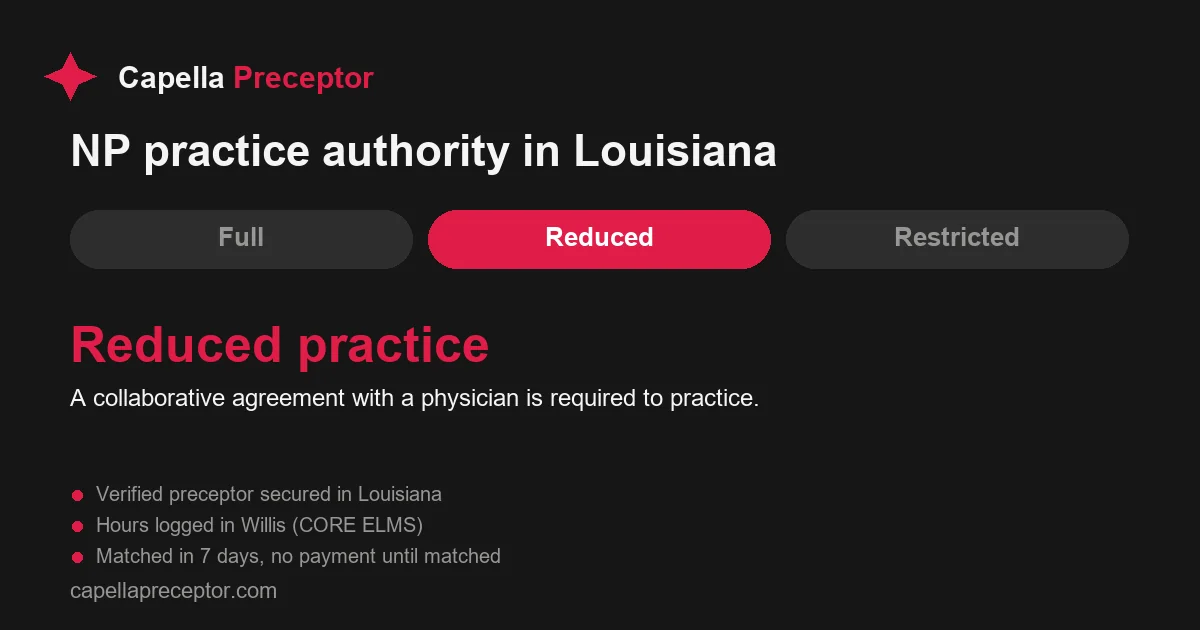
Nurse practitioner practice authority in Louisiana
The American Association of Nurse Practitioners classifies Louisiana as a reduced practice state (AANP, State Practice Environment; AANP, 2026 State Practice Environment, PDF). Reduced practice means state law limits at least one element of what an NP can do independently. In Louisiana, the central limit is that a nurse practitioner must hold a collaborative practice agreement with a licensed physician in order to diagnose, manage, and prescribe (AANP, Louisiana).
For a Capella student lining up a practicum, this matters in a concrete way. The clinician who precepts you is almost always working inside that collaborative structure. That is not an obstacle, it is just the shape of the placement you are looking for: a Louisiana-licensed NP or physician whose own authorization is current and who can legitimately supervise and sign off on your hours. When we vet a preceptor here, confirming that authorization is part of the check, so you are not surprised mid-rotation.
The Louisiana State Board of Nursing
Advanced practice in Louisiana is regulated by the Louisiana State Board of Nursing (LSBN), based in Baton Rouge. Approval by the LSBN is required to use the APRN title and to practice as a nurse practitioner in the state (LSBN, Joint Practice Statement). The board reviews and approves each collaborative practice agreement, grants prescriptive authority separately under the state administrative code, and keeps a public, current list of APRNs authorized to prescribe.
A few practical points the LSBN spells out that affect who can precept you:
- Board template. APRNs must use the LSBN's own collaborative practice agreement template (LSBN, Collaborative Practice Agreement template).
- Matched specialty. The collaborating physician must practice in Louisiana in the same or a comparable scope and specialty as the APRN, which is one reason specialty-matched preceptors can be scarce in some parishes.
- License verification. You can confirm any preceptor's Louisiana license and APRN authorization directly through the LSBN before your hours start (LSBN, Advanced Practice Registered Nurse).
Finding a preceptor and clinical site in Louisiana
Capella is direct about this: the student is responsible for securing the preceptor and clinical site, and the university does not assign one. Capella's coursework stays online while you complete practicum in your own community. In a reduced-practice state like Louisiana, the search is a little tighter, because the right preceptor also has to fit the collaborative-agreement and specialty-match rules above.
We place across Louisiana's major care hubs and the parishes around them:
Greater New Orleans and Jefferson Parish primary care, family medicine, and behavioral health.
Capital-region clinics and outpatient practices across East Baton Rouge.
Northwest Louisiana family and adult-gerontology placements.
Acadiana primary care and women's health sites.
Southwest Louisiana outpatient and family medicine.
Northeast and central Louisiana, plus surrounding rural parishes.
If you are in a smaller parish where a specialty-matched preceptor is genuinely hard to reach, the fully virtual option below keeps you on schedule rather than waiting months for a local opening.
Hours and practicum requirements for Louisiana students
Your hour total depends on your program. The RN-to-BSN capstone carries a focused practicum, the MSN-FNP runs 750 hours across six 125-hour courses, other NP tracks are similar, and the DNP adds project hours. We keep the per-program numbers on the hours breakdown and the specialty pages (FNP, PMHNP, AGPCNP, DNP) so you can check your exact requirement rather than read a generic figure here.
Whatever the total, the workflow into a Louisiana site is the same set of gates, and missing any one stalls your start:
- Propose your site and preceptor in Capella's practicum system, tracked in our workflow as CORE ELMS, for review and approval.
- Get the affiliation agreement signed between Capella and the Louisiana site before practicum begins.
- Clear third-party compliance such as background check and health records through Capella's current vendor (for example CastleBranch).
- Log and submit hours in CORE ELMS, where your preceptor approves what you record.
In-person or virtual practicum in Louisiana
Both routes work for Louisiana students, and the right one usually comes down to geography. In and around New Orleans, Baton Rouge, Shreveport, and Lafayette, in-person placements with a local, specialty-matched preceptor are realistic. In rural parishes, or when your program needs a population that nearby clinics cannot supply, a virtual preceptorship lets you complete supervised hours remotely while everything still flows through CORE ELMS and the affiliation agreement. We help you weigh the two against your timeline at the consult.
Louisiana FAQ
Is Louisiana a full practice authority state for nurse practitioners?
No. The AANP classifies Louisiana as a reduced practice state. NPs must hold a collaborative practice agreement with a licensed physician, approved by the Louisiana State Board of Nursing, to diagnose, manage, and prescribe.
Does the collaborative practice agreement affect my Capella practicum?
It shapes the kind of preceptor you need. A Louisiana NP preceptor practices under a collaborative agreement, so we confirm the preceptor and site are fully authorized before you log a single hour in CORE ELMS.
Which Louisiana cities do you place students in?
New Orleans, Baton Rouge, Shreveport, Lafayette, Lake Charles, Monroe, Alexandria, and the surrounding parishes, plus a fully virtual option for students in rural Louisiana.
How fast can I get a preceptor in Louisiana?
We guarantee a verified match within 7 days, with no payment until you are matched. Many Louisiana students start sooner.
Sources
- AANP, State Practice Environment (Louisiana reduced practice)
- AANP, 2026 State Practice Environment (PDF)
- AANP, Louisiana practice environment
- Louisiana State Board of Nursing, Advanced Practice Registered Nurse
- Louisiana State Board of Nursing, Joint Practice Statement
- Louisiana State Board of Nursing, Collaborative Practice Agreement template
How Capella Preceptor helps in Louisiana
You now know the two hurdles unique to a Louisiana placement: a reduced-practice rule that means your preceptor works under a collaborative agreement, and Capella leaving the search entirely to you. We close both. We secure a verified, Louisiana-authorized preceptor whose specialty fits your program, confirm their license and authorization with the LSBN, prepare every CORE ELMS form and affiliation agreement, and keep your hours logged and submitted on schedule.
- Verified, Louisiana-authorized preceptor matched in 7 days, in person or virtual
- Every CORE ELMS form and affiliation agreement handled for you
- No payment until you are matched, with your exact quote at the free consult
On the family nurse practitioner track? See Capella FNP preceptor requirements in Louisiana for FNP-specific practicum hours, Louisiana board rules, and local clinical settings.
Get a Capella preceptor in Louisiana
Free 15-minute consult. No payment until matched. We map your entire Louisiana practicum plan.
Get my free consult →