Home / MSN-FNP / FNP Preceptor in Louisiana
FNP × LouisianaCapella FNP Preceptor in Louisiana
The Capella MSN-FNP needs 750 practicum hours across six clinical courses, spanning primary care across the lifespan. Louisiana adds one wrinkle: it is a reduced-practice state, so your preceptor works under a collaborative practice agreement with a physician. We secure a verified, Louisiana-authorized FNP preceptor in 7 days, with no payment until you are matched.
Last updated: June 28, 2026 · Reviewed by the Capella Preceptor placement team
What does the Capella FNP practicum look like in Louisiana?
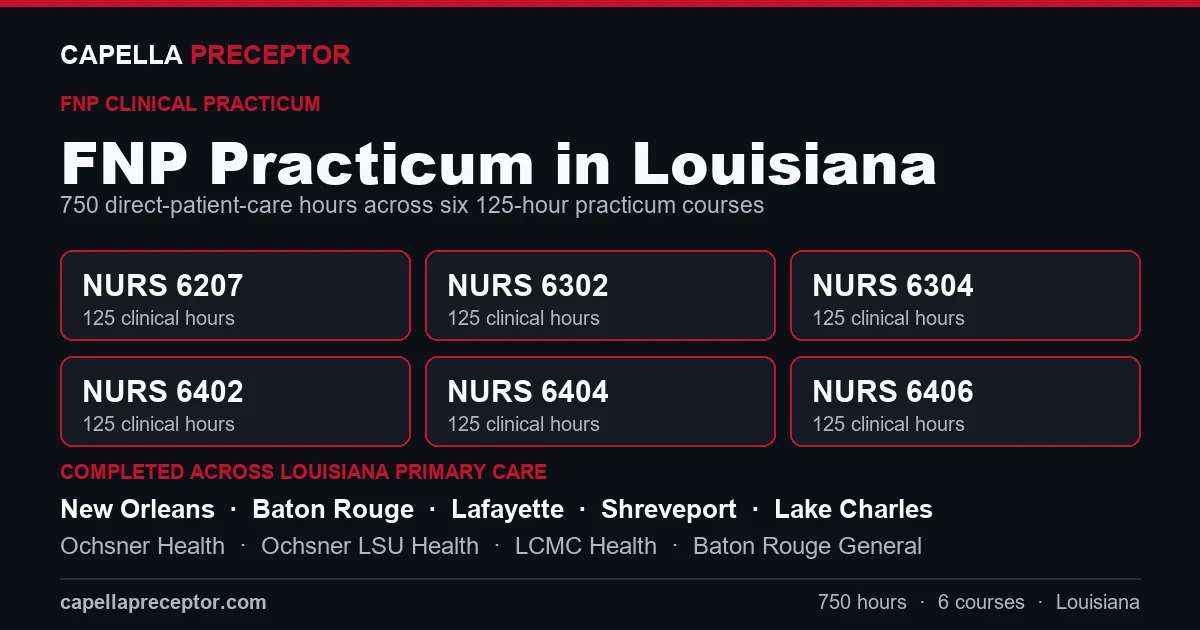
The clinical requirement does not change at the Louisiana state line. The Capella MSN Family Nurse Practitioner specialization needs a minimum of 750 practicum hours, spread across six clinical practicum courses that each carry 125 hours (Capella, MSN-FNP courses). The coursework stays online while you log those hours at a clinical site in your own Louisiana community. We keep the full FNP breakdown on the Capella FNP page and the general state rules on the Louisiana page; this page is the specific overlap, an FNP student placing in Louisiana.
What Louisiana changes is who can sign off on those hours and under what structure. Because the state classifies nurse practitioners as reduced practice, the NP who precepts you almost always works under a collaborative practice agreement with a physician. That is not a barrier to your practicum. It just defines the kind of preceptor and site you are looking for: a currently authorized Louisiana NP or physician whose own scope matches the family, primary care population your FNP courses require.
How does Louisiana reduced practice affect an FNP preceptor?
The American Association of Nurse Practitioners classifies Louisiana as a reduced-practice state (AANP, State Practice Environment; AANP, Louisiana). Reduced practice means state law limits at least one element of independent NP practice. In Louisiana, the central limit is that an NP must hold a collaborative practice agreement with a Louisiana-licensed physician, approved by the board, to medically diagnose, manage, and prescribe (LSBN, Collaborative Practice Agreement template).
Three details of that agreement directly shape who can precept your FNP hours, and they are the part most students miss until they are mid-search:
- Same or comparable specialty. The collaborating physician must practice in Louisiana in a scope, specialty, or expertise comparable to the APRN's. For a family, primary care preceptor, that is usually a family-medicine or internal-medicine physician, which is why a primary care clinic is the natural fit (La. Admin. Code tit. 46, XLVII-4513).
- No more than two collaborating physicians per site. The board approves a limited number of collaborating physicians per practice site, which can quietly cap how many NP preceptors a busy clinic is able to support at once (La. Admin. Code tit. 46, XLVII-4513).
- Prescriptive authority is its own approval. A Louisiana NP's authority to prescribe is granted separately by the board and is personal to that NP, tied to clinical practice hours and the collaborative agreement. A preceptor with current, active prescriptive authority is the one who can model the full primary care workflow your transition-to-practice course expects (LSBN, Advanced Practice Registered Nurse).
When we vet a Louisiana FNP preceptor, confirming that the agreement, specialty match, and authorization are current is part of the check. That is how you avoid the worst-case version of this, discovering mid-rotation that the clinician signing your hours was not actually authorized for the scope you logged.
Which patient populations must your 750 Louisiana hours cover?
The FNP is a family, primary care role, so your hours have to span the lifespan rather than sit in one age group. Capella's course sequence makes the expected mix explicit, and it is the same in Louisiana: adult and older-adult primary care, pediatrics, and reproductive or women's health (Capella, MSN-FNP courses). The Louisiana angle is purely practical: in a primary-care-short state, a single clinic that covers all three populations is valuable, because it lets you satisfy the spread under one collaborative agreement rather than stitching together multiple sites and agreements.
FlexPath learners see the same sequence as NURS-FPX6207, NURS-FPX6302, and so on. Confirm your exact codes on your own program map, because Capella periodically revises numbering and your enrollment date governs which version you follow.
Where do FNP students actually find a preceptor in Louisiana?
Louisiana is, bluntly, a hard state to self-place in, and not because of the board rules. It is the supply. Sixty of Louisiana's 64 parishes are designated primary care health professional shortage areas, with roughly 3,500 patients for every provider, and nearly two million residents living in a shortage area (Ochsner Journal, 2024). In several rural parishes, a nurse practitioner is the sole local primary care provider, which is exactly the clinician you want as a preceptor and exactly the clinician with the least spare time to take a student.
That makes geography the deciding factor. FNP-appropriate primary care is most reachable in and around the state's larger care hubs, where systems such as Ochsner Health, Ochsner LSU Health, LCMC Health, and Baton Rouge General run family medicine, internal medicine, pediatric, and women's health clinics. We place across these areas and the parishes around them:
Greater New Orleans and Jefferson Parish family medicine, primary care, and women's health panels.
Capital-region primary care and pediatric clinics across East Baton Rouge and Ascension.
Acadiana family medicine and women's health, a region where NPs carry much of the primary care load.
Northwest Louisiana family and adult-gerontology primary care.
Southwest Louisiana outpatient and family medicine.
Northeast and central Louisiana, plus the surrounding rural parishes.
If you are in a smaller parish where a family-medicine preceptor with an open collaborative agreement is genuinely out of reach, the virtual option keeps you moving rather than waiting a term for a local opening.
Who is responsible for finding the FNP preceptor at Capella?
This is the part that catches most FNP students off guard, and it compounds the Louisiana supply problem. Capella does not assign you a preceptor or a site. The university states plainly that "learners are responsible for finding an appropriate preceptor to oversee the practicum experience," and that practicum is completed in your own local community (Capella, MSN-NP program). Capella offers support resources and a placement-support team, but securing the actual placement is on you. In a reduced-practice, primary-care-short state, that search is tighter than in a full-practice state, because the right preceptor also has to satisfy the collaborative-agreement and specialty-match rules above.
What has to clear before your Louisiana practicum starts?
Once you identify a preceptor and site, the same clearance gates apply, and missing any one stalls your start. Capella manages practicum application, site and preceptor approval, hour tracking, and evaluations through its practicum management system, which we track in our workflow as CORE ELMS.
- Propose your Louisiana site and preceptor in CORE ELMS for review and approval, with the preceptor's license and population coverage documented.
- Get the affiliation agreement signed between Capella and the Louisiana clinical site before practicum begins.
- Clear third-party compliance such as background check, drug testing, and health records through Capella's current vendor (CastleBranch, on the myCB platform).
- Log and submit hours in CORE ELMS per course, where your Louisiana preceptor approves what you record before each course closes.
A small Louisiana-specific tip: you can confirm any preceptor's Louisiana license and APRN authorization directly through the Louisiana State Board of Nursing before your hours start, which is worth doing before you invest weeks in a site (LSBN, Advanced Practice Registered Nurse).
In-person or virtual FNP practicum in Louisiana?
Both routes work, and in Louisiana the right one usually comes down to where you live. In and around New Orleans, Baton Rouge, Lafayette, and Shreveport, an in-person placement with a local, specialty-matched family-medicine preceptor is realistic. In a rural parish, or when your pediatric or women's health course needs a population the nearest clinic cannot supply, a virtual preceptorship lets you complete supervised hours remotely while everything still routes through CORE ELMS and the signed affiliation agreement. We help you weigh the two against your course timeline at the consult, rather than letting a Louisiana shortage area decide it for you by default.
Louisiana FNP FAQ
How many practicum hours does the Capella FNP need in Louisiana?
A minimum of 750 practicum hours across six clinical courses that each carry 125 hours. That total is the same in Louisiana; what changes is that your preceptor works under a collaborative practice agreement because Louisiana is a reduced-practice state.
Can a Louisiana nurse practitioner precept my Capella FNP practicum?
Yes. A Louisiana-licensed NP can precept your FNP hours, and so can a physician. Because Louisiana is reduced practice, an NP preceptor works under a collaborative practice agreement, so we confirm the preceptor and site are currently authorized before any hours are logged in CORE ELMS.
Where can I find an FNP preceptor in Louisiana?
FNP-friendly primary care is concentrated in family medicine, internal medicine, pediatric, and women's health clinics around New Orleans, Baton Rouge, Lafayette, Shreveport, Lake Charles, Monroe, and Alexandria. With 60 of Louisiana's 64 parishes designated primary care shortage areas, rural placements are harder, so a virtual option keeps students on schedule.
Is Louisiana a full practice authority state for nurse practitioners?
No. The AANP classifies Louisiana as a reduced-practice state. An NP must hold a collaborative practice agreement with a Louisiana-licensed physician, approved by the Louisiana State Board of Nursing, to medically diagnose, manage, and prescribe.
How fast can you match a Louisiana FNP preceptor?
We guarantee a verified match within 7 days, with no payment until you are matched. We confirm the preceptor's Louisiana license and FNP-appropriate population coverage before you start.
Sources
- Capella University, MSN Family Nurse Practitioner courses (750 hours, six courses)
- Capella University, MSN-NP program (learner finds the preceptor)
- AANP, State Practice Environment (Louisiana reduced practice)
- Louisiana Administrative Code, tit. 46, XLVII-4513 (authorized practice, collaborating physicians)
- Louisiana State Board of Nursing, Collaborative Practice Agreement template
- Louisiana State Board of Nursing, Advanced Practice Registered Nurse
- Ochsner Journal, 2024 (60 of 64 parishes are primary care shortage areas)
How Capella Preceptor helps Louisiana FNP students
You now know the two things that make a Louisiana FNP placement harder than the average state: a reduced-practice rule that means your preceptor works under a collaborative agreement, and a primary care shortage across most of the state, layered on top of Capella leaving the search entirely to you. We close all three. We secure a verified, Louisiana-authorized FNP preceptor whose panel covers the adult, pediatric, and women's health populations your six courses require, confirm their license and authorization with the LSBN, prepare every CORE ELMS form and affiliation agreement, and keep your 750 hours logged and submitted on schedule.
- Verified, Louisiana-authorized FNP preceptor matched in 7 days, in person or virtual
- Specialty-matched to the collaborative-agreement rule and your population coverage
- No payment until you are matched, with your exact quote at the free consult
Get a Capella FNP preceptor in Louisiana
Free 15-minute consult. No payment until matched. We map your entire Louisiana FNP practicum plan, all 750 hours.
Get my free consult →