Home / Delaware
StateCapella Preceptor and Placement in Delaware
Delaware is a full practice authority state, so once you are licensed your nurse practitioner scope sits under the Delaware Board of Nursing alone, with no statewide collaborative agreement required. The piece Capella still leaves to you is the preceptor and the clinical site. Here is how practicum works in Delaware, then how we secure the placement for you.
Last updated: June 21, 2026 · Reviewed by the Capella Preceptor placement team
NP practice authority in Delaware
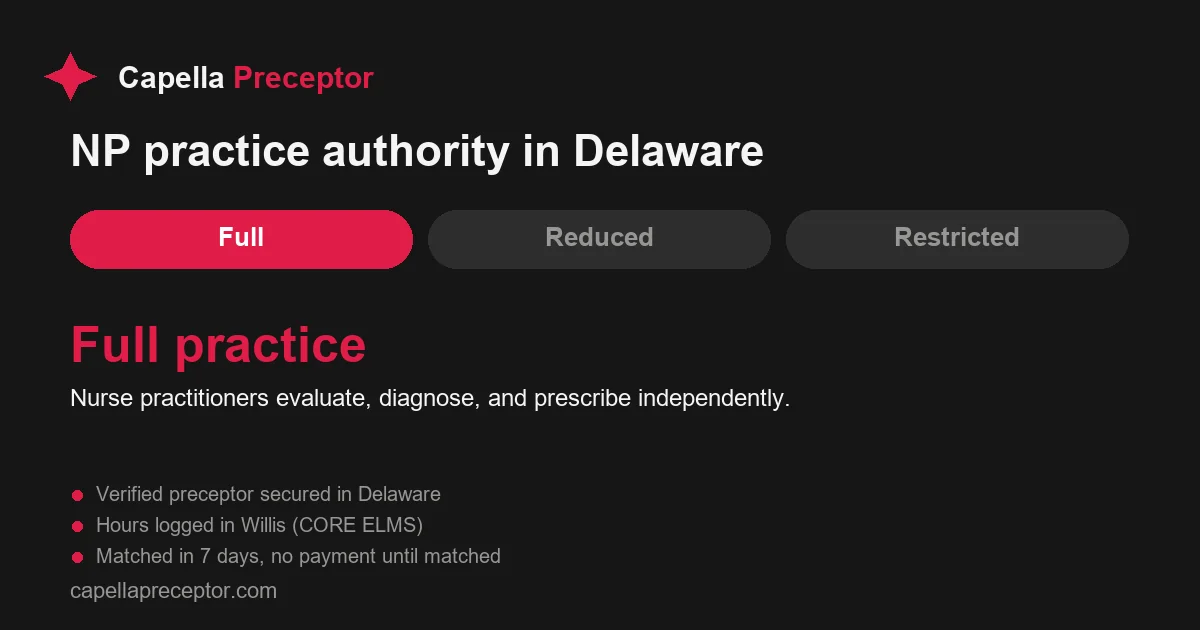
The American Association of Nurse Practitioners classifies Delaware as a full practice state (AANP, Delaware; AANP, State Practice Environment). That status arrived with House Bill 141, which amended Title 24 of the Delaware Code and moved the state into full practice authority alongside the District of Columbia and the other full practice jurisdictions (AANP, Delaware law expands access).
In day-to-day terms, full practice means a Delaware nurse practitioner can evaluate patients, diagnose, order and interpret diagnostic tests, and start and manage treatment, including prescribing, under the licensing authority of the Board of Nursing rather than under a supervising physician. The change "removes the requirement for a collaborative agreement for licensure purposes, although employers and health care organizations may still require one." For a Capella student lining up a practicum, that distinction matters: the state no longer mandates a collaborative agreement to be licensed, but the clinic where you train may still expect one, and Capella separately requires a qualified preceptor and an approved site before you log an hour.
The Delaware Board of Nursing
Nursing in Delaware is regulated by the Delaware Board of Nursing, which sits inside the Division of Professional Regulation (Delaware Board of Nursing). The board licenses RNs and recognizes the advanced practice roles, including the Family, Adult-Gerontology, Pediatric, and Women's Health nurse practitioner population foci that Capella students train into (Delaware Board of Nursing, APRN license).
Licensing and verification run through DELPROS, the state's online professional regulation portal, where you apply for an APRN license and where anyone can verify a license online (Delaware Board of Nursing). One practical detail the board notes: an APRN license carries automatic prescriptive authority for non-controlled substances, while a controlled substance registration is a separate step (Delaware Board of Nursing, APRN license). A preceptor you train under should hold a current, verifiable Delaware license in the role that matches your population focus, and we confirm that before any match.
Finding a preceptor and clinical site in Delaware
Capella is direct about whose job placement is: learners are responsible for finding an appropriate preceptor, and practicum is meant to be completed in the student's own local community. Delaware is small and densely served, which cuts both ways. The I-95 corridor around Wilmington and Newark in New Castle County holds most of the state's large health systems and outpatient practices, so adult-gerontology, family medicine, and behavioral health sites are reachable. The trade-off is that those same practices field placement requests from Delaware, southeastern Pennsylvania, Maryland, and New Jersey students at once, so good preceptors fill early.
South of the canal the picture changes. Dover and the Kent County seat carry steady primary care and women's health volume, Middletown, Bear, and Smyrna are growing fast, and Sussex County towns such as Milford, Seaford, Georgetown, and the Rehoboth Beach area lean rural and seasonal, where a single clinic may already host another school's student. We place across all three counties, and where local capacity is thin we keep you on schedule with a virtual placement instead of leaving you waiting on a waitlist.
Practicum requirements, applied to Delaware
Your required hours depend on your program: the RN-to-BSN capstone practicum is modest, the MSN-FNP runs 750 hours across six 125-hour courses, other NP tracks are similar in shape, and the DNP adds project hours. The full breakdown lives on our hours page and the specialty pages, so this page focuses on doing those hours in Delaware rather than re-listing every number.
Whatever the count, the clearance sequence is the same once you have a preceptor and site:
- Submit the site and preceptor for review and approval in Capella's practicum system, tracked in our workflow as CORE ELMS.
- Execute an affiliation agreement between Capella and the Delaware site before the first day of practicum.
- Clear third-party compliance through a background-check and health-records vendor such as CastleBranch; confirm the current vendor with your program.
- Log and submit hours in CORE ELMS, where your preceptor approves each block you record.
Because the agreement is between Capella and the site, a willing preceptor is not enough on its own. A small Delaware practice that has never hosted a Capella student sometimes balks at signing, which is exactly the kind of stall we clear, because the sites we work with already know the paperwork.
Virtual or in-person for Delaware students
Both paths work here, and full practice authority does not change which one you pick. The choice usually comes down to geography and population coverage.
Best when you live near Wilmington, Newark, or Dover and want hands-on hours in a local family medicine, primary care, or behavioral health clinic.
Best for Kent and Sussex county students, or anyone whose nearest site is already full, with hours tracked the same way in CORE ELMS.
Many Delaware students blend the two, using an in-person site for most hours and virtual coverage to fill a population the local panel cannot supply, such as pediatrics or women's health.
Delaware FAQ
Is Delaware a full practice authority state for nurse practitioners?
Yes. Under House Bill 141, Delaware adopted full practice authority, so nurse practitioners can evaluate, diagnose, order and interpret tests, and prescribe under the sole authority of the Delaware Board of Nursing, without a collaborative agreement for licensure.
Does a Capella student in Delaware still need a preceptor agreement?
Yes. Full practice authority removed the statewide collaborative-agreement mandate for licensure, but Capella still requires a qualified preceptor, an approved site, and a signed affiliation agreement before practicum hours can be logged in CORE ELMS.
Which Delaware cities do you place students in?
We place across the state, including Wilmington, Newark, Dover, Middletown, Bear, Smyrna, Milford, Seaford, Georgetown, and the coastal Rehoboth Beach area, plus rural Kent and Sussex counties through the virtual option.
Sources
- Delaware Board of Nursing, Division of Professional Regulation
- Delaware Board of Nursing, APRN license and prescriptive authority
- AANP, Delaware state advocacy and practice environment
- AANP, State Practice Environment (full practice category)
- AANP, Delaware law expands health care access (HB 141)
How Capella Preceptor helps
Full practice authority makes Delaware a strong place to train, but the state still leaves the preceptor and site to you, and the affiliation agreement is where students lose weeks. We secure a verified, Capella-compliant preceptor licensed by the Delaware Board of Nursing, in Wilmington, Newark, Dover, or anywhere across Kent and Sussex counties, in person or fully virtual, and we handle the paperwork from there.
- Verified Delaware preceptor matched in 7 days, with no payment until you are matched
- Every CORE ELMS form and affiliation agreement handled for the site
- In-person or virtual, with every hour logged and submitted on schedule
On the family nurse practitioner track? See Capella FNP preceptor requirements in Delaware for FNP-specific practicum hours, Delaware board rules, and local clinical settings.
Get a Capella preceptor in Delaware
Free 15-minute consult. No payment until matched. We map your entire Delaware practicum plan.
Get my free consult →