Capella FNP Preceptor in Delaware
A Capella MSN-FNP student in Delaware needs 750 primary care practicum hours and a qualified preceptor that the student secures, in a state where the Board of Nursing lets an APRN, physician assistant, pharmacist, or physician precept you, and where full practice authority means no collaborative agreement is required for licensure. Here is how the FNP requirement meets Delaware's board rules, then how we secure the placement.
Last updated: June 28, 2026 · Reviewed by the Capella Preceptor placement team
What the Capella FNP practicum requires before Delaware enters the picture
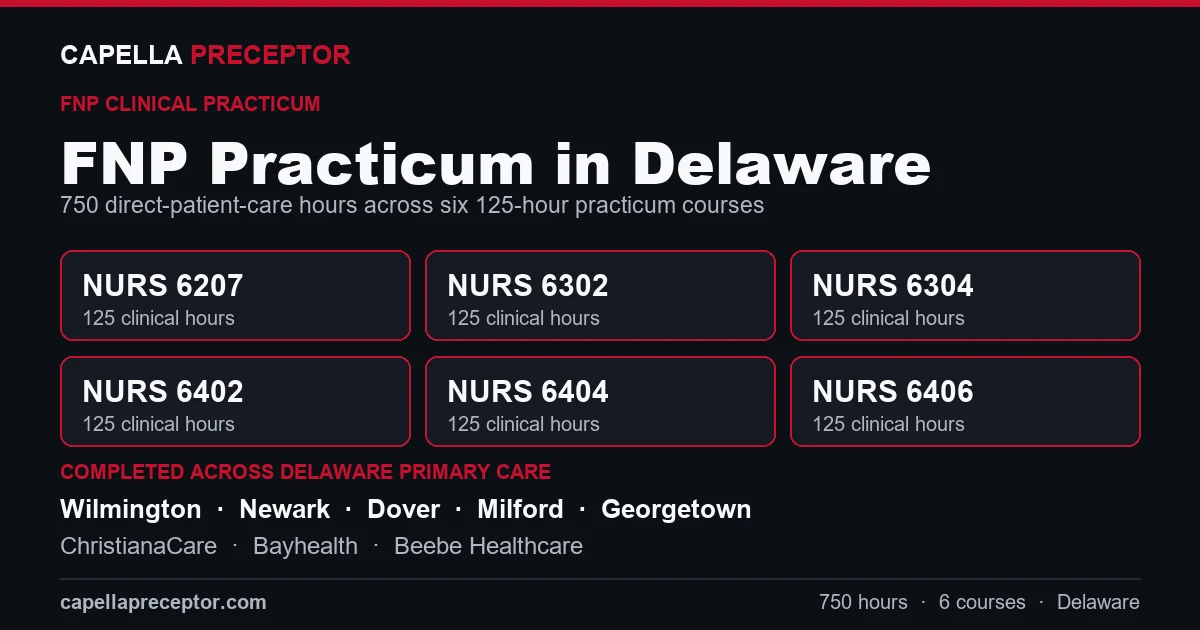
The Capella MSN Family Nurse Practitioner specialization requires a minimum of 750 practicum hours, split across six clinical courses that each carry 125 hours, completed in primary care across the lifespan (Capella, MSN-FNP courses). Capella is also explicit that "learners are responsible for finding an appropriate preceptor to oversee the practicum experience," and that practicum is done in your own local community while the coursework stays online. That is the part of the program Delaware actually shapes: the same 750-hour, six-course structure applies everywhere, but the rules for who may precept you, and where you can find primary care volume, are Delaware's. The deeper FNP breakdown lives on our Capella FNP page; this page is about doing those hours inside Delaware.
Is Delaware a full practice state for an FNP, and does that help?
Yes, Delaware is a full practice state. Under House Bill 141, signed into law on August 4, 2021, the state granted full practice authority and "removes the requirement for a collaborative agreement for licensure purposes although employers and health care organizations may still require one" (AANP, Delaware law expands access; Nurse-Led Care, Delaware full practice authority). Once you are licensed, a Delaware FNP evaluates, diagnoses, orders and interprets tests, and prescribes under the authority of the Board of Nursing rather than under a supervising physician.
For a student still in practicum, the honest answer is that full practice authority helps the climate more than the paperwork. It does not remove the need for a preceptor, an approved site, or the affiliation agreement, and it does not change your 750-hour count. What it does do is widen the pool of clinicians who can take you on, because a Delaware family or primary care nurse practitioner now runs an independent panel and can host an FNP student without a physician oversight contract sitting on top of the relationship.
Who can precept an FNP student under Delaware Board of Nursing rules?
This is where Delaware reads differently from a restricted state. The Delaware Board of Nursing rule for advanced practice education, 24 Del. Admin. Code 1900-8.0, says a clinical preceptor must "hold an active license that is not encumbered as an APRN, or a physician assistant, pharmacist, or physician" and must practice in a comparable practice focus to the program (Delaware Administrative Code, 24-1900-8.0). For an FNP track that is broad: a family or primary care nurse practitioner, not only a physician, is a fully qualified preceptor, which matters in a small state where physician slots fill fast.
The same rule sets two boundaries students miss. First, "clinical preceptors may be used to enhance faculty-directed clinical learning experiences, but not to replace them," and "faculty retain responsibility for evaluating clinical performance." Your Delaware preceptor supervises and teaches at the site, but your Capella faculty member still owns the grade and the evaluation. Second, "preceptors who supervise students in the clinical setting must be oriented to the curriculum requirements, practice course objectives, and expectations," so a willing clinician still has to be briefed on what your FNP course expects before the hours count. Those are exactly the details that stall a self-arranged placement, and the ones we handle.
Where do FNP students find primary care sites in Delaware?
Delaware is small and served by a handful of large systems, which makes the geography easy to map and the good preceptors easy to lose to whoever asks first. Your 750 FNP hours have to span adults, pediatrics, and women's health, so plan the spread against where each population actually sits.
In New Castle County, ChristianaCare anchors the Wilmington and Newark corridor with a large outpatient and family medicine footprint, and the county also holds independent family practices in Newark, Middletown, Bear, and Smyrna. In Kent County, Bayhealth runs employed primary care practices around its Dover campus and a Sussex campus in Milford, giving steady adult and women's health volume in the center of the state. Across coastal Sussex County, Beebe Healthcare serves a fast-growing, seasonal population around Lewes, Rehoboth Beach, Georgetown, and Seaford. Delaware now has a family medicine residency in each of its three counties, at ChristianaCare, Bayhealth, and Beebe, which signals where primary care teaching capacity is concentrated (Family Medicine Training in the US and Delaware, PMC).
The trade-off is real. Those same New Castle County practices field FNP placement requests from Delaware, southeastern Pennsylvania, Maryland, and New Jersey students at once, and a single rural Sussex County clinic may already host another school's student. A heavily adult primary care panel can also leave an FNP student short on pediatric or women's health hours. We place across all three counties, and where local capacity is thin we keep you on schedule with a virtual placement rather than a waitlist.
What clearance steps does an FNP placement in Delaware involve?
Once you have a Delaware preceptor and site that fit your FNP courses, the clearance sequence is the same one Capella runs nationwide, with Delaware's licensing layered on top:
- Verify the preceptor's Delaware license is active and unencumbered in a comparable focus, checked through DELPROS, the state's online verification portal.
- Submit the site and preceptor for review and approval in Capella's practicum system, CORE ELMS, with the preceptor oriented to your course objectives.
- Execute an affiliation agreement between Capella and the Delaware site before the first day of practicum.
- Clear third-party compliance through a background-check and health-records vendor such as CastleBranch; confirm the current vendor with your program.
- Log and submit hours per course in CORE ELMS, where your preceptor approves each block and your Capella faculty evaluates performance.
Because the affiliation agreement is between Capella and the site, a willing Delaware preceptor is not enough on its own. A small primary care practice that has never hosted a Capella student sometimes balks at signing, which is exactly the kind of stall we clear, because the sites we work with already know the paperwork.
Virtual or in-person for a Delaware FNP student?
Both work, and full practice authority does not change which one you pick. The choice comes down to where you live and which FNP populations your local panel can supply.
Best near Wilmington, Newark, or Dover, where a family medicine clinic can often cover adults, children, and women's health in one panel for the FNP lifespan requirement.
Best for Kent and Sussex county students or anyone whose nearest primary care site is full, with hours tracked the same way in CORE ELMS.
Many Delaware FNP students blend the two, anchoring most hours at a local family medicine site and using virtual coverage to fill a population the local panel runs thin on, such as pediatrics or reproductive health.
Delaware FNP FAQ
Can a Delaware FNP student precept under a nurse practitioner instead of a physician?
Yes. Delaware Board of Nursing rule 24 Del. Admin. Code 1900-8.0 allows a clinical preceptor to hold an active, unencumbered license as an APRN, physician assistant, pharmacist, or physician in a comparable practice focus. For an FNP student, a family or primary care nurse practitioner is a fully qualified preceptor, not only a physician.
How many FNP practicum hours does the Capella program require in Delaware?
A minimum of 750 practicum hours across six clinical courses that each carry 125 hours, in primary care across the lifespan. That count is the same in Delaware as anywhere else, and the hours are logged in Capella's CORE ELMS practicum system.
Does Delaware full practice authority change the FNP preceptor or site rules?
No. House Bill 141 removed the collaborative-agreement mandate for NP licensure, but a student in practicum still needs a qualified preceptor, an approved site, and a signed affiliation agreement between Capella and the site before any hour is logged. Capella faculty, not the preceptor, evaluate your clinical performance.
Where in Delaware can an FNP student find primary care clinical sites?
Family medicine and primary care sites cluster around ChristianaCare in New Castle County, Bayhealth in Dover and Milford in Kent County, and Beebe Healthcare across coastal Sussex County, plus independent family practices in Newark, Middletown, Smyrna, Seaford, and Georgetown. Where local capacity is full, a virtual placement keeps you on schedule.
Sources
- 24 Del. Admin. Code 1900-8.0, APRN clinical preceptor rules
- Delaware Board of Nursing, APRN license and prescriptive authority
- AANP, Delaware law expands health care access (HB 141)
- Capella University, MSN Family Nurse Practitioner courses
- Family Medicine Training in the US and Delaware (PMC)
How Capella Preceptor helps Delaware FNP students
Full practice authority makes Delaware a good place to train, but the FNP practicum still leaves the preceptor, the site, and the affiliation agreement to you, and that is where students lose weeks. We secure a preceptor who meets Capella's published FNP requirements and is licensed under the Delaware Board of Nursing in a comparable primary care focus, in Wilmington, Newark, Dover, or anywhere across Kent and Sussex counties, in person or fully virtual, with the populations your six FNP courses require, and we handle the paperwork from there.
- A verified Delaware FNP preceptor matched in 7 days, with no payment until you are matched
- License verification, CORE ELMS forms, and the affiliation agreement handled for the site
- All 750 hours across the lifespan logged and submitted on schedule, in person or virtual
Get an FNP preceptor in Delaware
Free 15-minute consult. No payment until matched. We map your entire Delaware FNP practicum plan.
Get my free consult →