Home / Hawaii
StateCapella Practicum and Preceptors in Hawaii
Hawaii is a full practice authority state, so a Hawaii-licensed nurse practitioner can diagnose, treat, and prescribe without a mandated collaborating physician. That makes the islands a strong place to do a Capella practicum, with one catch: Capella does not assign you a preceptor or a site. You secure both. This page explains how that works in Hawaii, and how we secure the placement for you.
Last updated: June 21, 2026 · Reviewed by the Capella Preceptor placement team
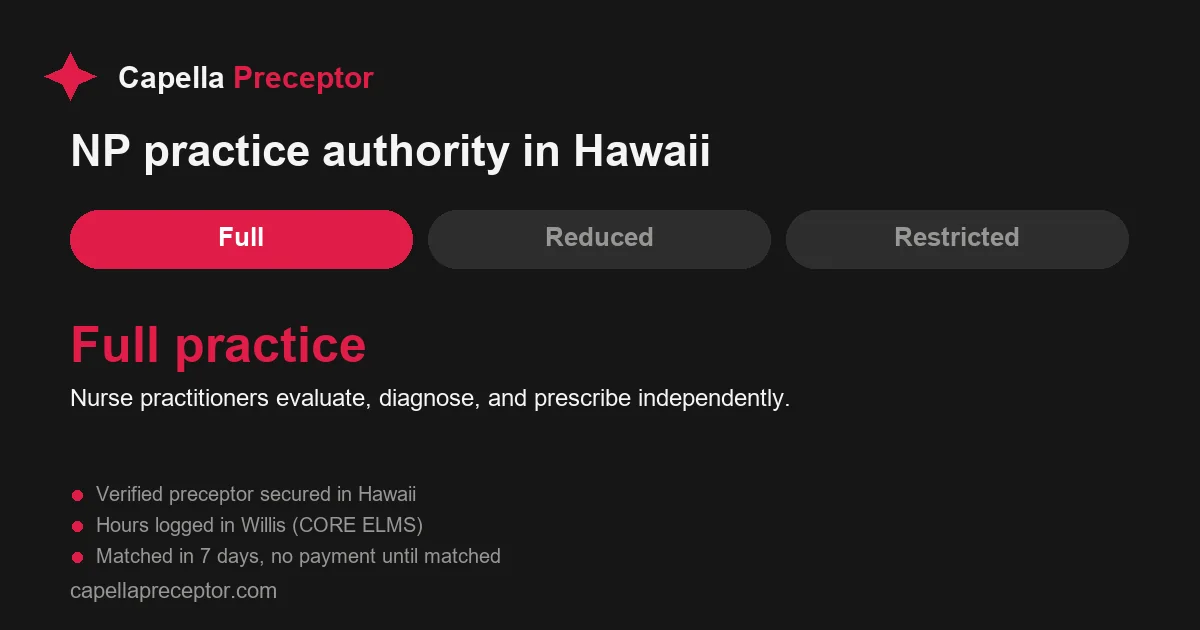
NP practice authority in Hawaii
The American Association of Nurse Practitioners places Hawaii in its Full Practice category, the most independent of the three classifications it uses (AANP, Hawaii state practice environment; AANP, State Practice Environment). In practice, full authority means a licensed Hawaii NP can assess, order and interpret tests, diagnose, and initiate treatment, and can hold prescriptive authority, all under the licensure of the state board rather than under a contract with a supervising physician.
For you as a Capella student, the distinction matters in a specific way. A full-authority NP can serve as your preceptor in their own right without first arranging physician oversight, which widens the pool of clinicians who can legally precept you on Oahu, Maui, Hawaii Island, and Kauai. Note that your status while precepting is still that of a student: you practice under your preceptor's supervision and within Capella's practicum rules, not independently, even though Hawaii would let a fully licensed NP do so.
The Hawaii Board of Nursing
Nursing in Hawaii is regulated by the Hawaii Board of Nursing, which sits within the Professional and Vocational Licensing (PVL) Division of the state Department of Commerce and Consumer Affairs (Hawaii DCCA, Board of Nursing). The board recognizes the Advanced Practice Registered Nurse credential, the category your NP preceptor must hold, and licenses are managed and renewed online through the state MyPVL portal.
A few points are worth confirming before a preceptor agrees to take you on:
- National certification is required. The board recognizes the APRN only with active certification from an approved body such as AANP or ANCC, so any preceptor you propose should be a board-certified NP.
- No collaborative agreement is mandated. Hawaii does not require a collaborating-physician contract for a licensed APRN, which keeps NP-led clinics open to you as placement sites (NursingLicensure.org, Hawaii APRN).
- Prescriptive authority is separate. An APRN-Rx designation is applied for on its own and requires advanced pharmacology coursework; relevant if your placement involves prescribing, but it concerns the preceptor's licensure, not yours.
You can confirm any Hawaii license yourself through the MyPVL portal, and the board also participates in Nursys, the national license-verification database. We verify every preceptor's Hawaii license and certification before we present them to you, but the board is the authority on its own current rules, so check the DCCA page for anything specific to your situation.
Securing a preceptor and clinical site in Hawaii
Capella states that the learner is responsible for finding an appropriate preceptor, and recommends completing practicum in your own local community (Capella, MSN-NP program). On islands where clinics are concentrated and clinicians are often already at capacity, that responsibility is real work. We do it for you and place across the state, including these areas:
Honolulu, Pearl City, Kapolei, and Kailua, the densest concentration of family medicine, primary care, and behavioral health sites in the state.
Hilo and Kailua-Kona, including community and rural clinics serving a wide catchment.
Kahului and Wailuku outpatient and primary care practices.
Lihue and surrounding clinics, where a virtual option often fills any local gap.
Because Hawaii grants full practice authority, NP-owned and NP-staffed clinics are common, which broadens where you can land. We match the site to your program: primary care and family medicine for FNP, behavioral health for PMHNP, adult and older-adult primary care for AGPCNP, and capstone or project settings for BSN and DNP students.
Practicum requirements, done in Hawaii
Once you have identified a Hawaii preceptor and site, the placement runs through Capella's clearance workflow before a single hour counts. The steps are the same wherever you live; here is how they land on the islands:
The number of hours you owe depends on your track. The RN-to-BSN capstone practicum is modest, the MSN-FNP runs 750 hours across six 125-hour courses, other NP tracks are similar, and the DNP adds project hours. The full breakdown by program lives on our hours page and the specialty pages such as FNP, PMHNP, and AGPCNP.
Virtual vs in-person practicum for Hawaii students
Geography shapes this choice more in Hawaii than in most states. Inter-island travel is expensive and a neighbor-island student may have only a handful of clinics within reach. Two paths work:
Best where you live near a metro such as Honolulu or Kahului with enough sites to match your population mix. You see patients on the ground under a local preceptor.
A fit for Kauai, rural Hawaii Island, and any student short on local options. Hours are tracked in CORE ELMS the same way, and the placement stays Capella-compliant.
Many island students mix the two, doing in-person hours where a site exists and using virtual to cover a population their local clinic cannot. We build the plan around what is actually reachable from your island.
Hawaii FAQ
Is Hawaii a full practice authority state for nurse practitioners?
Yes. AANP classifies Hawaii as a Full Practice state, so a licensed NP can evaluate, diagnose, and prescribe without a mandated collaborating physician. As a student you still practice under your preceptor's supervision.
Does the Hawaii Board of Nursing require a collaborative agreement for NPs?
No. Hawaii does not require a collaborative practice agreement or physician supervision for a licensed APRN. Prescriptive authority (APRN-Rx) is applied for separately and requires advanced pharmacology coursework.
Where in Hawaii can Capella Preceptor place me?
Across the islands, including Honolulu and greater Oahu, Hilo and Kailua-Kona on Hawaii Island, Kahului and Wailuku on Maui, and Lihue on Kauai. Where local sites are limited, our virtual option keeps you on schedule.
Sources
- AANP, Hawaii state practice environment
- AANP, State Practice Environment (national map)
- Hawaii DCCA, Board of Nursing (PVL Division)
- NursingLicensure.org, Hawaii APRN requirements
- Capella University, MSN-NP program
How Capella Preceptor helps in Hawaii
You know the landscape now: full practice authority, a board that recognizes certified NPs without a collaborative-agreement mandate, and a placement Capella leaves entirely to you. That last part is where island students lose months. We secure a verified, Hawaii-licensed, Capella-compliant preceptor whose setting fits your program, prepare every CORE ELMS form and the affiliation agreement, and keep your hours logged and submitted on schedule.
- Verified Hawaii preceptor matched in 7 days, no payment until matched
- In person across Oahu, Maui, Hawaii Island, and Kauai, or fully virtual
- Every CORE ELMS form, affiliation agreement, and CastleBranch step handled
On the family nurse practitioner track? See Capella FNP preceptor requirements in Hawaii for FNP-specific practicum hours, Hawaii board rules, and local clinical settings.
Get a Capella preceptor in Hawaii
Free 15-minute consult. No payment until matched. We map your entire practicum plan.
Get my free consult →