Home / Wisconsin
StateCapella Preceptor and Practicum Placement in Wisconsin
Wisconsin is a reduced practice state for nurse practitioners today, with a collaborative agreement still required, and that changes on September 1, 2026 when the APRN Modernization Act opens an independent practice pathway. Whichever side of that date your practicum falls on, Capella still leaves it to you to find your own preceptor and site. We secure a verified one in Wisconsin within 7 days, with no payment until you are matched.
Last updated: June 21, 2026 · Reviewed by the Capella Preceptor placement team
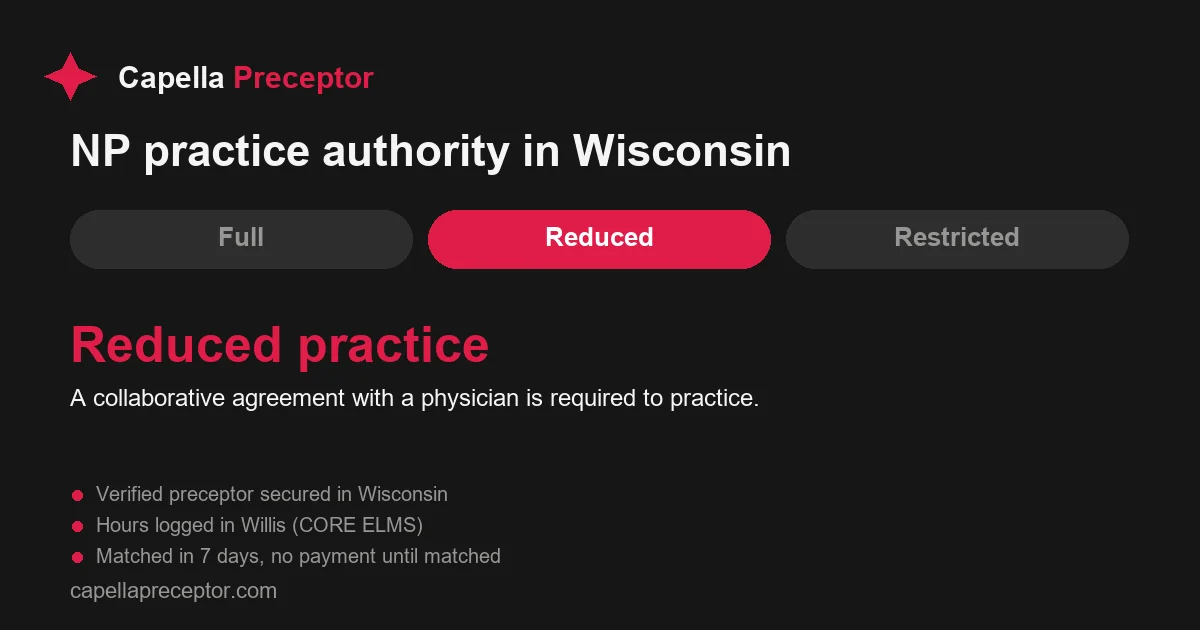
NP practice authority in Wisconsin
The American Association of Nurse Practitioners classifies Wisconsin as a reduced practice state (AANP, State Practice Environment). In plain terms, a nurse practitioner in Wisconsin can do much of the work independently but state law limits at least one element of practice: an advanced practice nurse prescriber must keep a documented collaborative relationship with a physician or dentist rather than practicing entirely on their own.
That picture is about to shift. Wisconsin enacted the APRN Modernization Act (2025 Wisconsin Act 17), which takes effect September 1, 2026 and, for the first time, lets a qualifying advanced practice registered nurse practice without a collaborative agreement after meeting an experience threshold (the law sets it at 3,840 clinical hours and at least 24 months in the role) (Hall Render, APRN Modernization Act effective Sept 1). The credential title also moves from Advanced Practice Nurse Prescriber (APNP) to Advanced Practice Registered Nurse (APRN).
For a Capella student lining up a practicum, the takeaway is practical, not theoretical. Whether your hours fall before or after September 1, your preceptor relationship is what makes the placement valid, and a preceptor who already supervises within Wisconsin's collaborative framework understands exactly what your evaluations and hour logs need to show. You are training, not yet practicing independently, so the supervised model applies to your rotation regardless of how the new law reshapes independent practice for licensed APRNs.
The Wisconsin Board of Nursing
Advanced practice nurses in Wisconsin are regulated by the Wisconsin Board of Nursing, which sits inside the Department of Safety and Professional Services (DSPS) (Wisconsin DSPS, Advanced Practice Nurse Prescriber). The board recognizes nurse practitioners through the APNP credential (the APRN credential under the new act), which requires national certification by a board-approved certifying body, a graduate degree in nursing or a related field, and at least 45 contact hours of clinical pharmacology within five years of application.
You can confirm any preceptor's standing yourself through the DSPS credential lookup (Wisconsin DSPS, Credential Lookup). We verify every preceptor's active Wisconsin license and national certification before we match you, so the person signing your hours holds the credentials Capella site approval expects.
Finding a preceptor and clinical site in Wisconsin
Here is the part Capella students often learn late: the university does not assign you a preceptor or a clinical site. Capella expects the student to secure both, in their own community, and complete the coursework online. That single requirement is where most practicum delays start, because cold-calling clinics in Milwaukee or Madison while a course clock runs is a slow way to find a willing, qualified preceptor.
We place across Wisconsin's major population centers and the smaller cities around them. In practice that means:
Milwaukee, Waukesha, Kenosha, and Racine, the state's densest cluster of primary care and specialty clinics.
Madison, Janesville, and Beloit, strong for academic-affiliated and outpatient sites.
Green Bay, Appleton, Oshkosh, and Fond du Lac.
Eau Claire and La Crosse, including border-region health systems.
Wausau, Stevens Point, and surrounding counties where local options can be thin.
Where in-person matches are scarce, the virtual option keeps you on schedule.
What has to clear before you log a Wisconsin hour
Identifying a preceptor is step one. Capella still has to approve the site and the preceptor, and there is paperwork to clear before any hour counts. All of it runs through Capella's practicum management system, which we track in our workflow as CORE ELMS. The number of hours you owe depends on your program, so see the hours breakdown and your specialty page for the exact totals rather than guessing from a general figure.
- Submit the site and preceptor in CORE ELMS for Capella review and approval.
- Get the affiliation agreement signed between Capella and the Wisconsin site before practicum begins.
- Clear third-party compliance (background check and health records through a vendor such as CastleBranch; confirm the current one with your program).
- Log hours in CORE ELMS, where your preceptor approves what you record.
An affiliation agreement can take weeks if a clinic has never worked with Capella, which is why we line up the agreement and the compliance file in parallel rather than waiting for one before starting the other.
In-person or virtual practicum for Wisconsin students
Wisconsin spreads a lot of its clinics across a wide map, so the right format depends on where you live. Students in the Milwaukee or Madison corridors usually have enough nearby sites for an in-person match. Students in the Northwoods, the Driftless region, or other rural counties often face a thinner field, and that is exactly where a virtual placement keeps the calendar intact.
A Wisconsin-licensed preceptor at a local clinic, best when you want hands-on rotations and have sites within reach in your metro.
Telehealth-based hours under a verified preceptor, hours tracked in CORE ELMS, useful for rural counties or competitive specialties.
Either way the compliance and logging are identical, and we handle both. See virtual preceptorship and in-person placement for how each works.
Wisconsin FAQ
Is Wisconsin a full or reduced practice state for nurse practitioners?
As of June 2026, AANP classifies Wisconsin as reduced practice, so an advanced practice nurse prescriber must keep a collaborative relationship with a physician or dentist. The APRN Modernization Act takes effect September 1, 2026 and creates an independent practice pathway for qualifying APRNs.
Does Capella assign a preceptor to Wisconsin students?
No. Capella requires you to secure your own preceptor and clinical site in your local community. We do that for you, matching a verified Wisconsin preceptor within 7 days, with no payment until you are matched.
Which Wisconsin cities do you place students in?
Milwaukee, Madison, Green Bay, Kenosha, Racine, Appleton, Waukesha, Eau Claire, Oshkosh, and La Crosse, among others, plus a fully virtual option for rural counties.
Sources
- AANP, State Practice Environment (Wisconsin: reduced practice)
- Wisconsin DSPS, Advanced Practice Nurse Prescriber (Board of Nursing)
- Wisconsin DSPS, Credential Lookup (license verification)
- Hall Render, Wisconsin APRN Modernization Act effective September 1, 2026
How Capella Preceptor helps in Wisconsin
You now know the lay of the land: Wisconsin is reduced practice with independent APRN practice arriving September 1, 2026, the Board of Nursing sets the credential rules, and Capella leaves the preceptor and site to you. That last piece is where months disappear. We secure a verified, Capella-compliant preceptor in your part of Wisconsin, prepare every CORE ELMS form and affiliation agreement, and keep your hours logged and submitted on schedule.
- Verified Wisconsin preceptor matched in 7 days, in person or virtual
- Every CORE ELMS form, affiliation agreement, and compliance step handled
- No payment until you are matched, with your exact quote in a free consult
On the family nurse practitioner track? See Capella FNP preceptor requirements in Wisconsin for FNP-specific practicum hours, Wisconsin board rules, and local clinical settings.
Get a Capella preceptor in Wisconsin
Free 15-minute consult. No payment until matched. We map your entire practicum plan.
Get my free consult →