Home / Oklahoma
StateCapella practicum and preceptors in Oklahoma
Oklahoma is a restricted practice authority state, so a nurse practitioner here works with a supervising physician on file with the Oklahoma Board of Nursing. That shapes how a Capella student lines up a preceptor, and it is exactly the part we take off your plate. Here is how practice authority, the board, and placement work in Oklahoma, then how we secure your site.
Last updated: June 21, 2026 · Reviewed by the Capella Preceptor placement team
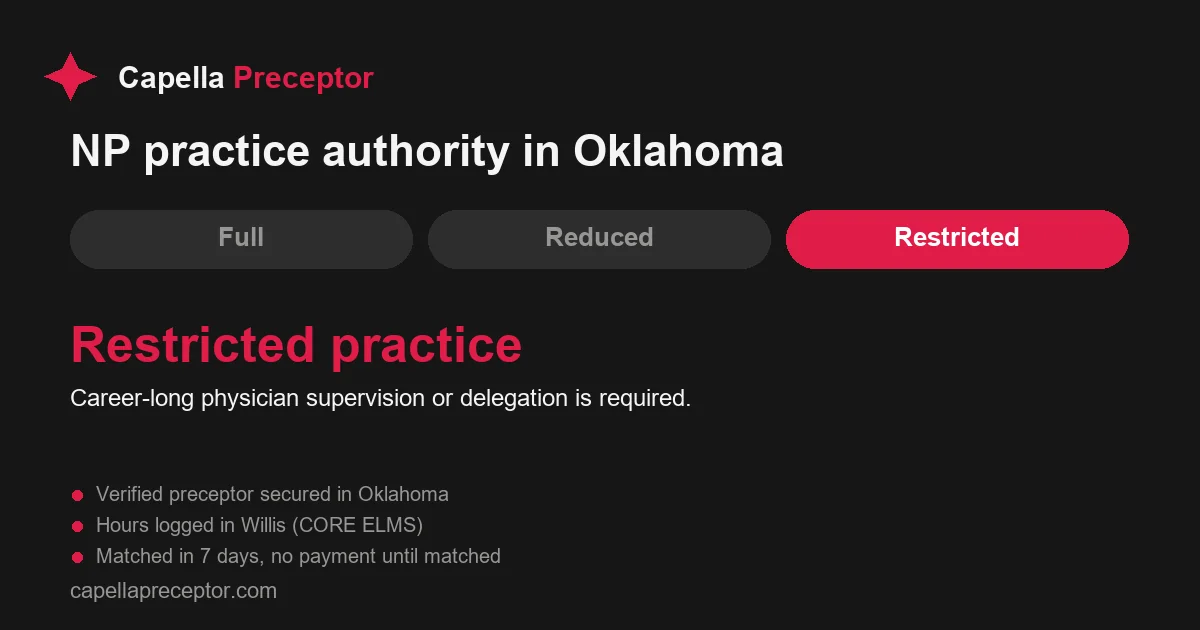
NP practice authority in Oklahoma
Oklahoma is one of the states the American Association of Nurse Practitioners places in the restricted category, the most limited of its three practice tiers (AANP, Oklahoma). In plain terms, a nurse practitioner in Oklahoma does not practice fully on their own authority. State law has long required a written agreement with a supervising physician for prescriptive authority, and changes to that supervising physician must be reported to the board within 30 days (Oklahoma Board of Nursing, Practice).
There is movement here worth knowing. House Bill 2298, effective November 1, 2025, created a route to independent prescriptive authority for APRNs who complete a large block of supervised clinical hours before they can drop the agreement (Oklahoma Board of Nursing, HB 2298 FAQ). For you as a Capella practicum student, the practical takeaway is the same either way: most preceptors you will train under in Oklahoma are practicing in a physician-collaborative model, and that is the environment your hours are earned in.
Why this matters for placement. In a restricted state, some clinics route a student request through both the NP and the supervising physician before saying yes. That extra step is a common reason Oklahoma students stall when cold-calling on their own. Knowing it up front lets you target practices that already precept.
The Oklahoma Board of Nursing
Licensing and advanced-practice recognition in the state run through the Oklahoma Board of Nursing (OBN), which administers the Oklahoma Nursing Practice Act. Oklahoma has recognized the Certified Nurse Practitioner role since 1980, alongside the Clinical Nurse Specialist, Certified Nurse-Midwife, and CRNA roles (Oklahoma Board of Nursing, Practice). The board sets the rules your preceptor practices under, and it is also where you confirm that a preceptor's credential is real and current.
Two board facts are useful when you vet a site. First, an Oklahoma NP with prescriptive authority maintains a supervising-physician agreement unless and until independent prescriptive authority is granted, so a compliant preceptor will have that paperwork in order. Second, license status is public: you can verify an Oklahoma APRN or RN through Nursys, and the OBN also publishes a written verification request form (Oklahoma Board of Nursing, Forms; Nursys license verification).
Finding a preceptor and clinical site in Oklahoma
Capella does not assign you a preceptor or a clinical site. The university is explicit that learners secure their own placement in their local community, and it provides resources but not the match itself. In a restricted state that responsibility is heavier, because the pool of practices willing to onboard a student is narrower and the yes often depends on a physician as well as the NP. That is the gap we fill.
We place Capella students throughout Oklahoma's population centers and beyond. The largest concentration of primary care, family medicine, behavioral health, and women's health sites sits in the two metros, but we also reach the smaller cities and rural counties where students often live.
Oklahoma City, Edmond, Norman, Moore, and Midwest City clinics.
Tulsa, Broken Arrow, Owasso, and Bixby practices.
Lawton, Stillwater, Enid, Muskogee, and rural Oklahoma counties.
For specialty placement we match the preceptor to your Capella track, whether that is a family medicine panel for the FNP, a behavioral health practice for the PMHNP, or an adult-gerontology clinic for the AGPCNP. The hour totals differ by program, from the RN-to-BSN capstone practicum up to the 750-hour MSN-FNP sequence and DNP project hours; the full breakdown lives on our hours page and the individual specialty pages.
Clearing practicum requirements in Oklahoma
Once a preceptor and site are identified, the Capella clearance steps are the same in Oklahoma as anywhere, and none of them can be skipped before you log an hour. The wrinkle in a restricted state is that the affiliation agreement sometimes routes through a clinic's medical group as well as the NP, which can add days. We start that clock early so it does not become your bottleneck.
- Propose the Oklahoma site and preceptor in Capella's practicum system, tracked in our workflow as CORE ELMS, for review and approval.
- Execute the affiliation agreement between Capella and the clinical site before practicum begins.
- Clear third-party compliance through a background-check and health-records vendor such as CastleBranch; confirm the current vendor with your program.
- Log and submit hours in CORE ELMS, where your Oklahoma preceptor approves what you record.
Virtual or in-person practicum for Oklahoma students
Oklahoma is large and unevenly served, so the right format depends on where you live. If you are in or near Oklahoma City or Tulsa, an in-person placement is usually straightforward and we match you locally. If you are in the Panhandle, southeastern Oklahoma, or another county where qualified sites are sparse, our virtual preceptorship keeps you moving without a long drive, with hours tracked the same way in CORE ELMS.
Best when you are inside a metro or a city with several primary care and specialty clinics. You build hands-on hours with a local preceptor.
Best for rural Oklahoma or when local sites will not take students fast enough. Telehealth-based hours that still meet Capella site approval.
Oklahoma FAQ
Is Oklahoma a full practice authority state for nurse practitioners?
No. The AANP classifies Oklahoma as a restricted practice state. An NP with prescriptive authority keeps a supervising-physician agreement on file with the Oklahoma Board of Nursing unless granted independent prescriptive authority under HB 2298.
Does the restricted environment make it harder to find a preceptor in Oklahoma?
It can. Because Oklahoma NPs practice under physician collaboration, some practices are slower to take on a student. We carry that by sourcing preceptors who already mentor and handling the CORE ELMS paperwork for you.
Where in Oklahoma do you place students?
Across the Oklahoma City and Tulsa metros, plus Norman, Edmond, Broken Arrow, Lawton, Stillwater, Enid, and rural counties. Where a local site is thin, our virtual option keeps you on schedule.
How do I verify an Oklahoma preceptor license?
Oklahoma APRN and RN licenses can be verified through Nursys at nursys.com, and the Oklahoma Board of Nursing also publishes a written verification request form. We confirm every preceptor credential before you start.
Sources
- AANP, Oklahoma state practice environment (restricted)
- Oklahoma Board of Nursing, Practice and Advanced Practice Information
- Oklahoma Board of Nursing, HB 2298 Independent Prescriptive Authority FAQ
- Oklahoma Board of Nursing, Forms and license verification
- Nursys, nurse license verification
How Capella Preceptor helps in Oklahoma
You now know the lay of the land: a restricted state, a physician-collaborative preceptor model, an OBN credential you can verify, and a placement Capella leaves to you. We close that last gap. We secure a verified, Capella-compliant Oklahoma preceptor whose practice fits your track, prepare every CORE ELMS form and the affiliation agreement, and keep your hours logged and submitted on schedule.
- Verified Oklahoma preceptor matched in 7 days, in person or virtual
- Every CORE ELMS form and affiliation agreement handled
- No payment until you are matched
On the family nurse practitioner track? See Capella FNP preceptor requirements in Oklahoma for FNP-specific practicum hours, Oklahoma board rules, and local clinical settings.
Get a Capella preceptor in Oklahoma
Free 15-minute consult. No payment until matched. We map your entire Oklahoma practicum plan.
Get my free consult →