Capella FNP preceptor in Oklahoma
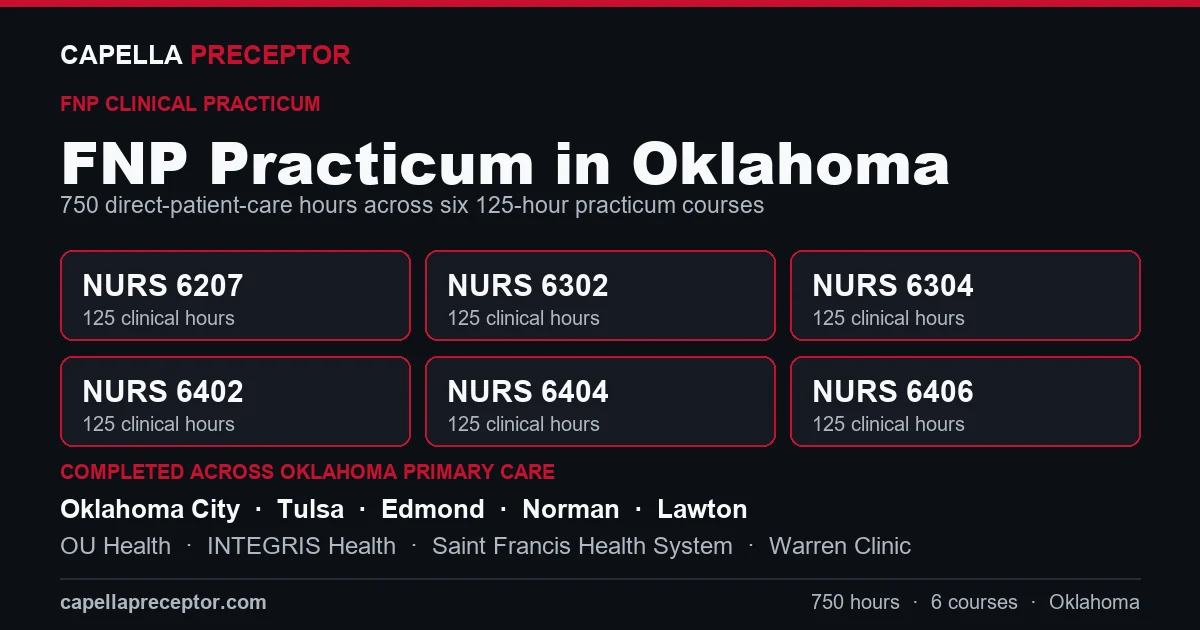
The Capella MSN-FNP needs 750 practicum hours across six clinical courses, and you secure the preceptor yourself. In Oklahoma, a restricted practice state, that preceptor works under a supervising-physician agreement filed with the Oklahoma Board of Nursing, which changes who can say yes and how fast. Here is exactly how the FNP requirement and Oklahoma's board rules meet, then how we secure your site.
Last updated: June 28, 2026 · Reviewed by the Capella Preceptor placement team
What does a Capella FNP preceptor in Oklahoma have to satisfy?
Two things at once. First, the Capella requirement: the MSN Family Nurse Practitioner specialization is a minimum of 750 practicum hours spread across six clinical courses that each carry 125 hours, in primary care across the lifespan (Capella, MSN-FNP courses). Second, the Oklahoma requirement: your preceptor must hold a current, unencumbered Oklahoma license, as an APRN or as a physician, and practice in a setting that matches the FNP population you are logging. Those are independent gates, and a site that clears one but not the other will not approve in CORE ELMS.
The wrinkle that is specific to Oklahoma is the third gate behind the first two. Because Oklahoma is a restricted practice state in the American Association of Nurse Practitioners framework, a nurse practitioner here does not practice on their own authority, so the clinic that hosts you usually has a supervising physician in the picture as well (AANP, Oklahoma). That is why finding an FNP preceptor in Oklahoma takes a different play than it does in a full-practice state next door.
How does Oklahoma's restricted practice authority affect FNP precepting?
In plain terms, an Oklahoma CNP with prescriptive authority keeps an Agreement for Physician Supervising Advanced Practice Prescriptive Authority on file with the Oklahoma Board of Nursing, and a change in that supervising physician must be reported to the board within 30 days (Oklahoma Board of Nursing, Practice). Oklahoma has recognized the Certified Nurse Practitioner role since 1980, so the regulatory structure is mature, but it is also genuinely supervisory rather than collaborative-in-name-only.
For you as an FNP student, none of that disqualifies your preceptor. A supervised Oklahoma NP can absolutely precept, and so can a family-medicine physician. What it changes is the approval path. Some Oklahoma clinics route a student request through the NP and the supervising physician before anyone signs, and the practice's exposure under that supervision agreement makes a few of them cautious about adding a learner. That extra signature is the single most common reason Oklahoma FNP students stall when they cold-call on their own.
One Oklahoma-specific limit to know. Even with prescriptive authority, an Oklahoma CNP prescribes from an Exclusionary Formulary and cannot prescribe Schedule II controlled substances (Oklahoma Board of Nursing). It does not block your hours, but it is part of the real prescribing scope you will see modeled at the bedside, so do not be surprised when a Schedule II is handed to the supervising physician.
Does HB 2298 change finding an FNP preceptor in Oklahoma?
Worth knowing, but not for your practicum. House Bill 2298 took effect on November 1, 2025, with the Oklahoma Board of Nursing accepting applications beginning November 3, and it created a route to independent prescriptive authority for eligible APRNs (CNP, CNS, and CNM). The catch is the threshold: an APRN must complete 6,240 supervised clinical practice hours with prescriptive authority before they can apply, and until the board grants it they keep practicing under a physician supervision agreement (Oklahoma Board of Nursing, HB 2298). The law also adds a malpractice-insurance requirement and does not expand the drug list, so the Schedule II restriction still stands.
The practical takeaway for an FNP practicum student is simple: 6,240 hours is several years of practice, so the large majority of preceptors available to you in Oklahoma today are still in the supervised, physician-collaborative model. Your 750 FNP hours will be earned in that environment, which is exactly the environment Capella's on-site preceptor approval is built around.
Which Oklahoma clinical settings fit the FNP populations?
The FNP track is primary care across the lifespan, so your 750 hours must span adult-gerontology, pediatrics, and reproductive or women's health rather than one age group. Oklahoma has the outpatient settings to cover all three, but they are concentrated in the two metros, which is why population coverage and geography have to be planned together. Real systems where these rotations exist include the following.
OU Health and INTEGRIS Health run family-care clinics across Oklahoma City, Edmond, and Norman that see adults, children, and women's health in one panel, the closest fit to FNP scope.
Saint Francis Health System and its Warren Clinic group carry hundreds of adult and pediatric providers across Tulsa, Owasso, Jenks, Muskogee, and beyond.
Where a family panel is light on a population, a pediatric clinic or an OB/GYN or women's health practice fills the pediatric primary care and reproductive health courses.
Federally Qualified Health Centers such as the Lawton Community Health Center deliver adult, pediatric, and OB/GYN care, a strong lifespan fit outside the metros.
A single Oklahoma family-medicine clinic can sometimes cover most of the lifespan, but many FNP students rotate across two or three sites to be sure they log pediatrics and women's health and do not arrive at the final Transition to Practice course short on a population (OU Health, family medicine; Saint Francis Health System, primary care).
What is the realistic way to find an FNP preceptor in Oklahoma?
Start from the honest baseline: Capella does not assign you a preceptor or a site. The university states that learners are responsible for finding an appropriate preceptor to oversee the practicum, completed in the student's local community, with a support team that helps connect learners to opportunities but does not make the match (Capella, MSN-NP program). In Oklahoma, with roughly 1,970 nurse practitioners licensed statewide and a supervision step on top, that search is heavier than in a high-NP, full-practice state. A method that works here:
1. Map all six FNP courses to populations -> 750 hours, adult + peds + women's health
2. Target Oklahoma practices that already precept, not random cold outreach
3. Ask whether the NP needs a supervising physician sign-off, and start it early
4. Confirm the preceptor's Oklahoma APRN or physician license is active and unencumbered
5. Submit the site and preceptor in CORE ELMS for Capella approval
6. Get the Capella-site affiliation agreement signed before day one
7. Clear the background-check and health-records requirements
8. Log hours per course in CORE ELMS for preceptor approval before each course closes
The step Oklahoma students underestimate is step 3. In a restricted state the supervising-physician sign-off can add days to weeks, so a placement that looks set can sit waiting on a signature while a 10-week course clock runs. Starting that clock early is the difference between finishing the FNP sequence on time and scrambling for a second site mid-program. We carry that whole load: see our FNP placement page for the full course-by-course breakdown and our Oklahoma page for board detail across every Capella nursing track.
How do you verify an Oklahoma FNP preceptor and clear CORE ELMS?
License status is public, which protects you. You can verify an Oklahoma APRN or RN through Nursys, and the Oklahoma Board of Nursing also offers a written verification request (Nursys license verification; Oklahoma Board of Nursing, Forms). Once the preceptor and site check out, the Capella clearance steps are the same in Oklahoma as anywhere, and none can be skipped before you log an hour.
- Confirm the Oklahoma credential is a current, unencumbered APRN or physician license that matches your FNP population.
- Propose the Oklahoma site and preceptor in Capella's practicum system, tracked in our workflow as CORE ELMS, for review and approval.
- Execute the affiliation agreement between Capella and the Oklahoma clinical site before practicum begins.
- Clear third-party compliance through a background-check and health-records vendor such as CastleBranch; confirm the current vendor with your program.
- Log and submit hours in CORE ELMS, where your Oklahoma preceptor approves each FNP course's hours before it closes.
In-person or virtual FNP practicum for Oklahoma students
Oklahoma is large and unevenly served, so format depends on where you live. Inside the Oklahoma City or Tulsa metros, a local in-person family or primary care placement is usually straightforward, and you build hands-on FNP hours across the lifespan with a nearby preceptor. In the Panhandle, southeastern counties, or anywhere qualified sites are sparse, our virtual preceptorship keeps your FNP sequence moving without a long drive, with hours tracked the same way in CORE ELMS.
Best inside a metro with several family, pediatric, and women's health clinics so one or two sites cover the full FNP lifespan.
Best for rural Oklahoma or when local sites cannot take a student fast enough. Telehealth-based hours that still meet Capella site approval.
Oklahoma FNP preceptor FAQ
Can an FNP precept Capella students in Oklahoma if the state is restricted practice?
Yes. Oklahoma is a restricted practice state, so an NP keeps a supervising-physician agreement on file with the Oklahoma Board of Nursing, but that does not stop an FNP from precepting. A qualified Oklahoma CNP or a physician can serve as your Capella practicum preceptor. The supervised relationship simply means the clinic sometimes routes a student request through both the NP and the supervising physician.
How many FNP practicum hours do I need at Capella, and where do Oklahoma hours count?
A minimum of 750 practicum hours across six 125-hour clinical courses spanning adult-gerontology, pediatric, and reproductive or women's health. In Oklahoma those hours are earned in outpatient primary care under a preceptor whose Oklahoma APRN or physician license is active, then logged in CORE ELMS for preceptor approval.
Does HB 2298 change finding an FNP preceptor in Oklahoma?
Not for your practicum. HB 2298, effective November 1, 2025, lets an Oklahoma APRN apply for independent prescriptive authority after 6,240 supervised clinical practice hours, but until that is granted the NP still practices under a physician supervision agreement. Most preceptors you train under in Oklahoma are still in a physician-collaborative model, and your FNP hours are earned there.
Where in Oklahoma do you place Capella FNP students?
Across the Oklahoma City and Tulsa metros and beyond: family medicine and primary care in Oklahoma City, Edmond, Norman, Tulsa, Broken Arrow, Owasso, Lawton, Enid, Stillwater, and rural counties. Where local family, pediatric, or women's health sites are thin, our virtual option keeps your FNP sequence on schedule.
How do I verify an Oklahoma FNP preceptor's license?
Oklahoma APRN and RN licenses can be verified through Nursys at nursys.com, and the Oklahoma Board of Nursing also offers a written verification request. We confirm every preceptor credential, including a current and unencumbered Oklahoma APRN or physician license, before your FNP practicum starts.
Sources
- Capella University, MSN Family Nurse Practitioner courses (750 hours, six practicum courses)
- Capella University, MSN-NP program (learner secures the preceptor)
- AANP, Oklahoma state practice environment (restricted)
- Oklahoma Board of Nursing, Practice and Advanced Practice Information
- Oklahoma Board of Nursing, HB 2298 Independent Prescriptive Authority
- Oklahoma Board of Nursing, Forms and license verification
- Nursys, nurse license verification
How Capella Preceptor helps FNP students in Oklahoma
You now know the terrain: 750 FNP hours across six courses, a restricted state where the preceptor works under a supervising-physician agreement, an OBN credential you can verify, and a placement Capella leaves to you. We close that last gap. We secure a verified preceptor who meets Capella's published requirements and whose Oklahoma panel covers the FNP populations your courses need, start the supervising-physician sign-off early so it does not become your bottleneck, prepare every CORE ELMS form and the affiliation agreement, and keep your hours logged and submitted on schedule. See our pricing for what placement costs.
- Verified Oklahoma FNP preceptor matched in 7 days, in person or virtual
- Panel matched to all six FNP courses, adult, pediatric, and women's health
- Every CORE ELMS form and affiliation agreement handled, no payment until matched
Get a Capella FNP preceptor in Oklahoma
Free 15-minute consult. No payment until matched. We map your entire Oklahoma FNP practicum plan.
Get my free consult →