Home / Alabama
StateCapella Preceptor and Placement in Alabama
Alabama is a reduced practice state for nurse practitioners, so the practice rules here lean on physician collaboration, and Capella still leaves it to you to find your own preceptor. This page explains what that means for a Capella student lining up a practicum in Alabama, then shows how we secure the placement for you.
Last updated: June 21, 2026 · Reviewed by the Capella Preceptor placement team
NP practice authority in Alabama
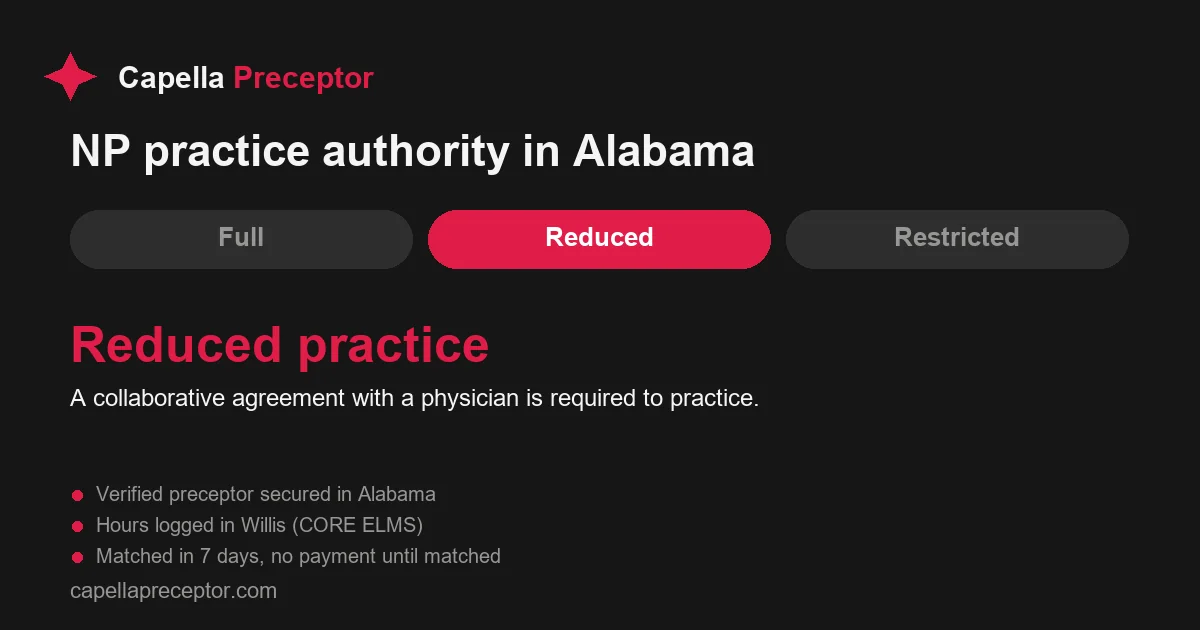
The American Association of Nurse Practitioners places Alabama in the reduced practice category (AANP, Alabama; AANP, State Practice Environment). Reduced practice means state law cuts into at least one element of independent nurse practitioner practice, and in Alabama that element is autonomy: a nurse practitioner, called a Certified Registered Nurse Practitioner (CRNP) here, must hold a collaborative practice agreement with a physician to deliver patient care (Ala. Admin. Code r. 610-X-5-.09).
For a working CRNP that collaboration is career-long, not a starter requirement that expires. Early-career CRNPs face tighter physician-presence rules than experienced ones, but the agreement itself never goes away. That is the practical difference between Alabama and a full practice state next door like its northern neighbor.
What this means for you as a student. The collaborative agreement governs licensed CRNPs in practice, not students in a practicum. You complete Capella hours under an approved preceptor, and the placement is governed by Capella's site and preceptor approval rather than by any agreement of your own. Knowing the rule still matters, because the preceptors you will work under operate inside it, and many Alabama physician practices already host a collaborating CRNP, which is exactly the kind of site that makes a good clinical placement.
The Alabama Board of Nursing and license verification
Advanced practice nurses in the state are recognized and regulated by the Alabama Board of Nursing (ABN), which approves CRNP certification in the population focus that matches the nurse's education and national certification (Alabama Board of Nursing, CRNP requirements). Collaborative practice is approved jointly with the Alabama Board of Medical Examiners, which is why a CRNP submits a standard protocol and quality assurance plan for each collaboration (Alabama Board of Medical Examiners, Collaboration).
You can confirm any preceptor's standing yourself. The ABN runs a free License Lookup that returns primary source verification of license status, expiration, and disciplinary history, with no account required. We verify every preceptor we propose against the board before you ever meet them, but a student should know the tool exists and how to read it.
Finding a preceptor and clinical site in Alabama
Here is the gap most Capella students hit. Capella does not assign you a preceptor or a clinical site. The university is explicit that learners are responsible for securing an appropriate preceptor and that practicum is completed in your own community (Capella, MSN-NP program). In a reduced practice state where the strongest sites are physician-led collaborative practices, cold outreach can stall for weeks. That is the part we take off your plate.
We place across Alabama's metros and the smaller towns between them, including:
The state's largest medical hub, including the Jefferson County clinics and outpatient networks around it.
Fast-growing North Alabama primary care and family medicine practices.
River Region clinics covering adult-gerontology and family care in the capital.
Gulf Coast primary care, pediatrics, and women's health sites.
West Alabama family and internal medicine practices.
Smaller-metro and rural sites where local capacity is thinner.
If you live in a rural county where the nearest qualified preceptor is an hour away, you are not stuck. Our virtual option keeps your hours moving while we work a local in-person match in parallel.
Practicum requirements, done in Alabama
Securing the preceptor is step one. Before you log a single hour, the placement has to clear Capella's practicum workflow, and that is the same in Alabama as anywhere: the difference is the local site and preceptor you put through it. The clearance steps:
- Submit your Alabama site and preceptor in Capella's practicum system, tracked in our workflow as CORE ELMS, so the placement can be reviewed and approved.
- Get an affiliation agreement signed between Capella and the Alabama clinical site before practicum starts.
- Clear third-party compliance through a background-check and health-records vendor such as CastleBranch (confirm the current vendor with your program).
- Log and submit hours in CORE ELMS, where your preceptor approves each block you record.
How many hours you owe depends entirely on your program, from the RN-to-BSN capstone practicum up through the MSN-FNP's 750 hours and DNP project hours. We keep the program-by-program numbers on the hours breakdown and the individual FNP, PMHNP, and AGPCNP specialty pages rather than repeating them all here.
Virtual or in-person for Alabama students
Both routes are open, and the right one usually comes down to where you live in the state and what your courses require.
Best when you are near Birmingham, Huntsville, Montgomery, or Mobile, where qualified sites are dense and a single practice can often cover much of your required scope. We match you locally and handle the introductions.
Best for rural Alabama or when a course component is hard to staff nearby. Hours are precepted live over video and tracked in CORE ELMS the same way, keeping you on schedule while a local option is arranged.
Always confirm with your faculty which components your program allows virtually before you commit hours, since program rules can differ by specialty and course.
Alabama FAQ
Is Alabama a full practice authority state for nurse practitioners?
No. The AANP classifies Alabama as a reduced practice state, which means a CRNP must maintain a collaborative practice agreement with a physician to deliver patient care.
Does the collaborative practice requirement affect my Capella practicum?
Not directly. The collaborative agreement governs licensed CRNPs in practice. As a student you work under an approved preceptor, and your practicum is governed by Capella's site and preceptor approval, not by your own agreement.
How do I verify an Alabama preceptor's license?
Use the Alabama Board of Nursing License Lookup, which gives free primary source verification of license status and any disciplinary action. We verify every preceptor against the board before placement.
Do you place Capella students in rural Alabama?
Yes. We place across Birmingham, Montgomery, Huntsville, Mobile, and smaller communities, and where local sites are thin our virtual option keeps you on schedule with hours tracked in CORE ELMS.
Sources
- AANP, Alabama state page (reduced practice)
- AANP, State Practice Environment
- Alabama Board of Nursing, CRNP requirements
- Alabama Board of Nursing, License Lookup
- Ala. Admin. Code r. 610-X-5-.09, collaborative practice
- Alabama Board of Medical Examiners, Collaboration
- Capella University, MSN-NP program
How Capella Preceptor helps in Alabama
You now know the lay of the land: Alabama is a reduced practice state, the Alabama Board of Nursing recognizes your future role as a CRNP, and Capella expects you to source your own preceptor. That last expectation is where students lose months. We secure a verified, Capella-compliant Alabama preceptor, prepare every CORE ELMS form and affiliation agreement, and keep your hours logged and submitted on schedule.
- Verified Alabama preceptor matched in 7 days, in person or virtual
- Every CORE ELMS form and affiliation agreement handled
- No payment until you are matched, with your exact quote at the free consult
On the family nurse practitioner track? See Capella FNP preceptor requirements in Alabama for FNP-specific practicum hours, Alabama board rules, and local clinical settings.
Get a Capella preceptor in Alabama
Free 15-minute consult. No payment until matched. We map your entire Alabama practicum plan.
Get my free consult →