Home / MSN-FNP / FNP Preceptor in Alabama
FNP × AlabamaCapella FNP Preceptor in Alabama
A Capella FNP preceptor in Alabama has to do two things at once: cover the 750 lifespan practicum hours your six FNP courses demand, and practice inside a state that runs nurse practitioners on physician collaboration. Alabama is a reduced-practice state, so the family-care providers you will work under operate under a board-filed agreement. This page explains how those two facts meet, where the real family-medicine sites are, and how we secure the match.
Last updated: June 28, 2026 · Reviewed by the Capella Preceptor placement team
What does a Capella FNP need from an Alabama preceptor?
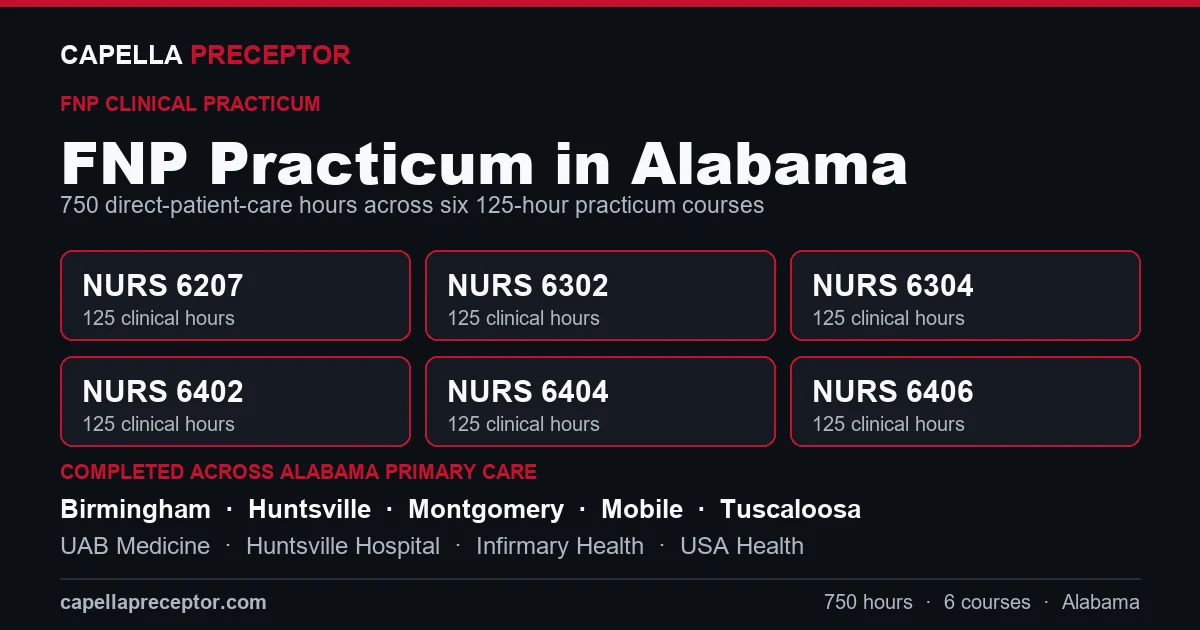
An Alabama FNP placement has to satisfy the Capella side first. The MSN Family Nurse Practitioner specialization requires a minimum of 750 practicum hours, built from six clinical courses that each carry 125 hours, and those hours have to span the whole family lifespan rather than one age group (Capella, MSN-FNP courses). So the preceptor you secure in Alabama needs a panel that touches adult and older-adult primary care, pediatrics, and women's or reproductive health, not just one slice of it. We keep the full course-by-course breakdown on the FNP requirements page so this page can stay on the Alabama-specific part.
There is a useful coincidence here. Alabama's own Board of Nursing sets a floor of 500 supervised direct-patient-care clinical hours for nurse practitioner licensure in the intended role, and Capella's 750 sits comfortably above it (Alabama Board of Nursing, CRNP requirements). The hours you log for Capella are the same hours that later support an Alabama license application, provided your program is one the board recognizes. That is one fewer thing to worry about, but it does not change who can teach you or how that teacher practices, which is where Alabama gets specific.
How does Alabama's reduced-practice rule affect an FNP placement?
Alabama is a reduced-practice state for nurse practitioners, classified that way by the American Association of Nurse Practitioners (AANP, State Practice Environment). In plain terms, a nurse practitioner here, formally a Certified Registered Nurse Practitioner (CRNP), cannot practice on their own judgment alone. Each CRNP works under a collaborative agreement with a physician, filed jointly with the Alabama Board of Nursing and the Alabama Board of Medical Examiners, and that agreement spells out the duties, the prescribing privileges, and the quality-assurance plan for the practice (Ala. Admin. Code r. 610-X-5-.09; Alabama Board of Medical Examiners, Collaboration).
The student-versus-CRNP distinction. The collaboration rule governs a licensed CRNP in practice. It does not govern you while you are a Capella practicum student. Your FNP hours are authorized by Capella's site and preceptor approval, not by a collaborative agreement of your own. What the rule does shape is the texture of your rotation: in a reduced-practice state the strongest FNP sites tend to be physician-led family practices that already collaborate with one or more CRNPs, so you frequently get to learn from both the physician and the CRNP working the same panel.
Who can precept an FNP student in Alabama?
For Capella, a preceptor must hold an active license in a role that matches the course population and practice in an appropriate primary care setting. In Alabama that means a CRNP licensed by the state board, or a collaborating physician, working in family medicine, internal medicine, pediatrics, or women's health. You can confirm any candidate's standing yourself through the board's free License Lookup, which returns primary-source verification of license status, expiration, and any disciplinary history with no account required. We run that check on every preceptor we propose, but you should know the tool exists.
One Alabama wrinkle is worth planning around: prescribing. A CRNP here can only prescribe controlled substances after obtaining a Qualified Alabama Controlled Substances Certificate (QACSC), which requires twelve months of active Alabama clinical practice, dedicated controlled-substance coursework, and limits the CRNP to Schedule III through V drugs (Alabama Board of Medical Examiners, QACSC). For your FNP rotation this is not a requirement, but a preceptor who holds a QACSC can model realistic primary-care prescribing, pain and anxiety management, controlled-substance stewardship, and PDMP checks, the way it actually happens in an Alabama clinic.
How does Alabama physician-presence change what a preceptor can offer?
Alabama scales the collaborating physician's involvement to the CRNP's experience, and that affects how present the physician is in the rooms where you will learn. For a CRNP with less than two years (4,000 hours) of experience since certification, the collaborating physician must be physically present for at least ten percent of the CRNP's scheduled hours at the practice site. For an experienced CRNP at or beyond that mark, the physician must meet with them at least quarterly and visit any remote sites at least twice a year (Ala. Admin. Code r. 610-X-5-.09).
Why this matters to an FNP student: a newer CRNP preceptor often works alongside a physician on site, which can give you more eyes on a tricky pediatric or prenatal case and more chances to compare reasoning. A seasoned CRNP running a more autonomous panel can give you volume and independence. Neither is better in the abstract; the right fit depends on which of your six courses you are in. We factor the preceptor's experience level into the match so the rotation suits where you are in the sequence.
Where are the FNP clinical sites in Alabama?
Family-care capacity in Alabama clusters around its medical metros and thins out across the rural counties, so the practical answer depends on where you live. Real settings that fit the FNP lifespan scope include large outpatient family-medicine networks in the north, the Gulf Coast primary-care systems in the south, and the River Region and West Alabama practices in between.
The state's densest medical market, anchored by UAB Medicine and the Jefferson County outpatient and family-medicine clinics around it.
North Alabama family medicine, including UAB Medicine Huntsville's family practice, the largest primary-care practice in the region, plus the Huntsville Hospital network.
River Region clinics spanning adult and family care in the capital, useful for the two adult-gerontology practicum courses.
Gulf Coast primary care, pediatrics, and women's health, including Infirmary Health and USA Health sites.
West Alabama family and internal medicine practices, including teaching clinics tied to the area's family-medicine residency.
Rural and small-metro counties from Selma to Dothan where local capacity is thinnest and the virtual option earns its keep.
The FNP catch in Alabama is the same one students hit nationwide: a single family-medicine clinic may cover adults and some pediatrics but fall short on women's health, or vice versa. In a rural county the nearest qualified site might be an hour off. If that is you, our virtual preceptorship keeps the harder-to-staff course hours moving while we line up an in-person match, with every hour tracked in CORE ELMS the same way.
What approvals does an Alabama FNP placement still need?
Finding the preceptor is step one. Before a single Alabama hour counts, the placement has to clear Capella's practicum workflow, which is the same workflow nationwide; only the local site and preceptor you run through it are Alabama-specific.
- Submit your Alabama site and FNP preceptor in Capella's practicum system, tracked in our workflow as CORE ELMS, for review and approval against the FNP requirements.
- Execute an affiliation agreement between Capella and the Alabama clinical site before practicum begins.
- Clear third-party compliance through a background-check and health-records vendor such as CastleBranch (confirm the current vendor with your program).
- Log and submit hours per course in CORE ELMS, where your preceptor approves each block, with the population mix balanced so no course runs short late.
Note what is not on this list: you do not file an Alabama collaborative agreement or a QACSC. Those belong to a licensed CRNP, not a student. Your job is the Capella clearance above, run against a real Alabama site and a verified Alabama preceptor.
In-person or virtual for an Alabama FNP?
Both routes are open, and the right call usually comes down to your county and which of the six FNP courses you are running.
Best near Birmingham, Huntsville, Montgomery, Mobile, or Tuscaloosa, where a single family-medicine panel can often cover much of the lifespan and you can see physician-CRNP collaboration in real time. We match you locally and handle the introductions.
Best for the rural Black Belt and Wiregrass, or when one course component, often pediatrics or women's health, is hard to staff nearby. Hours are precepted live and logged in CORE ELMS the same way, keeping you on schedule while a local match is arranged.
Always confirm with your faculty which course components your FNP plan allows virtually before you commit hours, since rules can differ by course.
Alabama FNP FAQ
How many hours does the Capella FNP practicum require in Alabama?
A minimum of 750 practicum hours, the same in Alabama as everywhere else, split across six FNP courses at 125 hours each and spanning adult-gerontology, pediatric, and women's health. Alabama's board sets a 500-hour floor for NP licensure, so Capella's 750 already clears the state minimum.
Does Alabama's reduced practice rule change who can precept my FNP hours?
Not the eligibility. A preceptor must meet Capella's published requirements, which means an Alabama-licensed CRNP or a physician in a primary care setting matching your course population. The reduced-practice rule governs how a licensed CRNP practices, through a collaborative agreement, not who may teach a student.
Can an FNP precept me in Alabama, or does it have to be a physician?
Either can, as long as the preceptor meets Capella's requirements and practices in the right population. Many Alabama family-medicine sites are physician-led practices that already host a collaborating CRNP, so you often have both available across one panel.
Will a controlled-substance prescriber make a better Alabama FNP preceptor?
It can help you see realistic prescribing. In Alabama a CRNP needs a Qualified Alabama Controlled Substances Certificate (QACSC) to prescribe Schedule III to V drugs, which requires 12 months of Alabama practice and dedicated training. A QACSC holder can model that within their collaborative agreement, though it is not a Capella placement requirement.
Do you place Capella FNP students in rural Alabama or only the big cities?
Both. We match in Birmingham, Huntsville, Montgomery, Mobile, and Tuscaloosa, and in smaller Black Belt and Wiregrass towns. Where one local site cannot cover pediatrics or women's health, our virtual option keeps those hours moving while we arrange an in-person match, all tracked in CORE ELMS.
Sources
- Capella University, MSN Family Nurse Practitioner courses (750 hours, six courses)
- AANP, State Practice Environment (Alabama reduced practice)
- Alabama Board of Nursing, CRNP requirements
- Ala. Admin. Code r. 610-X-5-.09, collaborative practice and physician presence
- Alabama Board of Medical Examiners, QACSC (controlled-substance certificate)
- Alabama Board of Nursing, License Lookup
How Capella Preceptor secures your Alabama FNP placement
You now have the full picture: 750 lifespan hours over six FNP courses, a reduced-practice state where your preceptors work under physician collaboration, and a clearance workflow that is yours to run while the license belongs to the CRNP. The part students lose months on is sourcing a preceptor whose panel actually covers adults, children, and women's health. We secure a verified Alabama preceptor who meets Capella's published FNP requirements, prepare every CORE ELMS form and affiliation agreement, and keep your hours logged on schedule.
- Verified Alabama FNP preceptor matched in 7 days, in person or virtual
- A panel mapped to cover adult, pediatric, and women's health across your six courses
- No payment until you are matched, with your exact quote on the free consult. See pricing.
Related: the full Capella FNP requirements and the broader Capella preceptor in Alabama page.
Get an FNP preceptor in Alabama
Free 15-minute consult. No payment until matched. We map your entire 750-hour Alabama FNP practicum.
Get my free consult →