Home / Pennsylvania
StateCapella Preceptor and Clinical Placement in Pennsylvania
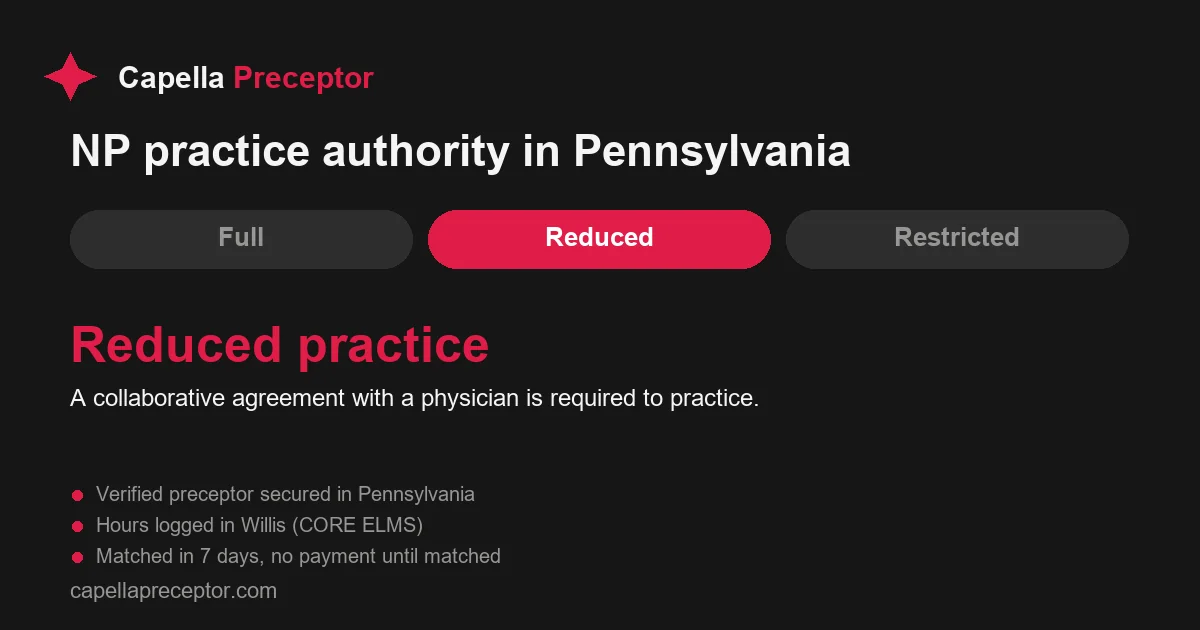
Pennsylvania is a reduced practice authority state for nurse practitioners, which means a certified registered nurse practitioner here works under a collaborative agreement with a physician for parts of practice and prescribing. For a Capella student that policy shapes who can precept you and how your site is structured. This page explains the rules first, then how we secure your placement.
Last updated: June 21, 2026 · Reviewed by the Capella Preceptor placement team
NP practice authority in Pennsylvania
The American Association of Nurse Practitioners places Pennsylvania in the reduced practice category (AANP, State Practice Environment; AANP, State Practice Environment fact sheet, PDF). Reduced practice means state law limits at least one element of how a nurse practitioner can work. In Pennsylvania the practical effect is that a certified registered nurse practitioner, the title the state uses, ties diagnosis, treatment, and prescribing to an ongoing collaborative relationship with a physician rather than practicing fully independently.
For a Capella student lining up a practicum, the category matters less for what you are allowed to do as a learner and more for the kind of preceptor and site you should target. A CRNP preceptor in Pennsylvania already operates inside that collaborative structure, so their clinic typically has a physician relationship in place. Many strong student sites are physician-led or physician-and-CRNP practices, which fits the state model and tends to make Capella site approval cleaner. You are training under supervision either way, so the reduced category does not block your hours; it simply describes the environment you are stepping into.
The Pennsylvania State Board of Nursing
Advanced practice nurses in the commonwealth are regulated by the Pennsylvania State Board of Nursing, housed in the Department of State's Bureau of Professional and Occupational Affairs. The board licenses registered nurses, licensed practical nurses, certified registered nurse practitioners, and clinical nurse specialists, and it sets the standards a CRNP must meet (Pennsylvania State Board of Nursing).
What the board governs for your preceptor
- CRNP recognition. The board certifies the CRNP credential on top of an active RN license, in a defined specialty such as family or adult-gerontology.
- Collaborative and prescriptive rules. Prescriptive authority is granted through a separate prescriptive-authority collaborative agreement with a physician, filed with the board (49 Pa. Code 21.285).
- License verification. Anyone can confirm a license and its status through the Pennsylvania Licensing System (PALS).
That collaborative agreement is a requirement on the practicing CRNP, not on you. You will not sign one as a Capella learner. We mention it because it tells you what a compliant Pennsylvania site looks like, and because we check it as part of vetting a preceptor.
How we verify a Pennsylvania preceptor
Before we hand you a name, we confirm the preceptor against the state's own record. Capella also requires that the preceptor be appropriately licensed and credentialed for the population in your course, so verification is not optional on either side.
- Confirm the base RN license and the CRNP credential separately in PALS; one active record does not prove the other.
- Check the certified specialty matches your Capella track, so an FNP student lands with a family or primary care preceptor.
- Confirm no open disciplinary action on the record before we propose the placement.
Finding a preceptor and clinical site in Pennsylvania
Capella does not assign you a preceptor or a clinical site. The university expects each learner to secure their own placement in their local community and provides resources but not the match itself. In a reduced practice state with Pennsylvania's clinic mix, that search can stall, especially for pediatric or women's health hours in the FNP sequence. This is the gap we close. We hold a vetted network across the commonwealth's main regions.
Philadelphia, the Main Line, Chester, Delaware, Montgomery, and Bucks counties, with dense primary care, pediatric, and women's health options.
Pittsburgh and Allegheny County out to Washington and Westmoreland, strong for family medicine and adult-gerontology.
Allentown, Bethlehem, Easton, plus Harrisburg, Lancaster, York, and Reading in the center of the state.
Scranton and Wilkes-Barre, Erie, and the rural counties between them, where the virtual option carries the load.
If you sit in a rural county where outpatient sites are thin, the virtual preceptorship keeps you on schedule rather than waiting months for a local opening.
Practicum requirements for Pennsylvania students
Your hours target depends on your program. The RN-to-BSN capstone practicum is modest, the MSN-FNP runs 750 hours across six 125-hour courses, other NP tracks are similar, and the DNP adds project hours. We keep the full breakdown on the hours page and on each specialty page rather than repeating every number here. Whatever the count, the Pennsylvania clearance steps are the same.
The affiliation agreement is the most common delay. Pennsylvania health systems route these through legal review, which can take weeks at a large network. We start the agreement the moment a site is identified so it is signed before your course clock starts.
Virtual or in-person practicum in Pennsylvania
Both routes are open, and the right one depends on where you live and what your course requires.
Best in the Philadelphia, Pittsburgh, Lehigh Valley, and Harrisburg corridors, where hands-on primary care, pediatric, and women's health sites are plentiful and within commuting range.
Best for rural and underserved counties and for students balancing work. Sessions run live with a verified preceptor and hours track in CORE ELMS. Confirm the in-person share your specific course demands.
Pennsylvania FAQ
Does Pennsylvania allow full practice authority for nurse practitioners?
No. The AANP classifies Pennsylvania as a reduced practice state. A CRNP practices with at least one element of practice tied to a collaborative agreement with a physician, and prescriptive authority requires a separate prescriptive-authority collaborative agreement filed with the State Board of Nursing.
Does my Pennsylvania preceptor need a collaborative agreement with me?
No. The Pennsylvania collaborative agreement is between a practicing CRNP and a physician for that CRNP's own practice. As a student you do not sign one. Your preceptor must hold an active, verifiable Pennsylvania license and be qualified to teach the population your Capella course covers.
Where in Pennsylvania can Capella Preceptor place me?
Across the Philadelphia region, Pittsburgh and southwestern Pennsylvania, the Lehigh Valley, Harrisburg and the capital region, Lancaster, Erie, and Scranton and Wilkes-Barre, plus rural counties where we use the virtual option when local sites are limited.
Sources
- AANP, State Practice Environment (Pennsylvania, reduced)
- AANP, State Practice Environment fact sheet (PDF)
- Pennsylvania State Board of Nursing
- 49 Pa. Code 21.285, prescriptive authority collaborative agreements
- Pennsylvania Licensing System (PALS) license verification
How Capella Preceptor helps in Pennsylvania
You now know the landscape: a reduced practice state, a State Board of Nursing that certifies the CRNP and the collaborative agreement behind it, and a placement that Capella leaves entirely to you. We secure a verified, Pennsylvania-licensed, Capella-compliant preceptor matched to your specialty, prepare every CORE ELMS form, push the affiliation agreement through site legal review, and keep your hours logged and approved on schedule.
- Verified Pennsylvania preceptor matched in 7 days, in person or virtual
- License and specialty confirmed in PALS before we propose a name
- No payment until you are matched, with your exact quote at the free consult
On the family nurse practitioner track? See Capella FNP preceptor requirements in Pennsylvania for FNP-specific practicum hours, Pennsylvania board rules, and local clinical settings.
Get a Capella preceptor in Pennsylvania
Free 15-minute consult. No payment until matched. We map your entire practicum plan.
Get my free consult →