Home / MSN-FNP / FNP Preceptor in Pennsylvania
FNP · PennsylvaniaCapella FNP Preceptor in Pennsylvania
A Capella MSN-FNP needs 750 practicum hours across six courses under a preceptor who covers primary care across the lifespan, and you are the one who has to secure that preceptor. Pennsylvania is a reduced practice state where nurse practitioners hold the CRNP title and work under a collaborative agreement with a physician. This page explains what that combination means for your placement, then how we close it.
Last updated: June 28, 2026 · Reviewed by the Capella Preceptor placement team
What a Capella FNP needs, and what Pennsylvania adds on top
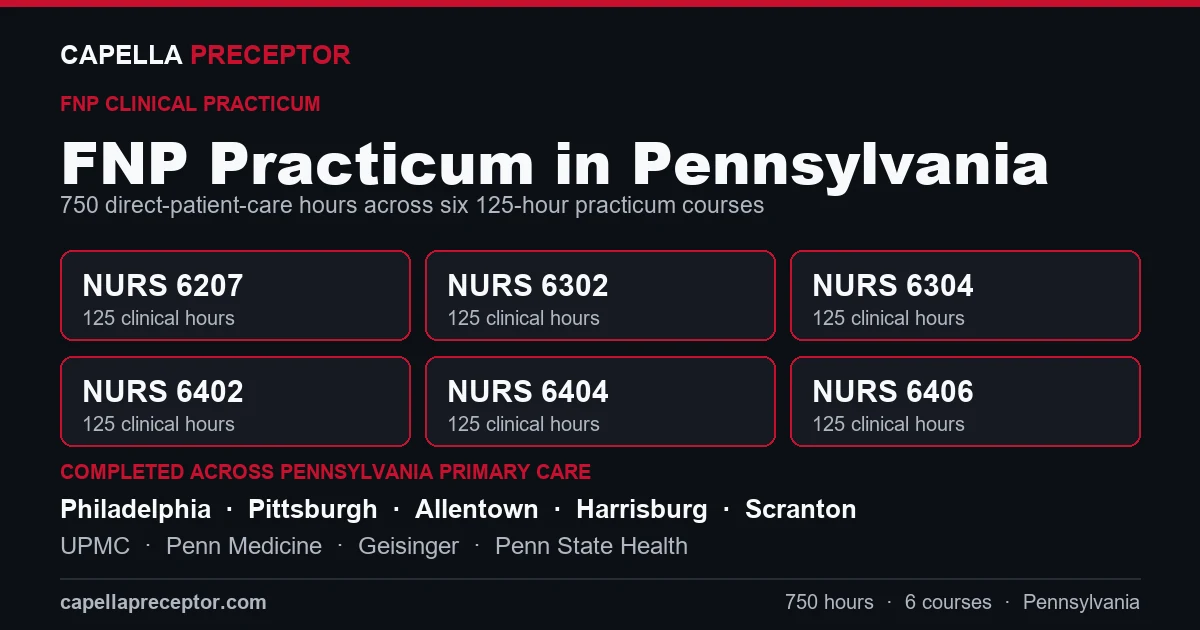
Start with the program, because the program number does not change at the state line. The Capella MSN Family Nurse Practitioner specialization requires a minimum of 750 practicum hours, spread across six clinical practicum courses that each carry 125 hours, completed in your own community while coursework stays online (Capella, MSN-FNP courses). Because the FNP is a family role, those hours have to span the lifespan: adult and older-adult primary care, pediatrics, and reproductive or women's health. A Pennsylvania placement does not lower that bar or raise it.
What Pennsylvania adds is context around who can precept you and what a compliant clinic looks like. The American Association of Nurse Practitioners places Pennsylvania in the reduced practice category (AANP, State Practice Environment). In plain terms, a nurse practitioner here, called a certified registered nurse practitioner or CRNP, ties at least one element of practice to an ongoing collaborative relationship with a physician rather than working fully independently. That single fact quietly explains most of what is different about lining up FNP hours in the commonwealth, and the rest of this page works through it.
Who can precept an FNP student in Pennsylvania?
Your FNP preceptor in Pennsylvania can be a CRNP or a physician, provided two things line up: the license is active and verifiable in the state, and the clinician genuinely practices with the population your current Capella course covers. The FNP sequence makes that population mix explicit, so the match is course by course, not just specialty by specialty.
- The two adult-gerontology courses (NURS6302 and NURS6304) want a family or adult primary care panel: chronic disease, acute visits, prevention, and the older-adult population.
- The pediatric course (NURS6402) needs a preceptor who sees children, for well-child and acute pediatric visits.
- The reproductive health course (NURS6404) needs prenatal, postpartum, contraception, and routine gynecologic visits.
A family-certified CRNP or a family medicine physician is the cleanest single match for the full FNP scope, because one panel can often cover adults, children, and women's health together. In a reduced practice state that arrangement is also common: a CRNP who already collaborates with a physician typically sits inside a practice that has both, which makes the population coverage and the site paperwork easier at once. We cover the full FNP requirement set, including the codes and settings, on the broader Capella FNP page.
How Pennsylvania's collaborative agreement rule actually touches your practicum
Reduced practice gets described as a burden, but for a student it is mostly background. The Pennsylvania State Board of Nursing, inside the Department of State's Bureau of Professional and Occupational Affairs, certifies the CRNP credential on top of an active RN license and defines collaboration as a process in which a CRNP works with one or more physicians within the CRNP's specialty (49 Pa. Code 21.251). Prescribing is governed separately: to prescribe, a CRNP must hold a prescriptive authority collaborative agreement with a Pennsylvania physician.
What the Pennsylvania prescriptive agreement requires of your preceptor (not of you)
- Named physicians. The written agreement must identify the collaborating physician and at least one substitute physician who covers when the primary is unavailable.
- 45 hours of pharmacology. Prescriptive authority requires 45 hours of advanced pharmacology coursework completed within the five years before applying.
- Kept, filed, and reviewed. The agreement is held at the CRNP's primary practice location, filed with the Bureau of Professional and Occupational Affairs, and reviewed at least once every two years (49 Pa. Code 21.285).
None of that is yours to sign. You are training under supervision the entire time, so the reduced category never blocks a student's hours. It matters to you for one practical reason: a CRNP preceptor who satisfies these rules is, by definition, working in a practice with a real physician relationship and documented prescribing structure, which is exactly the kind of site Capella approval moves through cleanly. We confirm that picture when we vet a name; you can read the full state-level breakdown on the broader Pennsylvania placement page.
Is full practice authority coming to Pennsylvania?
It has been proposed, not passed. Senate Bill 25 in the 2025 to 2026 session would let qualified nurse practitioners practice independent of a physician after completing a three-year, 3,600-hour collaboration, with a parallel House measure (House Bill 739). As of June 2026 neither has advanced out of committee, so the rule you plan your practicum around today is still the existing collaborative model (Pennsylvania General Assembly, SB 25). For a Capella FNP student that means nothing changes in how you secure or document a preceptor right now. We mention it only so you are not surprised by older articles that describe a future independent-practice Pennsylvania that is not yet law.
Where Pennsylvania FNP hours actually happen
FNP hours are earned in outpatient primary care, and Pennsylvania's clinic mix is unusually deep because several large systems run dense ambulatory networks. UPMC anchors the west, Penn Medicine and a cluster of independent practices fill the southeast, Geisinger and Penn State Health cover the center and northeast, and WellSpan runs through the south-central counties. Family medicine practices, federally qualified health centers, and community health clinics inside and around those systems are where most students log their lifespan mix. The regions below are where we hold a vetted FNP network.
Philadelphia, the Main Line, and Chester, Delaware, Montgomery, and Bucks counties, dense with family medicine, pediatric, and women's health panels for the full FNP spread.
Pittsburgh and Allegheny County out to Washington and Westmoreland, strong for family and adult primary care within the UPMC ambulatory footprint.
Allentown, Bethlehem, and Easton, plus Harrisburg, Lancaster, York, and Reading across the WellSpan and Penn State Health corridors.
Scranton and Wilkes-Barre in the Geisinger region and Erie in the northwest, with rural counties between them where the virtual option carries the load.
The recurring FNP problem in Pennsylvania is not finding any preceptor, it is finding pediatric or women's health hours when a single family clinic skews adult. In a rural county the same gap appears faster. That is the specific shortfall we plan around before your first course opens.
The real reason FNP placement stalls in Pennsylvania
Capella does not assign you a preceptor or a site. The university states plainly that learners are responsible for finding an appropriate preceptor to oversee the practicum, and that practicum is completed in your local community (Capella, MSN-NP program). For a 750-hour, multi-population FNP track in a reduced practice state, that responsibility lands hard for two reasons specific to Pennsylvania.
First, the busiest preceptor-friendly clinics in the large systems are also the ones most likely to route a student request through a system-level office, which slows a cold outreach. Second, the affiliation agreement between Capella and the site is the most common delay anywhere, and Pennsylvania health systems run these through legal review that can take weeks at a large network. Verify a preceptor before you commit, using the state's own record: confirm the base RN license and the CRNP credential separately in the Pennsylvania Licensing System (PALS), because one active record does not prove the other, check the certified specialty matches your FNP track, and confirm there is no open disciplinary action.
Clearance steps for a Pennsylvania FNP placement
Once you identify a Pennsylvania preceptor and site, the same Capella clearance workflow stands between you and your first logged hour. The state details sit inside familiar steps.
We start the affiliation agreement the moment a site is identified, precisely because the Pennsylvania legal-review queue is the step most likely to cost you a term if it begins late.
Virtual or in-person FNP hours in Pennsylvania
Both routes are open. The right one depends on where you live and which FNP course you are in, since some populations are harder to source in person than others.
Strongest in the Philadelphia, Pittsburgh, Lehigh Valley, and Harrisburg corridors, where family medicine, pediatric, and women's health sites sit within commuting range and can cover most of the FNP lifespan mix.
Best for rural counties and for the harder-to-source pediatric or women's health hours. Sessions run live with a verified Pennsylvania preceptor and hours track in CORE ELMS; confirm the in-person share your specific FNP course requires.
Pennsylvania FNP FAQ
Does my Pennsylvania FNP preceptor have to be a nurse practitioner?
No. Your Capella FNP preceptor can be a CRNP or a physician, as long as they are licensed in Pennsylvania and practice with the patient population your FNP course covers. The two adult-gerontology courses, the pediatric course, and the women's health course each need a preceptor who actually sees that population. A family-certified CRNP or a family medicine physician is the cleanest single match for the FNP scope.
Does Pennsylvania's collaborative agreement requirement affect me as a Capella FNP student?
Not directly. The Pennsylvania collaborative agreement is a rule on a practicing CRNP and their physician, not on you as a learner. You do not sign one. It matters only in that a compliant CRNP preceptor already works inside that structure, so their clinic usually has the physician relationship Capella site approval looks for.
How many FNP practicum hours do I need in Pennsylvania, and where do I log them?
The Capella MSN-FNP requires a minimum of 750 practicum hours across six clinical courses that each carry 125 hours, the same in Pennsylvania as anywhere else. You log them in CORE ELMS, where your preceptor approves the hours before each course closes. Pennsylvania adds no separate state hour count for students.
Where in Pennsylvania can a Capella FNP student get placed?
We place FNP students across the Philadelphia and southeastern region, Pittsburgh and southwestern Pennsylvania, the Lehigh Valley, Harrisburg and the capital region, Lancaster and York, Erie, and the Scranton and Wilkes-Barre area, with a virtual option for rural counties where local family, pediatric, or women's health sites are limited.
Is Capella Preceptor affiliated with Capella University?
No. We secure preceptors who meet Capella's published practicum requirements and verify them against Pennsylvania's own license records.
Sources
- Capella University, MSN-FNP courses (750 hours, six practicum courses)
- Capella University, MSN-NP program (learner secures preceptor, local practicum)
- AANP, State Practice Environment (Pennsylvania, reduced practice)
- 49 Pa. Code 21.251, CRNP definitions and collaboration
- 49 Pa. Code 21.285, prescriptive authority collaborative agreements
- Pennsylvania General Assembly, Senate Bill 25 (full practice authority, pending)
- Pennsylvania Licensing System (PALS), license verification
How Capella Preceptor helps an FNP student in Pennsylvania
You now have the full picture: 750 FNP hours across six courses and the lifespan, a reduced practice state where your preceptor is a CRNP or physician working under a collaborative agreement, large systems that slow cold outreach, and a placement Capella leaves entirely to you. We secure a verified, Pennsylvania-licensed preceptor whose panel covers the populations your FNP courses require, prepare every CORE ELMS form, push the affiliation agreement through site legal review early, and keep all 750 hours logged and approved on schedule.
- Verified Pennsylvania FNP preceptor matched in 7 days, in person or virtual
- RN license and CRNP specialty confirmed in PALS before we propose a name
- Pediatric and women's health hours planned up front, not scrambled mid-program
- No payment until you are matched, with your exact quote at the free consult
Get a Capella FNP preceptor in Pennsylvania
Free 15-minute consult. No payment until matched. We map all 750 FNP hours across the lifespan.
Get my free consult →