Home / Kentucky
StateCapella Preceptor and Placement in Kentucky
Kentucky is a reduced-practice state for nurse practitioners, which means a practicing NP collaborates with a physician on prescribing while still seeing and managing patients. For you as a Capella student, the bigger question is who lines up the preceptor, and Capella leaves that to you. This page explains what reduced practice means on the ground in Kentucky, how the Kentucky Board of Nursing fits in, and how we secure a verified preceptor for you across the commonwealth.
Last updated: June 21, 2026 · Reviewed by the Capella Preceptor placement team
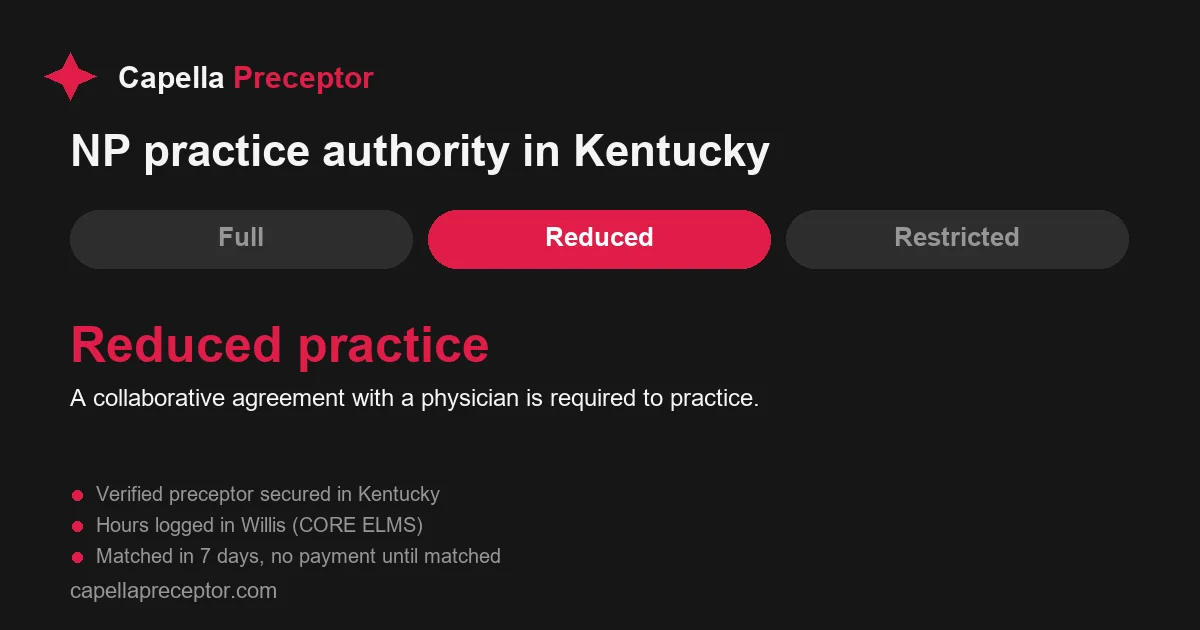
NP practice authority in Kentucky: reduced practice
The American Association of Nurse Practitioners classifies Kentucky as a reduced practice state (AANP, Kentucky state practice environment; AANP, State Practice Environment). Reduced practice does not mean an NP works under direct supervision for everything. In Kentucky a licensed APRN assesses, diagnoses, orders and interprets tests, and manages treatment within their certification, but state law conditions one element of practice, prescribing, on a written agreement with a physician.
That condition runs through two collaborative agreements. A Collaborative Agreement for Prescriptive Authority for Nonscheduled Legend Drugs (CAPA-NS) covers non-controlled prescriptions, and a separate Collaborative Agreement for Prescriptive Authority for Controlled Substances (CAPA-CS) covers controlled substances (Kentucky Board of Nursing, APRN prescriptive authority). The collaborating physician must hold an active Kentucky license in the same or similar specialty. After four years of prescribing in good standing under a CAPA-NS, an APRN may notify the board and continue nonscheduled prescribing without that agreement, while the CAPA-CS framework continues to govern controlled substances.
Here is why this matters for a Capella practicum and why it is easy to misread. The collaborative agreement is about a working NP's own prescriptive license. As a student, you are not prescribing under your own authority. You are learning under a preceptor who is already licensed. So the reduced-practice rule shapes the kind of clinicians available to teach you, but it does not add a separate supervision contract to your student placement. What you need is a preceptor who is properly licensed and certified for your population and approved through Capella's process.
The Kentucky Board of Nursing
Nursing and advanced practice in the commonwealth are regulated by the Kentucky Board of Nursing (KBN), which licenses RNs and APRNs, recognizes nurse practitioners by population focus, and maintains the rules on prescriptive authority described above (Kentucky Board of Nursing). The KBN also runs the public license verification tool that lets anyone confirm a nurse's or APRN's credential status.
We use that verification step on every Kentucky match. Before we propose a preceptor to you, we confirm an active, unencumbered KBN license and a national certification that fits your track, and you are welcome to run the same check yourself through the board. A preceptor whose license cannot be verified will not clear Capella's site and preceptor approval, so this is not a formality we skip.
Quick reference: the regulator is the Kentucky Board of Nursing (KBN). Reduced practice in Kentucky centers on physician collaboration for an APRN's prescribing (CAPA-NS and CAPA-CS), not on day-to-day supervision of a student in practicum.
Finding a preceptor and clinical site in Kentucky
Capella requires the student to secure their own preceptor and clinical site; the university does not assign one. That single sentence is where most Kentucky students lose weeks, because cold-calling clinics around Louisville or asking a current employer rarely produces a clinician who can commit the hours and clear Capella's paperwork. That is the gap we fill.
We place students throughout Kentucky, in the urban corridors and in the parts of the commonwealth where clinics are spread thin:
The largest pool of family medicine, internal medicine, pediatric, and behavioral health sites in the state.
University-anchored primary care and specialty clinics across Fayette and surrounding counties.
Covington, Florence, and the Cincinnati-adjacent suburbs with active outpatient practices.
Growing primary care capacity serving Warren County and beyond.
Regional clinics where local preceptor slots fill quickly and early planning pays off.
Ashland, Pikeville, Hazard, and rural areas where our virtual option is often the practical route.
Practicum requirements, done in Kentucky
Lining up a willing clinician is only half the work. Before a single hour counts, the placement has to clear Capella's practicum system, which we track in our workflow as CORE ELMS. The sequence is the same wherever you live, but it has to be completed with a Kentucky site and a KBN-licensed preceptor.
- Propose the Kentucky site and preceptor in CORE ELMS for Capella's review and approval.
- Execute an affiliation agreement between Capella and the clinical site before practicum begins.
- Clear third-party compliance (background check and health records through a vendor such as CastleBranch; confirm the current vendor with your program).
- Log and submit hours in CORE ELMS, where your Kentucky preceptor approves what you record.
The number of hours you owe depends on your program: an RN-to-BSN capstone practicum, 750 hours for the MSN-FNP across six 125-hour courses, comparable totals for other NP tracks, and project hours for the DNP. We keep the full breakdown on the hours page and on each specialty page so this page does not repeat every figure.
Virtual or in-person for Kentucky students
Kentucky's geography makes this a real decision rather than a checkbox. In the Louisville, Lexington, and Northern Kentucky markets, an in-person rotation close to home is usually realistic and we match you locally. In the eastern coalfields and the rural west, the nearest clinic that can both teach your population and clear Capella's paperwork may be an hour or more away, and that is where our virtual preceptorship earns its place.
A verified Kentucky preceptor at a clinic you can commute to, with site approval and the affiliation agreement handled for you.
Live, supervised clinical learning by video for students in counties where local slots are scarce, with hours logged the same way in CORE ELMS.
Either way, confirm any nonstandard arrangement with your faculty, because the population mix and setting still have to match your course requirements.
Kentucky FAQ
Does my Kentucky preceptor need a collaborative agreement for my Capella practicum?
The CAPA-NS and CAPA-CS collaborative agreements govern an APRN's own prescribing in Kentucky. Your role as a Capella student is supervised learning under a qualified preceptor, so what matters for placement is that the preceptor holds an active Kentucky license, is board certified for your population, and is approved through Capella's practicum system. We verify all of that before you start.
Can I do my Capella practicum virtually if I live in rural Kentucky?
Yes. For students in Appalachian and western Kentucky counties where local sites are scarce, our virtual preceptorship keeps you on schedule, with hours proposed and logged in CORE ELMS. In-person rotations are also available across Louisville, Lexington, and other metros.
Where can I verify a Kentucky preceptor's license?
License verification is available through the Kentucky Board of Nursing. We confirm every preceptor's active Kentucky license and certification before matching, and you can independently verify through the board.
Sources
- AANP, Kentucky state practice environment (reduced practice)
- AANP, State Practice Environment (national overview)
- Kentucky Board of Nursing, APRN prescriptive authority (CAPA-NS, CAPA-CS, license verification)
How Capella Preceptor helps
You now know the lay of the land in Kentucky: a reduced-practice environment governed by the Kentucky Board of Nursing, and a practicum that Capella expects you to staff yourself. We close that last gap. We secure a verified, KBN-licensed, Capella-compliant preceptor whose certification matches your track, prepare every CORE ELMS form and affiliation agreement, and keep your hours logged and submitted on time, anywhere from Louisville to the eastern counties.
- Verified Kentucky preceptor matched in 7 days, no payment until matched
- Every CORE ELMS form, affiliation agreement, and CastleBranch step handled
- In-person across Kentucky metros or fully virtual for rural counties
On the family nurse practitioner track? See Capella FNP preceptor requirements in Kentucky for FNP-specific practicum hours, Kentucky board rules, and local clinical settings.
Get a Capella preceptor in Kentucky
Free 15-minute consult. No payment until matched. We map your entire practicum plan.
Get my free consult →