Capella FNP Preceptor in Kentucky
The Capella MSN-FNP requires 750 practicum hours across the lifespan, and in Kentucky those hours have to be logged with a preceptor who holds an active Kentucky Board of Nursing license. Kentucky is a reduced-practice state, but that rule constrains a working APRN's prescribing, not your student placement. The real challenge here is the same one most FNP students hit: Capella expects you to find the preceptor yourself. This page covers what the Kentucky board requires, where family-practice hours actually exist in the commonwealth, and how we secure a verified match.
Last updated: June 28, 2026 · Reviewed by the Capella Preceptor placement team
What does the Capella FNP require, and does Kentucky change it?
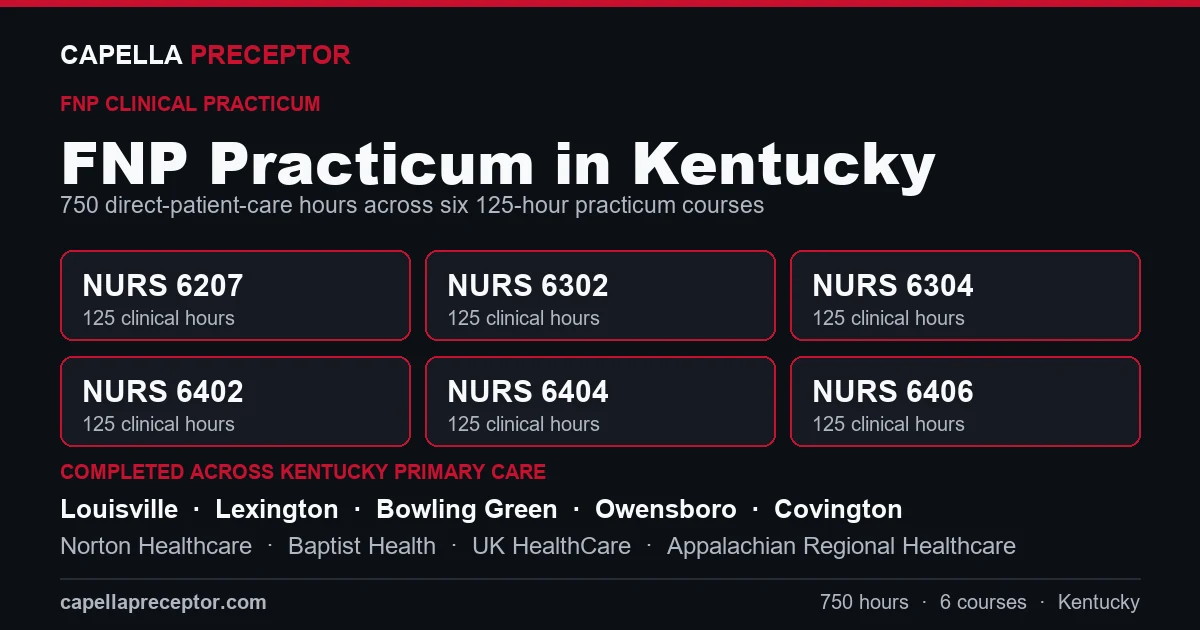
The Capella MSN Family Nurse Practitioner specialization requires a minimum of 750 practicum hours, split across six clinical courses that each carry 125 hours (Capella, MSN-FNP courses). That total is the same whether you live in Louisville or Los Angeles. Kentucky does not add hours, shorten them, or substitute its own count. The coursework stays online and the practicum is completed in your own community.
What Kentucky does change is who can supervise those hours and the kind of clinic you can realistically reach. The FNP is a primary care role across the lifespan, so your 750 hours have to span adult-gerontology, pediatrics, and women's or reproductive health. In a state where more than a third of residents live in a shortage area, lining up a single preceptor who covers all three populations and clears Capella's paperwork is the part that takes planning. We keep the full hour and course breakdown on the broader Capella FNP page, so this page stays focused on the Kentucky cell.
Does my Kentucky preceptor need a Kentucky license?
Yes, and this is the single most important Kentucky-specific rule for your placement. The Kentucky Board of Nursing (KBN) states that anyone who oversees nursing students in the clinical setting or serves as a preceptor in Kentucky must hold an unencumbered, active Kentucky RN and APRN license (Kentucky Board of Nursing, regulatory overview for out-of-state programs). A clinician licensed only in Ohio or Tennessee, even a strong family NP, cannot precept you for Kentucky hours on that license alone.
There is a wrinkle for clinicians who live across a state line. The KBN notes that a preceptor who resides in a compact (eNLC) state still needs a Kentucky APRN license to oversee students in the commonwealth, even though the compact covers the RN side. That detail matters in Northern Kentucky, where many primary care providers practice across the river in the Cincinnati area, and in border counties near Tennessee, Indiana, and West Virginia. A preceptor who looks local on a map may not be licensed for your Kentucky placement, which is exactly the kind of thing that stalls a self-arranged match late in the term.
Quick reference: a Capella FNP preceptor in Kentucky needs an active, unencumbered KBN APRN license and national certification that fits the family or primary care population. We verify both through the Kentucky Board of Nursing before we ever propose a name, and you can run the same public check yourself.
What does reduced practice mean for an FNP precepting relationship?
The American Association of Nurse Practitioners classifies Kentucky as a reduced-practice state (AANP, state practice environment). Reduced practice does not mean an NP works under direct supervision for everything. A licensed Kentucky APRN assesses, diagnoses, orders and interprets tests, and manages treatment within their certification. State law conditions one element, prescribing, on a written agreement with a physician.
That runs through two agreements. A CAPA-NS (Collaborative Agreement for Prescriptive Authority for Nonscheduled Legend Drugs) covers non-controlled prescriptions, and a separate CAPA-CS covers Schedule II through V controlled substances. The collaborating physician must hold an active, unrestricted Kentucky license in a same or similar specialty. Under the CAPA-CS, the APRN and physician meet quarterly in the first year and then at least biannually, reviewing the APRN's KASPER (the state prescription-monitoring) report. After four years of good-standing prescribing, an APRN may notify the KBN and continue nonscheduled prescribing without a CAPA-NS, and may request a CAPA-CS exemption with current DEA and KASPER documentation (Kentucky Board of Nursing, APRN prescriptive authority).
Here is why this is easy to misread as a Capella student. The collaborative agreement governs a working NP's own prescriptive license. You, as a student, are not prescribing under your own authority. You are learning under a preceptor who is already licensed and, if they prescribe, already has their own CAPA arrangements. So reduced practice shapes the pool of clinicians available to teach you, but it does not bolt a separate supervision contract onto your practicum. Notably, Kentucky imposes no distance requirement, no mandatory chart review, and no direct on-site supervision rule for these agreements, so a rural family NP can serve as a full-scope preceptor as long as their KBN license is active and their population matches your course.
Where do FNP clinical hours actually exist in Kentucky?
Kentucky is one of the harder states in which to self-place a primary care preceptor, and the reason is structural. As of December 2024, the commonwealth had 234 Health Professional Shortage Areas serving roughly 1.42 million people, about a third of the state's population, and 54 of Kentucky's 120 counties were designated primary care shortage areas (University of Kentucky College of Medicine, primary care workforce shortages; Kentucky Cabinet for Health and Family Services, HPSA and MUA). Fewer providers per capita means fewer open preceptor slots, and the clinicians who do precept are in heavy demand.
That said, FNP-appropriate primary care does exist across the commonwealth. Family medicine, internal medicine, pediatrics, and women's health practices sit inside and around larger systems such as Norton Healthcare and Baptist Health in the Louisville corridor, UK HealthCare in the Bluegrass, and Appalachian Regional Healthcare in the east, alongside a statewide network of rural health clinics and federally qualified health centers (Rural Health Information Hub, Kentucky resources). The map below is how we think about matching FNP students to hours that count:
The deepest pool of family medicine, pediatric, and women's health panels in the state, strong for covering the full FNP lifespan in fewer sites.
University-anchored primary care across Fayette and surrounding counties, useful for the two adult-gerontology practicum courses.
Covington and Florence outpatient practices, where we confirm the preceptor's Kentucky APRN license rather than assuming a Cincinnati-area credential carries over.
Growing family and primary care capacity serving Warren County, where early planning beats the slot shortage.
Regional clinics and rural health centers where pediatric and women's health hours need to be lined up well ahead of the course clock.
Ashland, Pikeville, and Hazard, where ARH sites and FQHCs serve as preceptor sites and our virtual option is often the practical route.
Why is finding an FNP preceptor in Kentucky so hard, and what fixes it?
Capella requires the student to secure their own preceptor and clinical site; the university does not assign one, though a support team helps connect learners with opportunities. Capella's own language is plain: "learners are responsible for finding an appropriate preceptor to oversee the practicum experience." For an FNP in Kentucky that sentence collides with three local realities at once: a primary care shortage that thins the preceptor pool, a multi-population requirement that often needs more than one site, and a board rule that disqualifies otherwise-willing out-of-state clinicians who lack a KBN APRN license. That combination is why Kentucky FNP students lose weeks cold-calling clinics around Louisville or leaning on an employer who turns out not to cover pediatrics or women's health.
That gap is what we close. We secure a verified, KBN-licensed preceptor whose certification and patient panel match the FNP lifespan, prepare every CORE ELMS form and the Capella-site affiliation agreement, and keep your hours logged and approved across the whole course sequence. Once you identify a preceptor, the same clearance workflow applies as anywhere else, but it has to be completed with a Kentucky site and a KBN-licensed preceptor:
- Propose the Kentucky site and preceptor in CORE ELMS for Capella's review and approval, with the KBN license on file.
- Execute an affiliation agreement between Capella and the Kentucky clinical site before practicum begins.
- Clear third-party compliance (background check and health records through a vendor such as CastleBranch; confirm the current vendor with your program).
- Log and submit hours in CORE ELMS, where your Kentucky preceptor approves what you record, course by course toward 750.
Should a Kentucky FNP student go in-person or virtual?
Kentucky's geography makes this a real decision, not a checkbox. In the Louisville, Lexington, and Northern Kentucky markets, an in-person rotation close to home is usually realistic, and we match you locally. In the eastern coalfields and the rural west, the nearest clinic that can both teach your population and clear Capella's paperwork may be an hour or more away, which is where a virtual preceptorship earns its place. The FNP's pediatric and women's health courses are often the hardest to source locally in a rural county, so a hybrid plan, in-person where it fits and virtual where it does not, is common here.
A verified KBN-licensed preceptor at a Kentucky clinic you can commute to, with site approval and the affiliation agreement handled for you.
Live, supervised clinical learning by video for students in shortage counties, with hours logged the same way in CORE ELMS.
Either way, confirm any nonstandard arrangement with your Capella faculty, because the population mix and setting still have to match each FNP course's requirements.
Kentucky FNP FAQ
Does my Kentucky FNP preceptor need a Kentucky license to supervise my Capella practicum?
Yes. The Kentucky Board of Nursing requires anyone serving as a preceptor for nursing students in Kentucky to hold an unencumbered, active Kentucky RN and APRN license. A preceptor who lives in a compact state still needs a Kentucky APRN license to oversee students here. We confirm an active KBN license and matching family or primary care certification before we propose anyone.
Does Kentucky's collaborative agreement requirement affect me as a Capella FNP student?
No. The CAPA-NS and CAPA-CS agreements govern a working APRN's own prescribing of legend drugs and controlled substances. As a student you do not prescribe under your own authority, so reduced practice shapes which clinicians are available to teach you, not your placement paperwork. What you need is a KBN-licensed preceptor whose panel covers the FNP lifespan and who clears Capella's CORE ELMS approval.
Where can I complete Capella FNP clinical hours in Kentucky?
FNP hours are earned in outpatient primary care across the lifespan: family medicine, internal medicine, pediatrics, and women's health. Kentucky options include practices in the Louisville and Lexington metros, Northern Kentucky, Bowling Green, and Owensboro, plus rural health clinics and FQHCs in the eastern coalfields and the west. For counties where local slots are scarce, a virtual preceptorship keeps you on schedule.
How many Capella FNP practicum hours do I need in Kentucky?
A minimum of 750 practicum hours, the same nationwide, spread across six clinical courses that each carry 125 hours. The total does not change because you are in Kentucky, but every hour has to be logged with a KBN-licensed preceptor at a Kentucky site Capella has approved in CORE ELMS.
Where can I verify a Kentucky preceptor's license?
License verification is available through the Kentucky Board of Nursing's public lookup. We confirm every preceptor's active Kentucky APRN license and certification before matching, and you are welcome to run the same check independently.
Sources
- Capella University, MSN Family Nurse Practitioner courses (750 hours, six 125-hour courses)
- Kentucky Board of Nursing, regulatory overview (preceptors must hold an active Kentucky APRN license)
- Kentucky Board of Nursing, APRN prescriptive authority (CAPA-NS, CAPA-CS, four-year rule)
- AANP, state practice environment (Kentucky reduced practice)
- University of Kentucky College of Medicine, Kentucky primary care workforce shortages
- Rural Health Information Hub, Kentucky resources (rural health clinics and FQHCs)
How Capella Preceptor helps in Kentucky
You now know the lay of the land: a 750-hour FNP practicum across the lifespan, a reduced-practice environment governed by the Kentucky Board of Nursing, a KBN license requirement that disqualifies out-of-state-only clinicians, and a primary care shortage that thins the preceptor pool. Capella leaves the placement to you. We close that gap. We secure a verified, KBN-licensed FNP preceptor whose panel covers adult, pediatric, and women's health, prepare every CORE ELMS form and affiliation agreement, and keep your hours logged on time, anywhere from Louisville to the eastern counties.
- Verified KBN-licensed FNP preceptor matched in 7 days, no payment until matched
- Lifespan coverage planned across adult, pediatric, and women's health for all 750 hours
- In-person across Kentucky metros or fully virtual for shortage counties
Related: the broader Capella FNP preceptor and placement guide and our Kentucky placement overview for other NP tracks across the commonwealth.
Get a Capella FNP preceptor in Kentucky
Free 15-minute consult. No payment until matched. We map your full 750-hour FNP plan across Kentucky.
Get my free consult →