Home / MSN-FNP / FNP Preceptor in Alaska
FNP · AlaskaCapella FNP Preceptor and Practicum Placement in Alaska
A Capella MSN-FNP practicum is 750 hours of primary care across the lifespan, and Capella leaves the preceptor search to you. Alaska makes the contracting easier, because it is a full practice authority state where an NP can precept on their own authority, but it adds one step most states do not have: the Alaska Board of Nursing expects an Advanced Nurse Practitioner Preceptorship Registration before an out-of-state student starts clinical hours. This page covers what the FNP requires, how Alaska's board fits in, where the real FNP sites are, and how we secure the placement for you.
Last updated: June 28, 2026 · Reviewed by the Capella Preceptor placement team
What does the Capella FNP practicum require in Alaska?
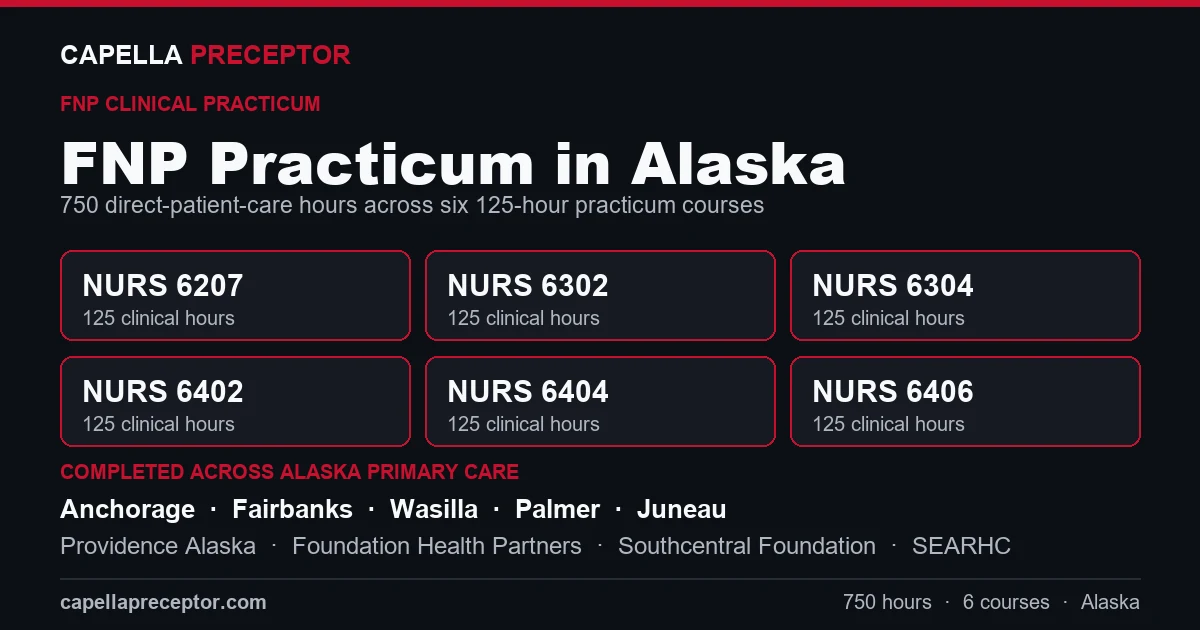
The requirement does not change at the Alaska border. The Capella MSN Family Nurse Practitioner specialization needs a minimum of 750 practicum hours, completed across six clinical courses that each carry 125 hours, under an on-site preceptor you are responsible for securing (Capella, MSN-FNP courses). The coursework is online; the practicum happens in your own Alaska community. Because the FNP is a family role, those hours have to span the lifespan rather than one age group: adult-gerontology, pediatrics, and reproductive or women's health. We keep the full course-by-course breakdown on the FNP page rather than repeating every code here.
What changes in Alaska is the logistics around those hours, not the count. The state's small number of population centers, its full practice authority, and its board-level preceptorship registration all shape how an Alaska FNP placement actually comes together. The rest of this page is the Alaska-specific part.
What does full practice authority mean for an FNP preceptor in Alaska?
The American Association of Nurse Practitioners lists Alaska in the full practice category on its State Practice Environment map (AANP, State Practice Environment). Under Alaska regulation, an APRN "practices independently in the role for which the individual has received specialized education" (Alaska Board of Nursing, statutes and regulations, 12 AAC 44). There is no career-long physician collaboration or supervision requirement, and even controlled-substance prescriptive authority does not require a collaborative plan with a physician, though it carries its own pharmacology and registration conditions.
For an FNP student, the practical effect shows up at the contracting stage. In a reduced or restricted state, a prospective preceptor often has to weigh whether taking a student touches a written collaborative arrangement. In Alaska an NP who runs an independent family or primary care practice can agree to precept on their own authority, with nothing to disturb. That removes one of the most common reasons a busy clinician declines, which is part of why an Alaska match can move quickly once a willing FNP-appropriate preceptor is found.
Does Alaska require a preceptorship registration with the board?
This is the Alaska detail most Capella students miss, and it is the one that can stall a start date. Alaska's Board of Nursing maintains an Advanced Nurse Practitioner Preceptorship Registration, and a student enrolled in an out-of-state program, which a Capella learner in Alaska almost always is, commonly needs that authorization on file before completing clinical hours in the state (Graduate Nursing Education, Alaska APRN preceptorship). Practical points from the board's process:
- It is a separate registration. The board's preceptorship registration is distinct from Capella's own CORE ELMS site-and-preceptor approval. You can clear one and still be waiting on the other.
- It has a fee and a clock. The authorization carries a filing fee and is valid for 12 months, renewable once, so it should be timed to your practicum window rather than filed too early.
- Adding a second preceptor is its own step. Because an FNP often rotates across sites to cover pediatrics and women's health, note that Alaska treats adding a preceptor or clinical site as a further board action, not an automatic extension.
Rules and forms change, so confirm the current requirement and fee with the board before you rely on a date (Alaska Board of Nursing). We track this registration alongside the Capella paperwork so the two timelines do not collide.
Who can precept a Capella FNP student in Alaska?
For an FNP practicum, the preceptor is a physician or an APRN whose practice matches the course population, working in an outpatient primary care setting. Alaska's board recognizes the APRN as a licensed independent practitioner, so an Alaska-licensed nurse practitioner is a fully qualified FNP preceptor here, with no co-signing physician needed. Two FNP-specific checks matter in Alaska:
- Active Alaska license. The board offers online license verification, which lets you confirm a prospective preceptor holds a current Alaska APRN credential before you commit (Alaska Board of Nursing, license verification).
- Population match. An FNP needs adult, pediatric, and women's health exposure. A single full-spectrum family practice can cover most of it, but a preceptor whose Alaska panel is heavily adult-only will leave you short on pediatrics, so plan the spread before you start.
We verify every preceptor's Alaska license against the board record before we present them, so you are not relying on a name alone.
Where do FNP students actually find clinical sites in Alaska?
Most of Alaska's population, and almost all of its primary care capacity, sits in a handful of communities. For a lifespan FNP placement that is both a constraint and a map of where to look. The systems below are real Alaska employers of family and primary care providers; we approach the sites where FNP-appropriate panels exist rather than chasing placements that cannot supply the populations your courses need.
The deepest market, home to Providence Alaska and its family medicine clinics, plus independent primary care. The best odds of covering adult, pediatric, and women's health near one another.
Foundation Health Partners and the Tanana Valley Clinic anchor primary care for a wide catchment, useful for the two adult-gerontology FNP practicum courses.
Wasilla and Palmer, fast-growing and within commuting range of Anchorage, with family practices that can suit a full-spectrum FNP rotation.
Southcentral Foundation, SEARHC in the Southeast, and Tanana Chiefs Conference run primary care across the lifespan and are a strong FNP fit where they accept students.
Kenai and Soldotna on the road system south of Anchorage, with clinics that can carry part of the FNP population mix.
Juneau, Sitka, and Ketchikan, plus off-road communities, where coverage is thinner and a hybrid plan often fills the gaps the FNP cannot.
Tell us your Alaska community and we will tell you honestly whether a local FNP match across all three populations is realistic there, or whether a multi-site plan is the faster route.
What clearances come before the first FNP hour in Alaska?
Finding the preceptor is step one. Before you log an Alaska hour, two clearance tracks have to be complete: the Alaska board's preceptorship registration above, and Capella's own practicum workflow, which runs the same way it does in every state.
The two tracks run on different clocks, which is exactly where Alaska FNP starts slip. We sequence the board registration and the CORE ELMS approval together so neither one is the thing holding up your first day.
In person or virtual for an Alaska FNP student?
The virtual question is more real in Alaska than almost anywhere, because weather, distance, and the lack of a connected road system can leave a student in a village or a smaller Southeast town with no nearby family practice. For the FNP specifically, though, the lifespan requirement pulls toward in-person hours: pediatric and women's health visits in particular expect direct, hands-on patient contact, so most of the 750 cannot be done at a distance.
The default for FNP, and most realistic where clinics cluster, such as Anchorage, the Mat-Su, and Fairbanks. You work on site with an Alaska-licensed preceptor whose panel fits your course populations.
For off-road students, some didactic and follow-up components may run remotely where Capella and the course permit, with hours logged and approved in CORE ELMS. The hands-on lifespan visits stay in person.
Always confirm what your specific FNP course allows before counting on any remote hours. We flag this for you up front so you are not surprised by a course that requires on-site contact.
Alaska FNP FAQ
Do I need to register my preceptorship with the Alaska Board of Nursing for a Capella FNP practicum?
Often, yes. Alaska maintains an Advanced Nurse Practitioner Preceptorship Registration, and out-of-state students such as Capella learners commonly need it on file before starting clinical hours. It carries a fee, is valid for 12 months, and can be renewed once. It is separate from Capella's CORE ELMS approval, so confirm the current requirement directly with the board.
How many practicum hours does the Capella FNP require in Alaska?
A minimum of 750 hours, the same as everywhere else, spread across six clinical courses at 125 hours each, and spanning primary care across the lifespan: adult-gerontology, pediatrics, and reproductive or women's health.
Does an Alaska NP need a physician agreement to precept a Capella FNP student?
No. Alaska is a full practice authority state, so an APRN practices independently under the Board of Nursing with no career-long physician collaboration or supervision agreement. An independent Alaska NP can agree to precept on their own authority.
Who can serve as a Capella FNP preceptor in Alaska?
Typically a physician or an APRN whose practice matches the course population, working in a primary care setting. We verify every preceptor's active Alaska license against the Board of Nursing record before presenting them.
Can I complete my Capella FNP practicum virtually if I live in rural Alaska?
Sometimes, where Capella and the course allow it, but FNP courses expect direct, hands-on lifespan contact, so most hours are in person. For off-road students a hybrid plan can help, with hours logged in CORE ELMS the same as in person. Confirm what your program allows first.
Sources
- Capella University, MSN-FNP courses (750 hours across six 125-hour practicum courses)
- AANP, State Practice Environment (Alaska listed as full practice)
- Alaska Board of Nursing, nursing statutes and regulations (AS 08.68, 12 AAC 44)
- Graduate Nursing Education, Alaska APRN preceptorship registration for out-of-state students
- Alaska Board of Nursing (license verification and current forms)
How Capella Preceptor helps with an Alaska FNP placement
Full practice authority makes Alaska a good state to precept an FNP in, but Capella still leaves the search to you, the map works against you, and the board's preceptorship registration adds a step no one warns you about. We secure a verified, Alaska-licensed FNP preceptor whose panel covers the lifespan your six courses require, time the Alaska board registration alongside the CORE ELMS approval, prepare the affiliation agreement, and keep all 750 hours logged and submitted on schedule.
- Verified Alaska FNP preceptor matched in 7 days, no payment until matched
- Alaska board preceptorship registration and CORE ELMS forms handled together
- In-person across Anchorage, Mat-Su, and Fairbanks, with a hybrid plan where you are remote
Get a Capella FNP preceptor in Alaska
Free 15-minute consult. No payment until matched. We map your full FNP practicum, the Alaska board registration, and all 750 hours.
Get my free consult →