Capella FNP Preceptor in Arizona
The Capella MSN-FNP requires 750 practicum hours across six clinical courses, and you have to secure the preceptor yourself. Arizona is a full practice authority state, so a nurse practitioner here can precept you on their own license without a supervising physician. That combination shapes both who can take you and where your family-practice hours come from. Here is what it means in Arizona, then how we secure the placement.
Last updated: June 28, 2026 · Reviewed by the Capella Preceptor placement team
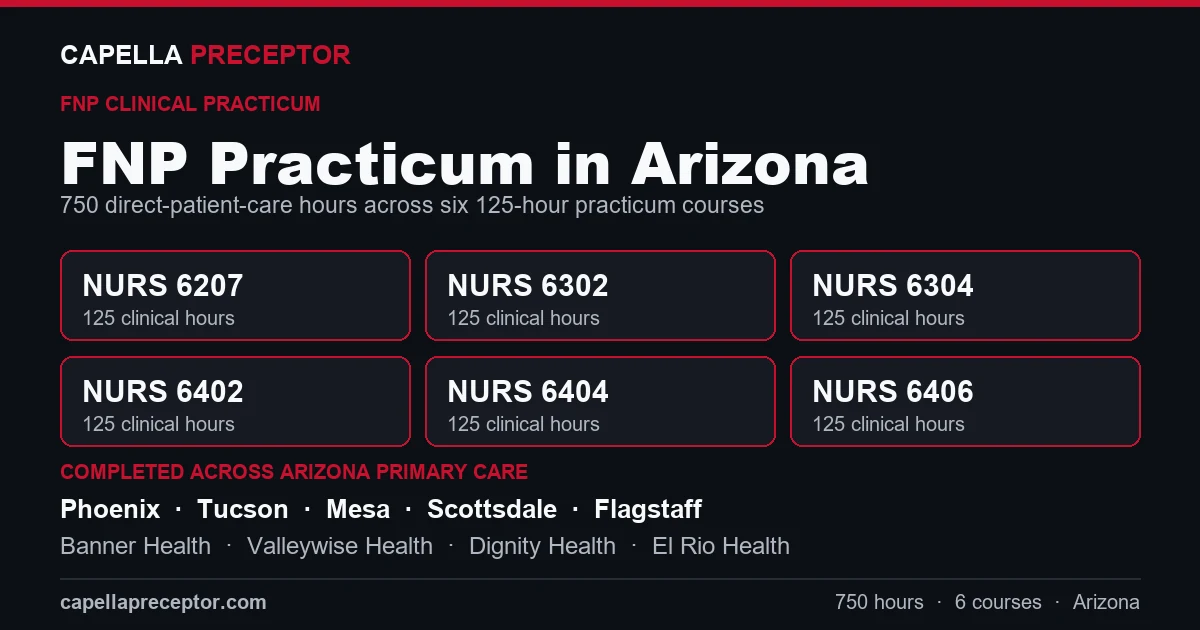
What does the Capella FNP require, and does Arizona change it?
The clinical requirement comes from Capella, not from Arizona. The MSN Family Nurse Practitioner specialization requires a minimum of 750 practicum hours, split across six clinical courses that each carry 125 hours, completed at an approved site under an on-site preceptor (Capella, MSN-FNP courses). The coursework is online; the practicum happens in your own community, which for you means somewhere in Arizona. The 750-hour total is identical in every state. What Arizona changes is not the number of hours but the supply of clinicians who can supervise them and the kind of paperwork that has to clear before you start. Both of those work in your favor here, and we explain why below. For the full course-by-course breakdown of the FNP track, see our FNP preceptor and placement page.
How does Arizona's full practice authority affect an FNP preceptor?
The American Association of Nurse Practitioners places Arizona in its highest tier, Full Practice. Arizona law calls the role a registered nurse practitioner (RNP) and authorizes that nurse to perform "diagnosing, performing diagnostic and therapeutic procedures" and "prescribing, administering and dispensing therapeutic measures, including legend drugs, medical devices and controlled substances within the scope of registered nurse practitioner practice" (A.R.S. § 32-1601). There is no mandated physician supervisory or collaborative-practice agreement.
For lining up an FNP practicum, that is a real advantage on the supply side. Because an Arizona NP is not tied to a supervising physician, many run independent or NP-led family practices and can agree to precept a student on their own authority, without first routing the decision through a physician group or a collaborating doctor. That widens the pool of family, primary care, and women's health NPs who are both willing and legally able to take you. It does not remove the practicum itself: full practice describes what a licensed NP may do after graduation, while you are still a student logging supervised hours, and Capella still leaves the search to you. Our broader Arizona placement page covers the state rules across every Capella program; this page stays on the FNP combination.
Who can serve as your FNP preceptor in Arizona?
FNP hours are earned in outpatient primary care under a qualified preceptor, and the FNP is a lifespan credential, so a single preceptor or panel rarely covers everything. Arizona programs generally accept a board-certified Family Nurse Practitioner, another primary care NP matched to the population, a physician (MD or DO), or in some courses a physician assistant, practicing in family medicine, internal medicine, pediatrics, or women's health. The catch is your population spread, not the title:
Two FNP practicum courses sit here. Arizona's large family and internal medicine practices and its older-adult panels in retirement-heavy areas like Mesa, Sun City, and Scottsdale supply this readily.
Well-child and acute pediatric visits. Often the hardest population to source, so we line up a pediatric or family-medicine NP early rather than mid-course.
Prenatal, postpartum, contraception, and routine gynecologic care, available through women's health practices and the community health centers below.
The final FNP practicum, consolidating full-scope family care. A family-medicine NP with a mixed panel is the cleanest fit for this one.
A preceptor whose panel skews to one age group can leave you short on another, so the population coverage matters more on FNP than on a single-population track. We map it across the whole six-course sequence before you commit an hour.
Where do Arizona FNP students actually do their hours?
Arizona has a deep bench of primary care sites, but it is unevenly spread, and the state runs a genuine preceptor shortage on top of it: roughly 65% of its primary care areas are designated medically underserved, and most NP students nationally spend three to four months cold-contacting clinicians before they land a placement (NPHub, finding Arizona preceptors). The good news is the site density where you do find an opening:
Phoenix, Mesa, Chandler, Gilbert, Scottsdale, Glendale, Tempe, and Peoria, where the deepest concentration of family medicine and primary care sits, including systems such as Banner Health, Valleywise Health, and Dignity Health's St. Joseph's network.
Tucson, Pima County, and border communities, anchored by El Rio Health, a large community health system with the family, pediatric, and women's health mix the FNP courses need.
Arizona's community health centers run more than 175 clinic sites statewide, strong for family practice, pediatric, and women's health hours, especially in south and west Phoenix shortage areas (AACHC).
Flagstaff, Prescott, Yuma, Lake Havasu City, and Sierra Vista, where local FNP options thin out fast and the virtual route keeps you on schedule.
Arizona has also tried to widen this pipeline directly: the 2022 law behind A.R.S. § 36-1803 funded a multiyear, multimillion-dollar Student Nurse and New Graduate Clinical Placements and Preceptor Training grant program through the Arizona State Board of Nursing, projected to add more than a thousand new preceptors statewide (AZBN, HB 2691 nurse training grant). That helps the long-term supply, but it does not place you this term, which is the gap we close.
How do you verify an Arizona FNP preceptor and clear practicum?
Your license and your preceptor's both run through the Arizona State Board of Nursing (AZBN), which credentials the registered nurse practitioner role and, separately, recognizes prescriptive and dispensing authority; NPs who prescribe controlled substances also hold a federal DEA registration and enroll in Arizona's Controlled Substances Prescription Monitoring Program. The board publishes APRN, RN, and LPN license status to Nursys, updated each business day, so an active, unencumbered Arizona license can be confirmed before you commit a single hour. We run that check on every preceptor we put in front of you.
Because Arizona has no collaborative-agreement mandate for NPs, there is no separate physician-supervision document to chase down the way there is in a restricted state, which is one fewer moving part in your clearance. The rest of the workflow is Capella's, the same in Arizona as anywhere, and tracked in CORE ELMS:
- Propose the Arizona site and FNP preceptor in CORE ELMS for Capella's review and approval.
- Execute the affiliation agreement between Capella and the Arizona clinical site, signed before day one.
- Clear third-party compliance through a background-check and health-records vendor such as CastleBranch; confirm the current vendor with your program.
- Log and submit hours in CORE ELMS, where your Arizona preceptor approves each block toward the 750-hour total.
In person or virtual: which fits an Arizona FNP student?
Arizona's geography makes this question real. A student in central Phoenix has dozens of family-practice clinics within a short drive; a student in Yuma, near Flagstaff, or close to tribal land may have very few that can supply the pediatric or women's health side of the FNP. Both routes are legitimate, and the right one depends on where you are and which populations your courses still need.
Best when you live in or near a metro with family, pediatric, and women's health sites. You get hands-on patient contact at an approved Arizona clinic, with the FNP preceptor and paperwork arranged for you.
Best for rural counties or a hard-to-fill population. Supervised telehealth hours, logged in CORE ELMS, keep you moving when no local site can cover a specific FNP course.
Arizona FNP FAQ
Does Capella assign an FNP preceptor in Arizona?
No. Capella states learners are responsible for finding an appropriate preceptor and recommends practicum in your local community. In Arizona you secure the preceptor and site yourself, then submit them in CORE ELMS for Capella's approval.
How many FNP practicum hours do I need in Arizona?
A minimum of 750 practicum hours across six clinical courses that each carry 125 hours. Capella sets that number, so it does not change by state; an FNP student in Arizona logs the same 750 hours as one anywhere else.
Does Arizona require a physician to supervise my FNP preceptor?
No. Arizona is a full practice authority state. Under A.R.S. 32-1601 a registered nurse practitioner diagnoses, prescribes, and dispenses, including controlled substances, without a mandated physician supervisory or collaborative agreement, so an Arizona NP can precept you on their own authority.
Which Arizona settings work for Capella FNP hours?
Primary care and outpatient settings across the lifespan: family medicine, internal medicine, pediatrics, and women's health. Arizona's 175-plus community health center sites and systems like Banner Health, Valleywise Health, Dignity Health, and El Rio Health in Tucson often carry the population mix the FNP courses require.
How do I verify an Arizona FNP preceptor's license?
The Arizona State Board of Nursing is the primary source for license status, and Arizona APRN, RN, and LPN licenses publish to Nursys, updated each business day. We confirm an active, unencumbered Arizona license on every preceptor before we match you.
Sources
- Capella University, MSN Family Nurse Practitioner courses (750 hours, six courses)
- Arizona Revised Statutes § 32-1601, registered nurse practitioner definition and authority
- American Association of Nurse Practitioners, Arizona (Full Practice classification)
- Arizona State Board of Nursing, HB 2691 nurse training and preceptor grant
- Arizona Alliance for Community Health Centers (statewide health-center network)
How Capella Preceptor helps FNP students in Arizona
Arizona's full practice authority widens the pool of NPs who can precept your FNP hours, but Capella still leaves the search, the vetting, and the paperwork to you, and the state's preceptor shortage means most students burn months cold-calling. We close that gap. We secure a verified, Arizona-licensed preceptor who meets Capella's published FNP requirements and whose panel covers the family, pediatric, and women's health hours your six courses need, in Phoenix, Tucson, Flagstaff, or fully virtual, prepare every CORE ELMS form and affiliation agreement, and keep your 750 hours logged and submitted on time.
- Verified Arizona FNP preceptor matched in 7 days, no payment until matched
- Population coverage mapped across all six FNP courses before you start
- Every CORE ELMS form and affiliation agreement handled, in person or virtual statewide
Get a Capella FNP preceptor in Arizona
Free 15-minute consult. No payment until matched. We map your entire 750-hour FNP plan across Arizona.
Get my free consult →