Capella FNP Preceptor in Arkansas
A Capella MSN-FNP student in Arkansas needs a preceptor who can cover 750 primary-care hours across the lifespan and who clears Arkansas board rules: an active, unencumbered APRN or physician license, current practice in the family population focus, and ideally prescriptive authority, because the state wants 300 clock hours of prescribing preceptorship. Arkansas is a reduced-practice state and Capella leaves the search to you. This page maps both at once, then shows how we secure the placement.
Last updated: June 28, 2026 · Reviewed by the Capella Preceptor placement team
What does a Capella FNP student need from a preceptor in Arkansas?
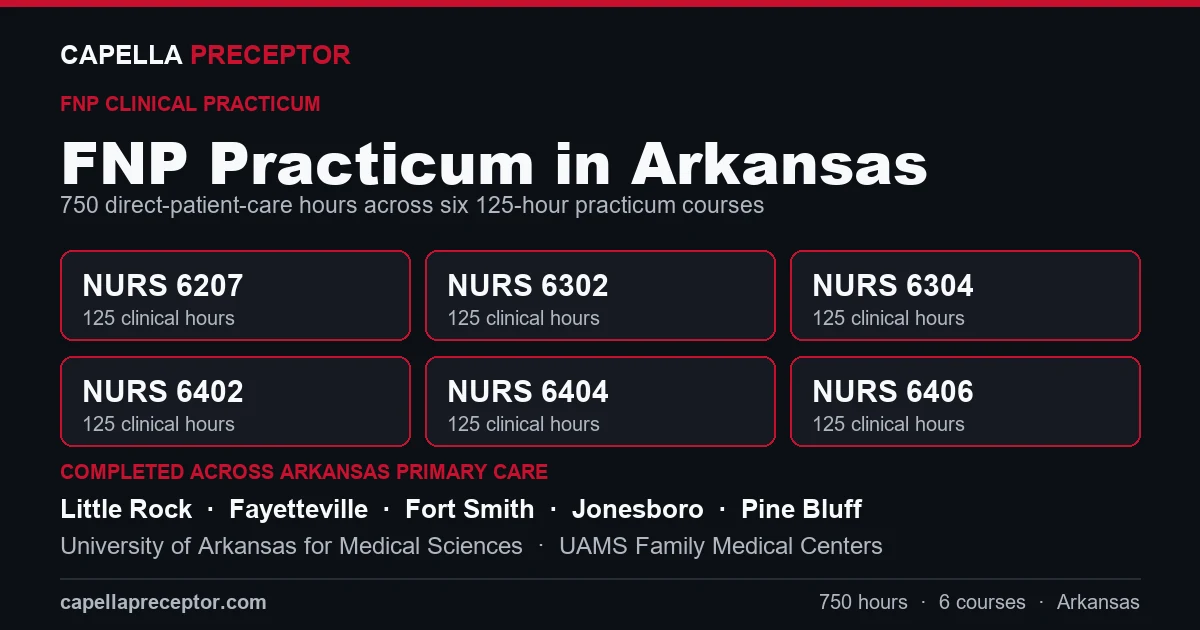
Two requirement sets stack here, and a strong Arkansas placement satisfies both. From Capella, the MSN Family Nurse Practitioner specialization requires a minimum of 750 practicum hours spread across six clinical courses at 125 hours each, in primary care across the lifespan (Capella, MSN-FNP courses). From Arkansas, the State Board of Nursing defines who may even serve as that preceptor. A qualified preceptor must hold an active, unencumbered APRN or physician license and be in current practice in the advanced role and population focus (ASBN, Chapter 4 Advanced Practice Registered Nurse). For an FNP that population focus is family, across the lifespan, so a single-population specialist who never sees children or women's health is a weak fit even if licensed.
The detail most Arkansas FNP students miss is the prescribing rule. Because the FNP is built to prescribe, the board expects documentation of a minimum of 300 clock hours of preceptorial experience in the prescription of drugs, medicines, and therapeutic devices with a qualified preceptor, initiated with the pharmacology course and completed within one year (ASBN, Chapter 4). A preceptor who personally holds prescriptive authority and a collaborative practice agreement is therefore the ideal match in Arkansas, not a nice-to-have. We screen for exactly that combination before we propose anyone.
Is Arkansas a full practice authority state for the FNP practicum?
No. The American Association of Nurse Practitioners classifies Arkansas as a reduced-practice state (AANP, Arkansas state practice environment). Reduced practice means an Arkansas nurse practitioner can act independently in some parts of the role but is limited in at least one element by state law, and the element that bites is prescribing. An APRN who wants prescriptive authority must keep a current collaborative practice agreement with a physician on file with the board, and may not prescribe under it until an approval letter is issued (ASBN, Prescriptive Authority and Collaborative Practice).
For a student in practicum this is about the environment you train in, not a document you sign during clinical hours. You are not the party filing a collaborative agreement. What reduced practice does is concentrate Arkansas primary care inside physician-APRN collaborations, which actually widens the pool of clinicians who already supervise advanced practice learners day to day. The agreement itself is specific: it sets out physician availability for consultation, a quality-assurance plan signed by both parties, and prescriptive authority limited to Schedules III through V unless a controlled-substance provision and an unrestricted DEA registration are added (ASBN, Chapter 4). Seeing how your preceptor's own collaboration is structured is a useful preview of the role you are about to step into.
Arkansas also built an exit ramp from the requirement. Under Act 412 of 2021, a certified nurse practitioner who logs 6,240 hours under a collaborative practice agreement, roughly three years of full-time practice, can apply through the board's Full Independent Practice Credentialing Committee for full independent authority (ASBN, Full Independent Practice Credentialing Committee). Your 750 practicum hours are the first measured steps on that longer arc.
How do Capella's 750 hours compare to Arkansas board minimums?
They clear the state floor with room to spare, which is good news. Arkansas rules require any graduate program leading to advanced practice licensure to deliver a minimum of 500 supervised direct-clinical-practice hours per population focus, plus the 300 prescribing clock hours noted above (ASBN, Chapter 4). Capella sets its FNP requirement at 750 hours, so meeting Capella satisfies Arkansas by design. The table below shows where each number comes from.
The practical takeaway is not the totals but the mix. Because the board counts hours by population focus and Capella counts them by course, you want a preceptor or set of sites that genuinely covers adults, pediatrics, and women's health rather than a single clinic that fills the hour count but skips a population. We plan the spread before day one so no course clock runs out waiting for a missing rotation.
Which Arkansas settings work for FNP primary-care hours?
The FNP is a primary-care credential, so the hours live in outpatient family medicine, internal medicine, pediatric, and women's health settings, not inpatient or single-specialty units. Arkansas has real density to draw on. The University of Arkansas for Medical Sciences runs UAMS Family Medical Centers in Little Rock, Fayetteville, Fort Smith, Jonesboro, Pine Bluff, Batesville, Helena, Magnolia, and Texarkana, and the Little Rock center is the state's first Level 3 Patient-Centered Medical Home (UAMS Health, Family Medical Center Little Rock; UAMS Regional Campuses, Community Health Centers). Alongside those, federally qualified community health centers and independent family practices fill in primary care for medically underserved rural and urban areas across the state.
Little Rock, North Little Rock, Conway, and Hot Springs hold the deepest mix of family medicine, internal medicine, and women's health sites for the adult and reproductive practicum courses.
Fayetteville, Springdale, Rogers, and Bentonville carry large multi-specialty groups and UAMS family medicine clinics, strong for lifespan coverage in one corridor.
Fort Smith, Jonesboro, and Pine Bluff anchor in-person hours through regional clinics and UAMS Family Medical Centers.
Where local family-practice supply is thin, a fully virtual preceptorship keeps you on pace, with every hour logged in CORE ELMS.
A single full-scope family medicine practice can sometimes cover most of the lifespan, but many FNP students in Arkansas rotate across two or three sites to reach the pediatric and women's health courses. We map that coverage to the six practicum courses rather than to a single clinic, so a preceptor with an adult-heavy panel never leaves you short on the pediatric block.
Why is finding an FNP preceptor in Arkansas hard, and who is responsible?
This is the part that stalls most Arkansas FNP students. Capella states plainly that "learners are responsible for finding an appropriate preceptor to oversee the practicum experience," and that practicum is completed in your local community (Capella, MSN-FNP courses). Capella offers support resources, but it does not assign the preceptor or the site. Layer the Arkansas board rules on top, a licensed-and-current preceptor in the family population focus, ideally one who can supply prescribing hours, and the realistic pool in a given town shrinks fast, especially outside the Little Rock and Northwest Arkansas metros.
We do that search instead. We source a preceptor who meets Capella's published requirements, confirm an active unencumbered Arkansas APRN or physician license, check that their practice and population focus fit your FNP courses, and line up a site willing to execute Capella's affiliation paperwork. We never claim a preceptor is "endorsed by Capella," because only Capella approves a placement; we prepare a compliant, verifiable match and submit it for Capella's own review.
What clears before FNP practicum starts in Arkansas?
Securing the preceptor is the first half. Before you log a single hour at an Arkansas site, Capella's clearance workflow has to run. Practicum application, site and preceptor approval, and hour logging all happen in Capella's practicum management system, which we track in our workflow as CORE ELMS. A signed affiliation agreement between Capella and the Arkansas site, plus third-party background and health-records compliance such as CastleBranch, must be in place before practicum begins (Capella, MSN-FNP program).
- Submit the Arkansas site and preceptor in CORE ELMS for Capella's review and approval.
- Confirm preceptor licensure against the Arkansas State Board of Nursing: active, unencumbered, current in the family population focus.
- Execute the affiliation agreement between Capella and your Arkansas clinical site before day one.
- Clear compliance through the third-party background and health-records vendor (such as CastleBranch); confirm the current vendor with your program.
- Log and submit hours in CORE ELMS per course, where your preceptor approves what you record before each course closes.
If a board-specific question about your own situation is unclear, the Arkansas State Board of Nursing is the authority to ask. We point students to ASBN directly rather than guessing at a regulation, then handle the placement logistics around whatever the board confirms. For the broader picture, see our Capella FNP page for the full course and hours breakdown and our Arkansas placement page for the state board and metro detail.
Virtual or in person for Arkansas FNP students?
Both satisfy Capella when the preceptor and site are approved, and the choice usually comes down to geography. If you are in or near Little Rock or Northwest Arkansas, an in-person family medicine placement is straightforward and we match you locally. If you are in a rural county where the nearest qualified family practice is an hour away, a virtual preceptorship lets you complete supervised hours without the commute, with everything still logged in CORE ELMS. For the FNP specifically, the deciding factor is often population coverage rather than distance: we make sure whichever path you take still reaches pediatrics and women's health, not just adult primary care.
Hands-on FNP hours at an approved Arkansas family practice, strongest in the Little Rock and Northwest Arkansas metros where lifespan coverage is easiest to assemble.
Supervised telehealth-based hours that keep rural and delta FNP students on schedule, fully tracked in CORE ELMS.
Arkansas FNP FAQ
What does a Capella FNP student need from a preceptor in Arkansas?
A preceptor who covers the FNP's 750 primary-care hours across the lifespan and meets ASBN rules: an active, unencumbered APRN or physician license, current practice in the family population focus, and ideally prescriptive authority, since the board expects 300 clock hours of prescribing preceptorship.
Is Arkansas a full practice authority state for the FNP practicum?
No. AANP classifies Arkansas as reduced practice, so a prescribing APRN keeps a collaborative practice agreement with a physician on file with the board. For a student in practicum this shapes the training environment, and most FNP preceptors here already work inside that physician-APRN collaboration.
How many clinical hours does the Capella FNP require, and does Arkansas require fewer?
Capella requires a minimum of 750 practicum hours across six 125-hour courses. Arkansas sets a floor of 500 supervised direct-care hours per population focus and 300 clock hours of prescribing preceptorship, so Capella's 750 already exceeds the state minimums.
Where can a Capella FNP student be placed for primary care in Arkansas?
In family medicine, internal medicine, pediatric, and women's health settings. Verifiable sites include UAMS Family Medical Centers in Little Rock, Fayetteville, Fort Smith, Jonesboro, Pine Bluff, and Batesville, plus community health centers and independent family practices, with virtual placement for rural counties.
Sources
- Capella University, MSN Family Nurse Practitioner courses (750 hours, six courses)
- Arkansas State Board of Nursing, Chapter 4 Advanced Practice Registered Nurse (preceptor, 300 prescribing hours, 500 direct-care hours)
- Arkansas State Board of Nursing, Prescriptive Authority and Collaborative Practice
- Arkansas State Board of Nursing, Full Independent Practice Credentialing Committee (Act 412 of 2021)
- AANP, Arkansas state practice environment (reduced practice)
- UAMS Health, Family Medical Center Little Rock (primary-care setting)
How Capella Preceptor helps Arkansas FNP students
You now have the full picture: 750 FNP hours across six lifespan courses, a reduced-practice state where prescribing runs through a collaborative agreement, ASBN rules that define who can precept you and expect 300 prescribing hours, real family-medicine sites from Little Rock to Fayetteville, and a placement Capella leaves entirely to you. That last part is where students lose months. We secure a preceptor who meets Capella's published requirements and Arkansas board rules, prepare every CORE ELMS form and affiliation agreement, and keep your hours logged on schedule.
- Verified Arkansas FNP preceptor matched in 7 days, no payment until matched
- Licensure checked against ASBN; population focus matched to your six FNP courses
- Every CORE ELMS form and affiliation agreement handled, in person or virtual
Get a Capella FNP preceptor in Arkansas
Free 15-minute consult. No payment until matched. We map your entire FNP practicum plan, in person or virtual.
Get my free consult →