Home / MSN-FNP / FNP Preceptor in California
FNP · CaliforniaCapella FNP Preceptor in California
A Capella MSN-FNP student in California needs 750 practicum hours of primary care across the lifespan under a California-licensed preceptor, and the university expects you to find that preceptor yourself. California is a restricted-practice state, so your nurse practitioner preceptor works under standardized procedures with a supervising physician rather than fully independently. That changes the kind of preceptor you line up, not whether you can train here. We secure a verified one for you, from San Diego to the far north of the state.
Last updated: June 28, 2026 · Reviewed by the Capella Preceptor placement team
What does the Capella FNP practicum require in California?
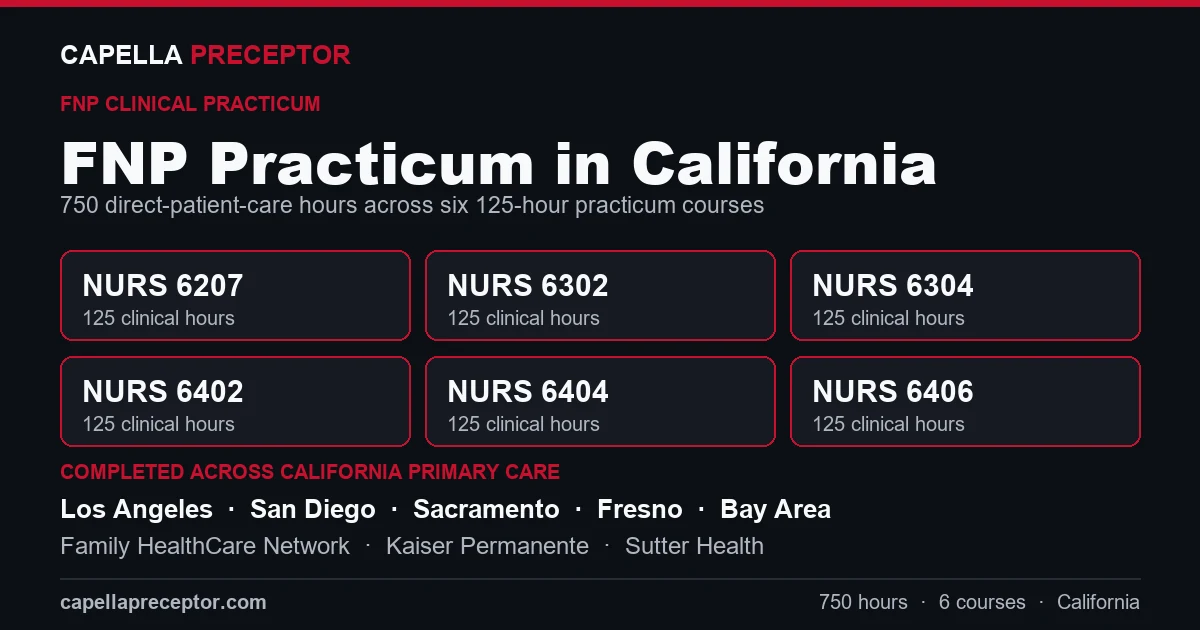
The requirement that follows you into any state is the same: the Capella MSN Family Nurse Practitioner specialization needs a minimum of 750 practicum hours, spread across six clinical practicum courses that each carry 125 hours (Capella, MSN-FNP courses). Because the FNP is a family, lifespan credential, those hours must span adult-gerontology primary care, pediatrics, and reproductive or women's health, and you complete them in your own California community while the coursework stays online. The full course-by-course breakdown lives on our Capella FNP page; this page is about the part that changes when "your community" is California.
What is genuinely California-specific is the preceptor you sit beside. California regulates nurse practitioners more tightly than most states, and that shapes who is available to precept you, how they practice, and where in this very large state you can realistically log family-practice hours. The three things below are the ones a Capella FNP student in California actually has to plan around.
What does restricted practice mean for an FNP precepting relationship here?
The American Association of Nurse Practitioners classifies California as a restricted practice environment, its most limited category, meaning state law requires career-long supervision, delegation, or team management by another health professional for an NP to deliver patient care (AANP, State Practice Environment). In California that takes a specific shape: standardized procedures, which are written protocols an NP and a supervising physician develop and approve together, along with the facility administrator, that define exactly which drugs and devices the NP may furnish and under what circumstances (California BRN, Nurse Practitioner).
For your FNP practicum, that context is mostly a help, with one real catch. The help: your California preceptor already works inside a documented, structured scope, so the expectations for what you observe and perform under their oversight are clear, and a physician is a valid preceptor for many FNP courses alongside NP preceptors. The catch is the supervision ratio. Under Business and Professions Code 2836.1, a supervising physician "shall not supervise more than four nurse practitioners at one time," and that physician's involvement, while it does not require physical presence, does require availability by telephone during patient care (California BPC 2836.1). In practice this caps how many NPs a single practice can run, which tightens the preceptor pool where students compete hardest for hours.
There is a path to more NP independence in California, but it is a career milestone, not a practicum rule. Assembly Bill 890 created the "103 NP" and "104 NP" categories that let qualified nurse practitioners practice without standardized procedures after completing roughly 4,600 hours, about three full-time years, of post-certification clinical practice in California, clarified by Senate Bill 1451 as of January 2025 (California BRN, Assembly Bill 890). As a student you are nowhere near that threshold, and you do not need to be: you train under the standardized-procedure model that is simply the current California norm.
Who can precept a Capella FNP student in California?
A preceptor for your FNP practicum in California should hold an active California license, practice in a primary-care setting that matches the FNP course population, and meet Capella's published preceptor requirements so the placement can be approved. Both NPs and physicians qualify. What is worth checking in California specifically:
- An NP preceptor holds a BRN nurse practitioner certification and, if they prescribe, a furnishing number that lets them order or furnish drugs and devices under standardized procedures (California BRN, Nurse Practitioner). For your prescribing-heavy courses, a furnishing NP is the closest match to the work.
- A physician preceptor in family medicine, internal medicine, or pediatrics can supervise FNP hours, and in the standardized-procedure model is often the very physician whose protocols the clinic's NPs already work under.
- Population fit matters more than title. The FNP spans the lifespan, so a single family-medicine panel can sometimes carry most of your hours, while pediatric and women's health courses may need a second preceptor or site. Plan the spread before you start, not mid-course.
We confirm certification and, where prescribing is involved, the furnishing number before you ever log an hour.
Why is finding an FNP preceptor in California genuinely hard?
This is the part Capella leaves to you, and California makes it harder than the map suggests. The state has clinics in every metro, but two pressures collide. First, the four-NP supervision cap means a single practice can only run so many nurse practitioners, and every one of those is a potential preceptor already spoken for. Second, California has a deep primary-care shortage: nearly 8 million Californians live in the state's roughly 640 primary-care Health Professional Shortage Areas, concentrated in the Central Valley and the rural north (California Health Care Foundation). Fewer providers, more programs chasing them, and a supervision cap on top is why FNP students here lose the most time on the search.
Where the placements actually exist, they cluster in a few setting types that fit FNP primary-care scope:
The closest fit to FNP scope, often covering adults, children, and women's health under one roof in metros like Los Angeles and the Bay Area.
California FQHCs and community clinics, including large networks such as Family HealthCare Network in the Central Valley, staff FNPs across many sites.
Kaiser Permanente, Sutter Health, and county and community clinics run the primary-care panels that map to the FNP courses.
We carry the search for you, matching a verified, Capella-compliant California preceptor whose setting fits your course, and we place beyond the metros into the Inland Empire, the Central Coast, and the far north. Where local capacity is genuinely thin, our virtual preceptorship keeps your hours moving rather than letting a shortage area stall your term.
What clears a California FNP placement before hours start?
Identifying a California preceptor is step one. Capella manages practicum application, approval, and hour tracking through its practicum management system, which we track in our workflow as CORE ELMS, and a single missing item can push your start by weeks. The California-specific friction is usually the affiliation agreement, because large California health systems route those through their own legal review.
- Submit the site and preceptor in CORE ELMS for Capella's review and approval, with the preceptor's California license and certification attached.
- Execute an affiliation agreement between Capella and the California site before practicum begins; start early, because Kaiser, Sutter, and county systems run their own contract review.
- Clear third-party compliance through Capella's background-check and health-records vendor, CastleBranch; confirm your current requirements with your program.
- Log and submit hours in CORE ELMS per course, where your California preceptor approves what you record before each 125-hour course closes.
The total is the same 750 hours wherever you train; California changes the cast, not the count. For the per-course populations and codes, see the Capella FNP page, and for the statewide placement picture across every specialty, the California overview.
In-person or virtual FNP hours in California
California's geography is the real variable. In a dense metro like Los Angeles, San Diego, or the Bay Area, an in-person family-practice placement near home is usually realistic. In the Central Valley, the eastern Sierra, or the rural north, all inside the state's primary-care shortage areas, local preceptor capacity can be thin, and that is where the virtual option earns its place.
A local California primary-care site and preceptor matched to your FNP course, ideal when you are in or near a major metro and want hands-on family-practice hours close to home.
Telehealth-based FNP hours with a California-appropriate preceptor for shortage areas where in-person capacity runs short, all still logged in CORE ELMS. Confirm telehealth limits with your Capella faculty.
California FNP preceptor FAQ
Does a Capella FNP preceptor in California have to be a physician?
No. A Capella FNP preceptor can be a nurse practitioner or a physician, as long as they hold an active California license, practice in a primary-care setting that matches the FNP course population, and meet Capella's published preceptor requirements. California's restricted practice authority shapes how your NP preceptor practices day to day, through standardized procedures with a supervising physician, but it does not require your preceptor to be an MD.
Does California's restricted NP practice authority make the 750 FNP hours harder?
The restriction affects how a California NP practices, not whether you can complete the Capella 750-hour FNP practicum here. Your hours still span adult-gerontology, pediatric, and reproductive or women's health primary care across six 125-hour practicum courses. The bigger California-specific challenge is competition for preceptors, because a supervising physician may oversee no more than four nurse practitioners at once, which tightens the pool in shortage areas.
Where in California can I complete the Capella FNP practicum?
FNP primary-care hours are available across California in family medicine offices, federally qualified health centers, community clinics, and integrated systems in metros such as Los Angeles, San Diego, the Bay Area, Sacramento, and Fresno. In the Central Valley and the rural north, which fall inside California's primary-care Health Professional Shortage Areas, local preceptor capacity is thinner, and that is where our virtual option keeps you on schedule.
How do I verify a California FNP preceptor's license?
The California Board of Registered Nursing publishes license status through the Department of Consumer Affairs license search. We confirm every preceptor's active California RN license, NP certification, and, where prescribing is involved, their furnishing number before you begin, and the records are available for your Capella faculty to check independently.
How fast can I get a Capella FNP preceptor in California?
We guarantee a verified, Capella-compliant California FNP match within 7 days, with no payment until you are matched, and many California students start sooner. We line up coverage across the adult, pediatric, and women's health populations the six FNP practicum courses require.
Sources
- Capella University, MSN Family Nurse Practitioner courses (750 hours across six practicum courses)
- American Association of Nurse Practitioners, State Practice Environment (California: restricted)
- California Board of Registered Nursing, Nurse Practitioner (standardized procedures and furnishing number)
- California Business and Professions Code 2836.1 (four-NP supervision limit)
- California Board of Registered Nursing, Assembly Bill 890 (103/104 NP categories, 4,600 hours)
- California Health Care Foundation, primary-care provider shortage and HPSAs
How Capella Preceptor helps FNP students in California
You now know the lay of the land: a 750-hour FNP practicum, a restricted-practice state, a BRN-licensed preceptor working under standardized procedures, a four-NP supervision cap that thins the pool, and a placement Capella expects you to find on your own. We take that last burden off you, matching a verified, Capella-compliant California FNP preceptor whose panel covers the adult, pediatric, and women's health populations your courses need, preparing every CORE ELMS form and affiliation agreement, and keeping your hours logged and submitted on schedule. See pricing or start a free consult below.
- Verified California FNP preceptor matched in 7 days, in person or virtual
- Every CORE ELMS form, affiliation agreement, and CastleBranch step handled
- No payment until you are matched, statewide from San Diego to the north coast
Get a Capella FNP preceptor in California
Free 15-minute consult. No payment until matched. We map your entire California FNP practicum plan across all 750 hours.
Get my free consult →