Capella FNP Preceptor in Colorado
The Capella MSN-FNP needs 750 primary-care hours across the lifespan, you are the one who secures the preceptor, and Colorado is a full practice authority state. That combination shapes how an FNP placement comes together here: independent NP-led clinics are common, but the prescribing and registry rules around them are Colorado's own. Here is what counts for FNP, what the Colorado State Board of Nursing controls, and how a preceptor gets placed from the Front Range to the Western Slope.
Last updated: June 28, 2026 · Reviewed by the Capella Preceptor placement team
What does the Capella FNP need, and does Colorado change it?
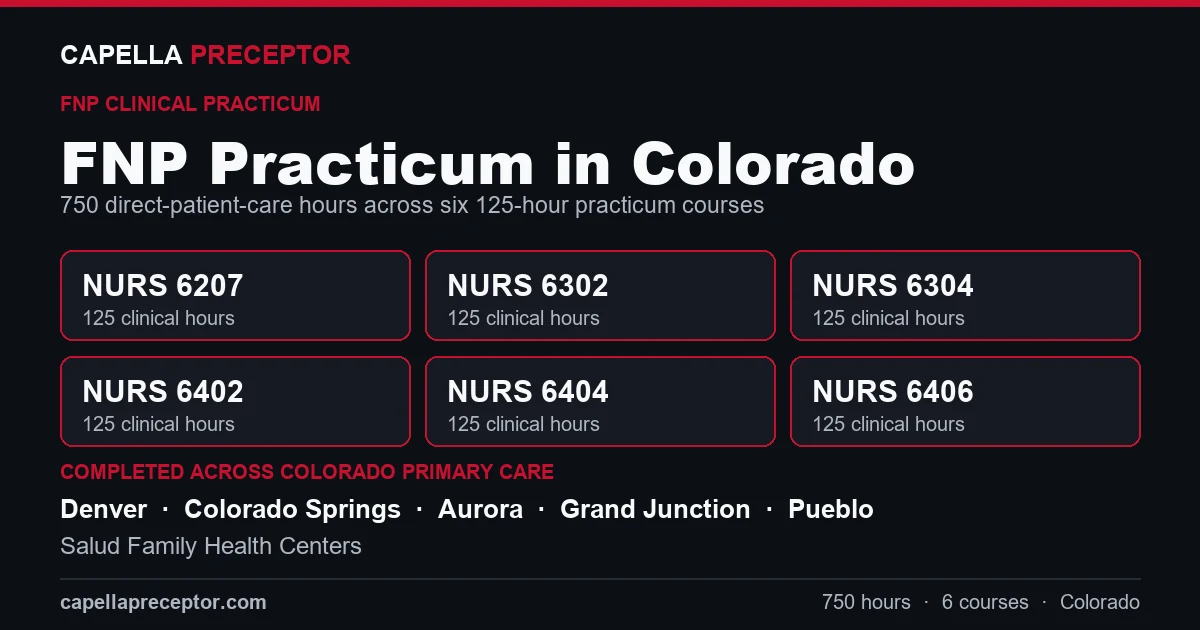
The Capella MSN Family Nurse Practitioner specialization requires a minimum of 750 practicum hours, split across six clinical practicum courses that each carry 125 hours, in primary care across the lifespan (Capella, MSN-FNP courses). The coursework is online; the practicum is completed in your own community. The full breakdown of the six courses and the populations they cover lives on the FNP specialty page; this page is about doing that practicum specifically in Colorado.
Colorado does not change the hour count, the course sequence, or the rule that you secure your own preceptor. Capella states plainly that "learners are responsible for finding an appropriate preceptor to oversee the practicum experience." What Colorado changes is the clinical landscape you are placing into: this is a full practice authority state, so the supply, the sign-off chain, and the prescribing rules around your preceptor look different than they would in a restricted state like neighboring Texas or Utah's reduced model.
What does full practice authority mean for an FNP placement in Colorado?
The American Association of Nurse Practitioners places Colorado in the full practice authority category (AANP, Colorado). A fully credentialed Colorado NP can evaluate, diagnose, order and interpret tests, and prescribe under the Colorado State Board of Nursing, with no standing physician contract required just to practice. For an FNP student, the practical effect is on the supply side: many family medicine and community clinics across the state already run on NP-led primary care, which is exactly the across-the-lifespan setting your six courses need.
There is a catch worth understanding before you assume every Colorado NP can be your preceptor. Full authority is not handed to a new NP on day one of prescribing. Colorado runs a two-step prescriptive model. An NP first holds provisional prescriptive authority (RXN-P), then earns full prescriptive authority (RXN) after completing a 750-hour prescribing mentorship within three years, supervised by a physician or an NP who already holds full RXN (3 CCR 716-1.15). The RXN also maintains an articulated plan for safe prescribing and ongoing collaboration (C.R.S. 12-255-112).
Why this matters to you: a preceptor who holds full RXN is one who can model the full scope of prescribing your FNP courses expect, and who is firmly on the Advanced Practice Registry you can verify. It does not mean a preceptor must hold RXN to oversee a student. Capella's requirement is a qualified clinician matched to the population, commonly a physician or an experienced NP. The two-step prescribing rule is about the preceptor's own practice, not a Capella precepting condition. We screen for both.
Who regulates your FNP preceptor in Colorado?
Nurses and advanced practice nurses in Colorado are regulated by the Colorado State Board of Nursing, inside the Department of Regulatory Agencies (DORA), Division of Professions and Occupations (Colorado DPO, Nursing). The board licenses RNs, registers advanced practice registered nurses on Colorado's Advanced Practice Registry (APR), and grants the RXN-P and RXN prescriptive credentials described above. One quirk catches students out: Colorado registers an NP's advanced practice status (APN) and grants prescriptive authority (RXN) as two separate steps, so a clinician can be on the registry without yet holding full prescriptive authority.
Anyone can verify a Colorado license through the DORA Division of Professions and Occupations online lookup (Colorado DORA license lookup). For an FNP placement we confirm the preceptor holds an active, unrestricted license, sits on the APR with a population focus that fits family or primary care, and can sign the evaluations your specialty courses require. The broader Colorado state page covers the board and registry across every NP specialty; this section is the FNP slice.
Where do Capella FNP students actually find primary-care hours in Colorado?
The FNP is a lifespan, primary care role, so your 750 hours have to span adult and older-adult primary care, pediatrics, and reproductive or women's health. That mix is easiest to hit in outpatient primary care, and Colorado has a real supply of it, but it is unevenly distributed. The Front Range fills first; the plains and the mountains are thinner and run on a tighter slot count.
Denver, Aurora, Colorado Springs, Fort Collins, Boulder, Greeley: the deepest pool of family and internal medicine clinics.
Federally qualified centers such as Salud Family Health Centers staff NPs across adult, pediatric, and women's health, a strong FNP fit.
Pueblo and Cañon City family medicine and community clinics, where slots are real but fewer than Denver.
Grand Junction, Montrose, Durango: primary care exists, but pediatric and women's health depth varies by town.
Glenwood Springs, the Vail valley, Summit County: seasonal demand, limited student slots.
Eastern plains and the San Luis Valley are largely primary-care shortage areas; placements take more planning here.
The reason geography matters so much for FNP and not for a single-population track is the lifespan requirement. A federally qualified health center like Salud, which staffs medical, pediatric, and women's health under one roof, can sometimes cover most of your courses in one site. A small rural family clinic may cover adults well but leave you short on pediatrics or reproductive health, which is the most common way an FNP student stalls a course clock. We map the population coverage before you commit, not after.
What has to be in place before you log a Colorado FNP hour?
Identifying a willing Colorado preceptor is step one, not the finish line. Before a single FNP hour counts, the placement runs through Capella's practicum workflow, which we track as CORE ELMS. Full practice status can speed the first step, because an independent NP can often agree to precept without routing the decision through a supervising physician, but every clearance step still applies in full.
- Propose the Colorado site and FNP preceptor in CORE ELMS for Capella to review and approve, with the population mix your six courses need.
- Execute a signed affiliation agreement between Capella and the Colorado site before practicum begins.
- Clear third-party compliance for the background check and health records (a vendor such as CastleBranch); confirm the current vendor with your program.
- Log FNP hours in CORE ELMS per course, for preceptor approval, before each of the six courses closes.
If you want the same checklist for every NP specialty rather than the FNP view, the Colorado state page walks the statewide clearance sequence, and the hours breakdown shows the totals by program.
In-person or virtual for a Colorado FNP student?
Geography drives this choice more in Colorado than in a compact state. A student in Aurora or Colorado Springs has many primary care options within a short drive; a student in the San Luis Valley, on the eastern plains, or in a small mountain town may have very few, and several of those counties are designated primary-care shortage areas. We support both routes for the FNP track:
A local Colorado preceptor and site near you, best when your area has family medicine or an FQHC with open student slots and you want hands-on lifespan hours.
A remote option for telehealth-eligible primary-care hours when local slots are thin in the mountains, plains, or San Luis Valley, with hours still tracked in CORE ELMS.
Confirm with your Capella faculty which FNP hours can be earned virtually, because the mix differs by course and the pediatric and women's health components are often expected to be hands-on. We build the plan around what your specific courses will accept.
FNP in Colorado: FAQ
Is Colorado a good state to do a Capella FNP practicum?
It can be. Colorado is a full practice authority state, so many primary care clinics are NP-led and an independent NP can agree to precept without routing the decision through a physician, which shortens negotiation. It does not change the Capella requirement: you still secure your own FNP preceptor and site for the 750-hour, across-the-lifespan practicum, then get them approved in CORE ELMS with a signed affiliation agreement.
Does my Colorado FNP preceptor need full prescriptive authority?
No. Capella requires a qualified preceptor matched to the population, typically a physician or an experienced NP. Full Colorado prescriptive authority (RXN) is a credential the preceptor earns for their own practice, not a Capella precepting condition. It helps indirectly: a full-RXN preceptor can model the prescribing your FNP courses cover and is firmly on the Advanced Practice Registry you can verify.
How does a Capella FNP get primary-care hours across rural Colorado?
Front Range family medicine, internal medicine, and FQHC sites such as Salud Family Health Centers cover most FNP populations. On the eastern plains, in the mountains, and in the San Luis Valley, slots are thinner and many counties are shortage areas, so we line up a local site or a virtual option for telehealth-eligible hours, tracked in CORE ELMS.
Who verifies a Colorado FNP preceptor's license?
The Colorado State Board of Nursing, within DORA's Division of Professions and Occupations, licenses RNs, registers APRNs on the Advanced Practice Registry, and grants the RXN-P and RXN prescriptive credentials. Anyone can check a license on the DORA online lookup. We verify every preceptor against it before matching you.
How fast can you place an FNP preceptor in Colorado?
We match a verified, Colorado-licensed, Capella-compliant FNP preceptor in 7 days, in person or virtual, with no payment until you are matched. For a multi-population FNP track we plan the pediatric and women's health coverage up front so a single course clock does not stall you mid-program.
Sources
- Capella University, MSN-FNP courses (750 hours across six 125-hour courses, learner secures the preceptor)
- AANP, Colorado state advocacy (full practice authority)
- Colorado State Board of Nursing (DORA, Division of Professions and Occupations)
- Colorado DORA online license lookup
- 3 CCR 716-1.15, prescriptive authority rules for APRNs (RXN-P, 750-hour mentorship, full RXN)
- C.R.S. 12-255-112, APRN prescriptive authority and the articulated plan
- Salud Family Health Centers (Colorado FQHC, primary care across the lifespan)
How Capella Preceptor places your FNP in Colorado
You now have the full picture: the FNP needs 750 lifespan hours, Colorado is a full practice state with its own two-step prescribing rules and its Advanced Practice Registry, and Capella still leaves the placement to you. That last part is where Colorado FNP students lose weeks chasing clinics, especially for the pediatric and women's health pieces. We secure a verified, Colorado-licensed, Capella-compliant FNP preceptor whose panel covers your courses, near you or virtual, prepare every CORE ELMS form and affiliation agreement, and keep your hours logged on schedule.
- Verified Colorado FNP preceptor matched in 7 days, lifespan coverage, in person or virtual
- License checked against the DORA registry, every CORE ELMS form and affiliation agreement handled
- No payment until matched, statewide from Denver and Colorado Springs to the Western Slope
Get a Capella FNP preceptor in Colorado
Free 15-minute consult. No payment until matched. We map your full FNP practicum plan, lifespan coverage included.
Get my free consult →