Capella FNP Preceptor in Connecticut
A Capella MSN-FNP practicum is 750 hours across six clinical courses, and you secure the preceptor. Connecticut is a full practice authority state, so an experienced nurse practitioner can precept your family-practice hours on their own license, without a physician on the contract. This page merges the two: what the FNP track demands, what Connecticut's board rules mean for who can sign your evaluations, and how we lock the placement in.
Last updated: June 28, 2026 · Reviewed by the Capella Preceptor placement team
What the Capella FNP requires before Connecticut even enters the picture
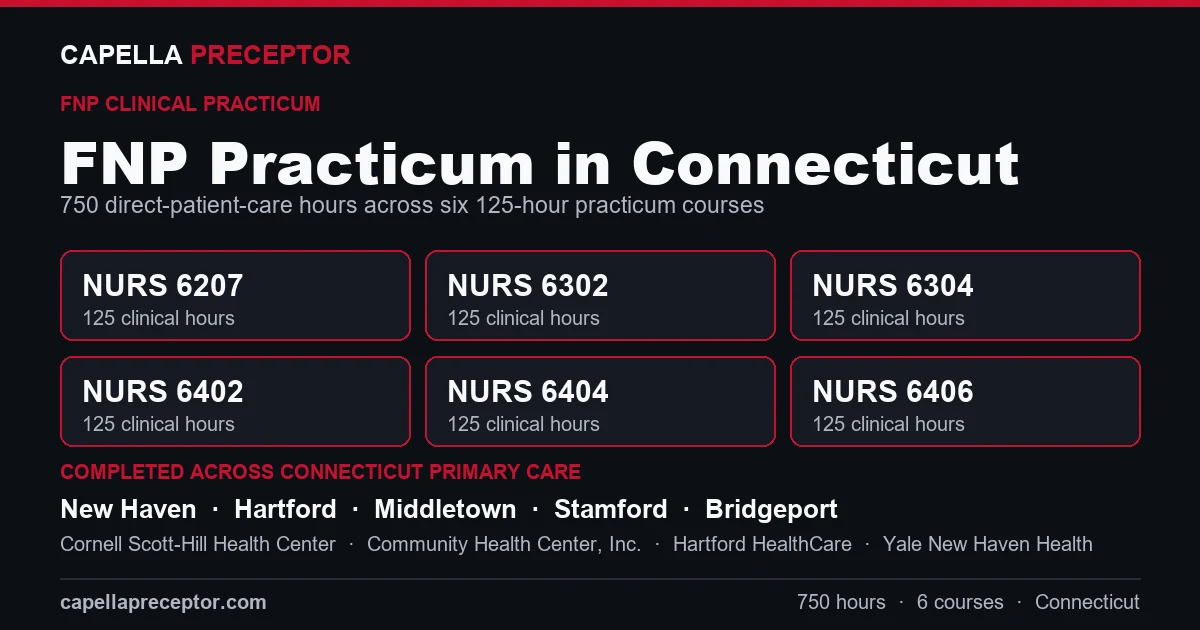
Start with the number that does not move: the Capella MSN Family Nurse Practitioner specialization requires a minimum of 750 practicum hours, split across six clinical courses that each carry 125 hours (Capella, MSN-FNP courses). The coursework is online; the practicum is completed in person in your own community, which for you means Connecticut (Capella, MSN-NP program). Because the FNP is a family role, those hours span the lifespan: two adult-gerontology primary care courses, pediatric primary care, reproductive or women's health, then a transition-to-practice course.
That spread is what makes a Connecticut placement a planning exercise rather than a single phone call. A preceptor whose panel is all adults can carry the two adult-gerontology courses, but you will still be short pediatric and women's health hours. The full hour and course breakdown lives on the Capella FNP page; this page is about doing it inside Connecticut's rules.
Does full practice authority change who can precept my FNP hours in Connecticut?
It widens the pool of preceptors in your favor. The American Association of Nurse Practitioners classifies Connecticut as a full practice authority state (AANP, Connecticut), the 18th state to grant nurse practitioners that authority when the legislature passed the change in 2014 (Connecticut General Assembly, OLR report 2016-R-0190). An experienced Connecticut NP can evaluate, diagnose, order diagnostics, and prescribe under the sole authority of the state board, with no mandatory contract tying them to a supervising physician. For your FNP practicum, an independent family or adult-gerontology nurse practitioner can take you on and sign your evaluations on their own license, so you are not limited to physician-led practices the way you would be in a restricted state.
One Connecticut-specific wrinkle shapes which clinicians qualify, because the state reaches full authority through a transition model. A licensed APRN must work in collaboration with a Connecticut-licensed physician for at least three years and 2,000 hours before practicing independently; only after meeting both thresholds, documenting them, and giving written notice to the Department of Public Health may the APRN drop the collaborative agreement (Connecticut DPH, APRNs practicing not in collaboration). So a seasoned NP precepts you outright, while a newer NP inside that transition window precepts you with their collaborating physician in the background. Both are valid FNP preceptors; the difference is only whether a physician is formally attached to the practice.
Which Connecticut clinicians and settings fit the FNP scope?
An FNP preceptor must hold an active Connecticut license and practice in a primary care, outpatient setting that matches your course populations. In a full practice state that pool is wide: independent FNPs and adult-gerontology NPs, family physicians, and pediatric or women's health clinicians all qualify for the courses matched to their panel. The settings below line up with the FNP lifespan requirement.
The closest fit to the FNP scope, often covering adults, children, and women's health in one panel, common across suburban Connecticut.
Connecticut has roughly ten federally qualified health centers serving the full lifespan, strong for hitting several FNP populations at one site.
Well-child and acute pediatric visits to satisfy the pediatric primary care practicum, plentiful around Hartford and New Haven.
Prenatal, postpartum, and gynecologic visits for the reproductive health practicum course.
Connecticut's safety-net network is a particular advantage for FNP students, because those sites see the lifespan mix the track demands. The state's first federally qualified health center, Cornell Scott-Hill Health Center in New Haven, runs primary care, pediatric, and women's health services across more than thirty sites in Greater New Haven and the Lower Naugatuck Valley (Cornell Scott-Hill Health Center, About). Community Health Center, Inc. in Middletown and Generations Family Health Center in eastern Connecticut run similar full-lifespan primary care, and the large systems, Hartford HealthCare and Yale New Haven Health, anchor primary care across the Greater Hartford and shoreline corridors. Inpatient or specialty-only rotations are a poor fit because the FNP is a primary care credential, so confirm any nonstandard Connecticut site with your faculty before committing hours.
How do I verify a Connecticut FNP preceptor before I commit?
Nursing in Connecticut is regulated by the Board of Examiners for Nursing, which sits within the Department of Public Health and sets practice standards for RNs and APRNs; licensing and renewals run through its Practitioner Licensing and Investigations section (Connecticut DPH, APRN Practice). Before a clinician oversees a single FNP hour, confirm the credential is active and unencumbered through Connecticut's online eLicense verification, which returns any RN, APRN, or physician license in about a minute (Connecticut eLicense).
We run the eLicense check on every Connecticut preceptor we propose and confirm their panel covers the FNP populations your courses require, so the clinician who signs your evaluations holds a current Connecticut license in the right role.
Why is finding an FNP preceptor in Connecticut harder than it looks?
Here is the gap Capella leaves to you. Capella states that "learners are responsible for finding an appropriate preceptor to oversee the practicum experience," and that practicum happens in your local community; the university does not assign the preceptor or the site (Capella, MSN-NP program). Connecticut is small and densely populated, which sounds like an easy market, but the same family practices in the Hartford, New Haven, and Fairfield County corridors field requests from students at every regional FNP program at once, including the campus and online programs run out of UConn, Yale, Sacred Heart, and Southern Connecticut State. A 750-hour FNP needs not one yes but coverage across adult, pediatric, and women's health, so one unanswered email in February becomes a missed start date in May.
We secure the placement instead, and we match across the whole state rather than asking you to commute across county lines:
- Greater Hartford, including West Hartford, New Britain, and the Farmington Valley primary care corridor.
- New Haven and the shoreline, where the FQHC and Yale New Haven primary care network runs deep.
- Fairfield County, covering Stamford, Norwalk, Bridgeport, and Danbury family practices.
- Eastern and northeastern Connecticut, including Norwich, New London, and the more rural Windham County towns where FNP options are thinner.
The clearance steps for a Connecticut FNP practicum
Full practice authority decides what an NP may do once licensed; it does not shortcut Capella's clearance workflow. However favorable Connecticut's environment is, you cannot log an FNP hour until the placement is approved. The sequence:
1. Confirm the Connecticut preceptor's license in eLicense -> active and in role
2. Propose site and preceptor in Capella's practicum system -> CORE ELMS
3. Sign the affiliation agreement between Capella and the Connecticut site
4. Clear third-party compliance, background check and health records, e.g. CastleBranch
5. Log and submit each course's 125 hours in CORE ELMS for preceptor approval
Two pieces consistently stall Connecticut FNP students. The affiliation agreement is a contract between Capella and the site, and a busy practice manager can sit on it for weeks; we push it through. Third-party compliance, typically a CastleBranch package, must be complete before day one. And because FNP hours are tied to specific courses, you cannot bank hours early and coast, so a preceptor who can commit across the whole multi-population sequence matters more here than for a single-focus track.
In person or virtual for a Connecticut FNP practicum
Connecticut is compact, but FNP-suitable supply is not evenly spread: the Hartford, New Haven, and Fairfield County corridors carry most of the primary care, pediatric, and women's health practices, while the northeast and northwest hills have fewer. Many FNP students blend the two options, anchoring with a local family practice for hands-on contact and using a virtual preceptorship to fill the one population, often pediatrics or women's health, the local site cannot cover, with those hours captured and approved in CORE ELMS just as on site. We build the plan around where you live in Connecticut and which of your six courses still need hours. The broader trade-offs are on the Connecticut placement page.
Connecticut FNP FAQ
Can a Connecticut nurse practitioner precept my Capella FNP practicum on their own?
In most cases yes. Connecticut is a full practice authority state, so an APRN who has completed at least three years and 2,000 hours of collaborative practice may practice and precept independently. A newer APRN still in that transition window works in collaboration with a Connecticut-licensed physician, who supports the practice. Either way, a Connecticut-licensed FNP, AGNP, or family physician can serve as a preceptor who meets Capella's published requirements.
How many FNP practicum hours do I need to complete in Connecticut?
A minimum of 750 practicum hours, split across six clinical courses that each carry 125 hours. The total is the same in any state; what changes by state are the board rules and the supply of preceptors near you.
Where can FNP students find primary care clinical sites in Connecticut?
Family medicine, internal medicine and primary care, pediatric clinics, and women's health practices across Greater Hartford, New Haven, and Fairfield County all fit the FNP scope. Connecticut also has community health centers and FQHCs, such as Cornell Scott-Hill Health Center in New Haven and Community Health Center, Inc. in Middletown, that see the lifespan mix the FNP track requires.
Does Capella assign an FNP preceptor in Connecticut?
No. Capella states learners are responsible for finding an appropriate preceptor, and practicum is completed in the student's local community. Capella does not assign the preceptor or site. We secure a verified, Connecticut-licensed preceptor who meets Capella's published requirements, typically within seven days, with no payment until you are matched.
How do I confirm a Connecticut FNP preceptor's license?
APRN and physician licenses in Connecticut are issued by the Department of Public Health and can be checked through the state's online eLicense verification at elicense.ct.gov. We verify every preceptor's Connecticut credential and role before we match you.
Sources
- Capella University, MSN Family Nurse Practitioner courses (750 hours, six 125-hour courses)
- Capella University, MSN-NP program (student secures the preceptor, local practicum)
- AANP, Connecticut state page (full practice authority)
- Connecticut DPH, APRNs practicing not in collaboration (3 years / 2,000 hours, written notice)
- Connecticut DPH, APRN Practice and the Board of Examiners for Nursing
- Connecticut General Assembly, OLR report on APRNs (2016-R-0190)
- Connecticut eLicense, online License Verification
- Cornell Scott-Hill Health Center, About (Connecticut's first FQHC, Greater New Haven)
How Capella Preceptor helps in Connecticut
The full picture: the FNP is 750 hours across six lifespan courses, Connecticut is full practice authority so independent NPs can precept on their own license, and Capella still leaves the placement to you. That last gap is where FNP students lose months. We secure a verified, Connecticut-licensed preceptor who meets Capella's published requirements and whose panel covers the populations your courses need, prepare every CORE ELMS form and the affiliation agreement, and keep your hours logged and submitted on time, in person or virtual.
- Verified Connecticut FNP preceptor matched in 7 days, no payment until matched
- Panel matched to all six FNP courses: adult-gerontology, pediatric, and women's health
- Every CORE ELMS form, affiliation agreement, and compliance step handled across Hartford, New Haven, and Fairfield County, or fully virtual statewide
Get a Capella FNP preceptor in Connecticut
Free 15-minute consult. No payment until matched. We map all 750 hours across your six FNP courses.
Get my free consult →