Home / MSN-FNP / FNP Preceptor in Florida
FNP · FloridaCapella FNP Preceptor and Practicum Placement in Florida
The Capella MSN-FNP requires 750 practicum hours across six 125-hour courses spanning the lifespan, and Florida is a restricted nurse practitioner state, so the preceptor you train under here works inside a physician supervisory protocol. That combination is exactly where Florida FNP students stall. We secure a verified, Florida-licensed preceptor whose population focus fits your FNP courses, in person or fully virtual, within 7 days, and handle every CORE ELMS and CastleBranch step.
Last updated: June 28, 2026 · Reviewed by the Capella Preceptor placement team
How many FNP hours do you need, and does Florida change that?
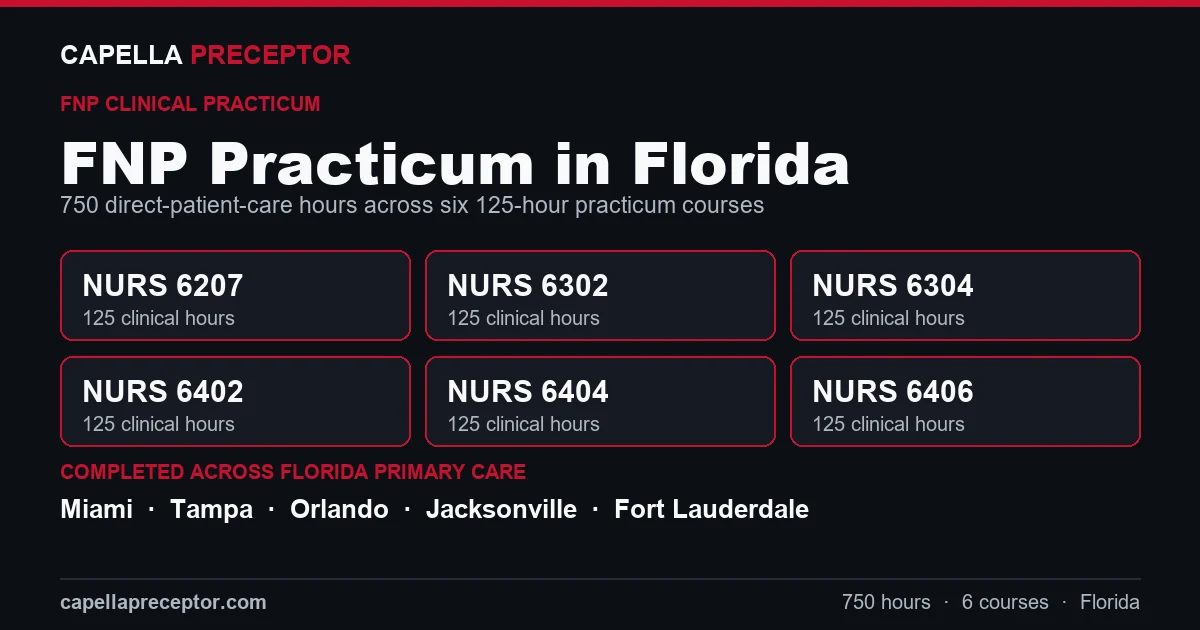
The hour total is the same everywhere. The Capella MSN Family Nurse Practitioner specialization requires a minimum of 750 practicum hours, completed across six clinical practicum courses that each carry 125 hours (Capella, MSN-FNP courses). Florida does not add or subtract a single hour. What Florida changes is the supervision framework your preceptor sits inside, and that is what trips students up when they go to get a site approved.
Because the FNP is a primary care role across the lifespan, those 750 hours have to spread across adult-gerontology, pediatric, and reproductive or women's health, not pile up in one clinic. A Florida preceptor whose panel is heavily adult-only can leave you short on pediatric or women's health hours late in the program, with a course clock already running. The full course-by-course breakdown lives on our Capella FNP page; this page is about doing it in Florida specifically.
What does Florida being a restricted practice state mean for your preceptor?
The American Association of Nurse Practitioners classifies Florida as a restricted practice state (AANP, State Practice Environment). In practice, that means a standard Florida APRN does not work independently. Under Florida Statute 464.012, an APRN must perform the functions authorized for advanced practice within the framework of an established supervisory protocol with a physician, and that protocol must be maintained on site at each location where the APRN practices (Florida Statutes 464.012). National board certification is required for every Florida APRN specialty before licensure (Florida Board of Nursing, APRN requirements).
For your FNP practicum, this is the practical reality: the family nurse practitioner who precepts you is almost always working under a protocol with a collaborating physician, and Capella will expect that preceptor's license, certification, and scope to line up with your course before it approves the site. A physician (MD or DO) in family or internal medicine can precept you directly. Getting that match right the first time is the difference between an approved Florida site and a rejected submission that costs you a term.
Can an FNP precept you in Florida, or does it have to be a doctor?
A Florida-licensed APRN can absolutely precept your Capella FNP practicum, as long as the preceptor's population focus matches the course you are in. That is the common case, since the FNP is a primary care credential and most family-practice preceptors are themselves nurse practitioners. What Florida law requires is that the precepting APRN is operating legally, which means one of two arrangements:
- Supervisory protocol (the default). The APRN holds an established protocol with a physician under Statute 464.012, kept on site at the clinic. This covers most family medicine, pediatric, and women's health practices in Florida.
- Autonomous registration. An APRN who registered for autonomous practice under Statute 464.0123 can practice independently in primary care. This route is open only to clinicians who have logged at least 3,000 clinical hours under physician supervision within the past five years, plus graduate coursework in differential diagnosis and pharmacology (Florida Statutes 464.0123).
- A physician preceptor. An MD or DO in family medicine, internal medicine, or pediatrics can serve as your preceptor directly, with no protocol question at all.
Florida defines autonomous primary care narrowly: family medicine, general pediatrics, and general internal medicine, including health promotion, disease prevention, and the diagnosis and treatment of acute and chronic illness (Florida Administrative Code 64B9-4.001). That definition lines up almost exactly with what your FNP courses ask you to cover, which is why a primary care preceptor is the right fit and a specialty-only clinic is not.
How do you verify a Florida preceptor before you submit them?
Nurse practitioners in Florida are licensed and regulated by the Florida Board of Nursing, inside the Florida Department of Health. Before you put a preceptor into CORE ELMS, confirm three things on the public record, because a credential that does not hold up under faculty review is the most common reason a Florida site submission bounces.
Anyone can run the license check through the Florida Department of Health MQA verification tool, which returns the clinician's license type, status, and specialty (Florida DOH, MQA license verification). We run that check on every Florida preceptor we present, then match the population focus to the FNP course you are entering, so the credential you submit in CORE ELMS clears review the first time.
Where do FNP students find primary care hours in Florida?
Florida is one of the largest NP markets in the country, and demand for primary care is climbing. State workforce projections show Florida adding thousands of NP positions this decade, and the U.S. Health Resources and Services Administration projects a primary care provider deficit in Florida by the mid-2030s. That demand is good news for finding a placement, but the metro clinical markets are also crowded with students from many programs, so the right setting and a preceptor with capacity both matter. The FNP fits these Florida settings:
The closest fit to the FNP scope, often covering adults, children, and women's health under one panel across Florida's primary care clinics.
Florida has more than 70 FQHCs delivering primary care, pediatrics, and women's health to underserved communities, a strong source of varied lifespan hours.
Well-child, prenatal, and gynecologic visits to satisfy the pediatric and reproductive health FNP practicum courses.
Outpatient primary care across Miami-Dade, Broward, Tampa Bay, Orlando, and Jacksonville, plus rural and Panhandle counties where capacity is widest.
We place Capella FNP students across the whole state, not only the headline metros: South Florida (Miami, Fort Lauderdale, Hialeah), Central Florida and the I-4 corridor (Orlando, Kissimmee, Lakeland), Tampa Bay (Tampa, St. Petersburg, Clearwater, Sarasota), North and Northeast Florida (Jacksonville, Gainesville, Tallahassee), and the Southwest and Panhandle (Fort Myers, Naples, Cape Coral, Pensacola). If your county is saturated, a fully virtual placement keeps you on schedule, and the hours, preceptor sign-off, and CORE ELMS record look the same to Capella either way.
Clearing the Capella FNP practicum steps in Florida
Once you identify a compliant Florida preceptor and site, the clearance workflow is the same one Capella runs nationally, with the Florida license and protocol check folded into the first step. Capella states that learners are responsible for finding their own preceptor and site, so this sequence is on you unless you hand it to a placement team (Capella, MSN-NP program).
Submit the placement in Capella's practicum system, tracked in our workflow as CORE ELMS, with the preceptor's Florida license and population focus attached.
A signed agreement between Capella and the Florida clinical site must be in place before any hours count.
Clear the background-check and health-record requirements through Capella's vendor, such as CastleBranch; confirm the current one with your program.
Record FNP hours in CORE ELMS, where your Florida preceptor approves them course by course through the term.
The Florida-specific risk sits in step one: a preceptor whose license has lapsed, whose certification does not match your population, or whose protocol is not on file can be rejected, and you find out after you have lost setup time. We prepare these forms with you, verify the Florida credential up front, chase the signatures, and keep the submission moving so a site approval does not stall the start of a course.
Virtual or in-person FNP practicum for Florida students
Both paths satisfy Capella. In-person placement puts you in a Florida primary care clinic with a local preceptor and is the natural fit when you want hands-on lifespan time near home. Virtual preceptorship pairs you with a qualified clinician over secure video, which is the practical choice when your county's clinical slots are taken or your schedule will not bend. Because Florida is a restricted state, we confirm in either case that the preceptor's license and protocol or autonomous-registration arrangement line up with what Capella will approve, so the supervision question is settled before your first logged hour.
Florida FNP FAQ
How many practicum hours does the Capella FNP need in Florida?
A minimum of 750 practicum hours across six 125-hour clinical courses, the same total in every state. Florida does not change the hour count; it changes the supervision framework your preceptor practices under, because Florida is a restricted nurse practitioner state.
Can an FNP precept me in Florida, or does it have to be a physician?
A Florida-licensed APRN can precept your Capella FNP practicum as long as their population focus matches your course. Florida law requires that APRN to practice within a supervisory protocol with a physician under Statute 464.012, unless they hold autonomous registration under 464.0123. A physician (MD or DO) in family or internal medicine can also serve as your preceptor.
What does Florida being a restricted practice state mean for my FNP placement?
It means the preceptor you train under is operating inside a physician-supervised framework. A standard Florida APRN keeps an established supervisory protocol on site at each practice location. Capella will want a preceptor whose license, certification, and protocol arrangement are intact, so verifying that before you submit the placement avoids a rejected site in CORE ELMS.
Where do FNP students complete Florida primary care hours?
FNP hours are earned in outpatient primary care: family medicine, internal medicine, pediatrics, and women's health. In Florida that includes the state's federally qualified health centers, private family practices, and retail and urgent primary care clinics across Miami-Dade, Tampa Bay, Orlando, and Jacksonville, plus rural and Panhandle counties where primary care demand is highest.
How fast can I be matched with an FNP preceptor in Florida?
Within 7 days, with no payment until you are matched. We verify the preceptor's license on the Florida Department of Health MQA record and confirm their population focus covers the FNP lifespan before we present them.
Sources
- Capella University, MSN Family Nurse Practitioner courses (750 hours, six 125-hour courses)
- AANP, State Practice Environment (Florida classified restricted)
- Florida Statutes 464.012, supervisory protocol maintained on site
- Florida Statutes 464.0123, autonomous APRN practice in primary care
- Florida Board of Nursing, APRN licensure requirements (national certification)
- Florida Department of Health, MQA license verification
How Capella Preceptor helps Florida FNP students
You now know the Florida picture: 750 FNP hours across the lifespan, a restricted state where your preceptor works under a supervisory protocol or autonomous registration, the Board of Nursing licensing every APRN, and Capella leaving the placement to you. We close that last gap. We match you with a verified, Florida-licensed, Capella-compliant FNP preceptor whose panel covers the populations your courses require, in person or virtual, and we carry the paperwork from first submission to final hour.
- Verified Florida FNP preceptor matched in 7 days, no payment until matched
- License checked on the DOH MQA record and protocol arrangement confirmed
- Population coverage matched across all six FNP practicum courses, in person or virtual
- Every CORE ELMS form, affiliation agreement, and CastleBranch step handled
Get a Capella FNP preceptor in Florida
Free 15-minute consult. No payment until matched. We map your entire 750-hour FNP plan and confirm the Florida supervision question up front.
Get my free consult →