Home / MSN-FNP / FNP Preceptor in Georgia
FNP · GeorgiaCapella FNP Preceptor in Georgia for the 750-Hour Practicum
Your Capella MSN-FNP needs 750 practicum hours in primary care across the lifespan, and you are the one who must secure the preceptor. In Georgia there is a second wrinkle: it is a restricted-practice state, so the clinicians you precept under work inside a written nurse protocol agreement with a delegating physician. That shapes who can teach you, not whether you can finish here. Below is how the Georgia rules touch an FNP placement specifically, then how we lock one in.
Last updated: June 28, 2026 · Reviewed by the Capella Preceptor placement team
What does an FNP preceptor in Georgia actually need to cover?
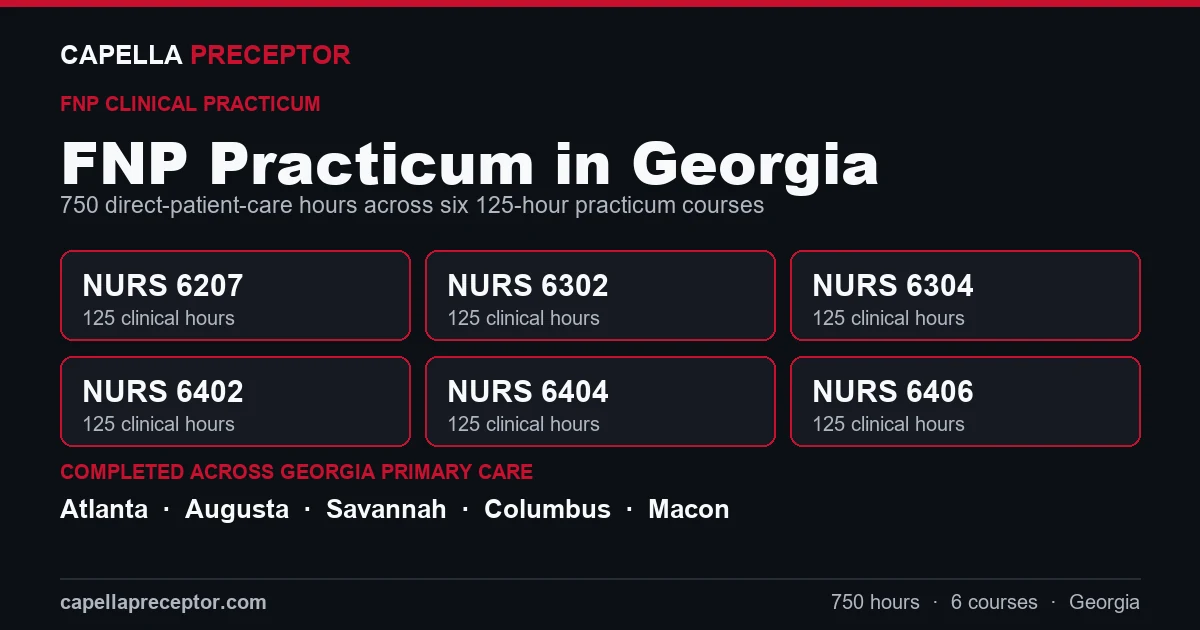
Start with what Capella requires, because the Georgia rules sit on top of it. The MSN-FNP is a minimum of 750 practicum hours across six clinical courses at 125 hours each, and the family scope means those hours have to span the lifespan: adult and older-adult primary care, pediatrics, and reproductive or women's health (Capella, MSN-FNP courses). A Georgia preceptor whose panel is all adults can leave you short on pediatric or women's health hours, the most common reason an FNP student stalls mid-program. The full hour and course breakdown lives on our FNP program page; this page is about how Georgia changes the search.
For the FNP track the preceptor is usually a family physician, an internal medicine or pediatrics physician, or an experienced family nurse practitioner whose patient mix matches the course you are in. Capella does not publish a preceptor list and does not assign one; it states learners are responsible for finding an appropriate preceptor and recommends completing practicum in your local community. In a restricted state, "local community" is exactly where the supply gets tight.
What does restricted practice mean for an FNP placement in Georgia?
The American Association of Nurse Practitioners places Georgia in the restricted tier, its most limited level of practice authority (AANP, State Practice Environment). A Georgia nurse practitioner cannot practice on their own authority at any point in their career. State law requires a written nurse protocol agreement with a delegating physician, and that physician delegates the medical acts the NP may perform. There is no experience-based pathway to independence here, unlike a full-practice state.
For you as an FNP student, this changes the texture of a placement rather than blocking it. Most of the strong FNP-scope clinicians you meet in Georgia are embedded in a physician-led practice, which is often a deep teaching environment because there is a collaborating physician on hand. What it does mean is that an NP preceptor's day-to-day scope is defined by their own protocol, so we screen for preceptors whose protocol scope and patient panel line up with the FNP course you are completing, not just any open NP.
Restricted
AANP tier for Georgia NPs.
Nurse protocol
Physician-delegated, career-long.
750, unchanged
Restricted status does not move the Capella total.
Which Georgia boards and rules govern your preceptor?
Two state boards touch a Georgia NP, which trips up students who assume the nursing board handles everything. The Georgia Board of Nursing, under the Secretary of State, authorizes the APRN under Board Rule chapter 410-11 (GA Rules, Chapter 410-11). The Georgia Composite Medical Board reviews and registers the nurse protocol agreement between the NP and the delegating physician under Chapter 360-32 (GA Rules, Chapter 360-32). You do not manage either process to be a student, but it helps to know which board governs what when you vet a Georgia preceptor.
Two Georgia-specific details are worth knowing because they affect preceptor availability. First, the protocol framework caps how many advanced practitioners one physician can collaborate with. A delegating physician historically could hold agreements with no more than four APRNs at once; under a Composite Medical Board rule change effective May 25, 2026, that cap rises to the combined equivalent of eight APRNs or PAs, with quarterly clinical collaboration meetings between the physician and APRN that must be documented (GA Composite Medical Board, 2026 rule updates). Practically, a single physician practice can host more APRNs than it once could, which slightly widens the pool of teaching sites. Second, Georgia's prescribing rules have loosened: a 2024 law lets an APRN with at least one year of post-licensure experience prescribe hydrocodone or oxycodone in emergency situations, capped at an initial five-day supply for patients eighteen or older, only when written into the protocol (HunterMaclean, 2024 Georgia scope expansion). The underlying structure is still physician-delegated collaboration, not independent practice.
You can confirm any Georgia preceptor's license yourself. Public verification runs through the Secretary of State portal at verify.sos.ga.gov. Before we present a match we verify the preceptor's active Georgia license and national certification there, so you are never relying on a name on an email.
Why is finding an FNP preceptor in Georgia genuinely hard?
It is not just paperwork. Georgia has a real primary care supply problem, and the FNP rotation lands right in the middle of it. Roughly two-thirds of Georgia's 159 counties are designated primary care Health Professional Shortage Areas, and well over two million Georgians live without consistent access to a primary care provider (Georgia Public Policy Foundation). The clinics that do exist are often running at capacity, and because every NP is tied to a physician's protocol, a practice can only absorb so many learners before the collaborating physician's review load gets heavy. Cold-emailing clinics rarely scales when you also need the right pediatric and women's health mix that an FNP course demands.
There is one Georgia-specific lever that genuinely helps, and most students do not know about it. As of January 1, 2026, Georgia's Preceptor Tax Incentive Program lets an APRN or PA preceptor claim up to 7,500 dollars in state tax credits per year, and a supervising physician or dentist up to 10,000 dollars, for unpaid community-based rotations of Georgia-enrolled students, with a rotation defined as 160 hours and up to ten rotations a year (Georgia Department of Revenue, preceptor tax credit). When you approach a Georgia practice, that credit is a concrete reason for a busy clinician to say yes, and it is one of the first things we raise on your behalf.
The closest fit to FNP scope, often covering adults, children, and women's health in one Georgia panel.
Strong for the two adult-gerontology FNP courses and chronic disease across the metro and mid-size markets.
Well-child and acute visits to satisfy the pediatric primary care practicum, the hours students miss most.
Prenatal, postpartum, and gynecologic visits for the reproductive health course.
Where in Georgia do FNP placements actually happen?
Supply is deepest in the metros and thins out fast beyond them, which is why your home county matters. We place across metro Atlanta and its suburbs (Marietta, Alpharetta, Decatur, Sandy Springs), the Augusta corridor, coastal Savannah, Columbus, Macon, and Athens, and into smaller markets such as Albany, Valdosta, Warner Robins, and the Gainesville and Rome areas in north Georgia. Georgia employs more than 10,000 nurse practitioners statewide (US Bureau of Labor Statistics, 2024), so the clinicians exist; the work is matching the right FNP-scope preceptor to your specific course populations and getting the site to commit.
When a county simply has no open primary care or pediatric slot, we move you to a fully virtual FNP preceptorship rather than letting a course clock run out. That is common for students in south Georgia and rural north Georgia, where the shortage is sharpest. Either route logs hours the same way in CORE ELMS.
A local Georgia preceptor and site matched to your FNP courses, useful in Atlanta, Augusta, or Savannah where patient volume is deep.
A fully remote, Capella-compliant option that keeps you on schedule when local primary care slots are scarce, common for rural Georgia students.
What clearance has to happen before you log an FNP hour in Georgia?
Identifying a Georgia preceptor is step one. Capella runs every placement through a clearance workflow before any FNP hour counts, and the steps are the same in Georgia as anywhere else, even though the supervision context here is physician-delegated. None of the four steps below is Georgia-specific in form, but the nurse protocol context means the clinician you name should be one whose Georgia scope actually fits your course.
- Propose the Georgia site and preceptor in Capella's practicum system, tracked in our workflow as CORE ELMS, so the placement can be reviewed and approved.
- Sign an affiliation agreement between Capella and the Georgia clinical site, which must be in place before practicum starts.
- Clear third-party compliance through a background-check and health-records vendor such as CastleBranch; confirm the current vendor with your program.
- Log and submit hours by course in CORE ELMS, where your preceptor approves what you record before each of the six FNP courses closes.
For the full step-by-step of how the Georgia rules interact with every Capella specialty, not just the FNP, see our broader Georgia placement page.
FNP-in-Georgia FAQ
Can I complete my Capella FNP practicum in Georgia even though it is a restricted state?
Yes. Georgia's restricted classification limits how a practicing nurse practitioner works, not whether a Capella FNP student can complete a 750-hour practicum here. The clinicians you precept under already work under a nurse protocol agreement with a delegating physician, which is normal for Georgia. You log your FNP hours the same way as in any state, through Capella's practicum system tracked in our workflow as CORE ELMS.
Does my FNP preceptor in Georgia have to be a nurse practitioner?
Not necessarily. A Capella FNP preceptor must be a qualified, currently licensed clinician whose practice matches the course population, which for the FNP means primary care across the lifespan. In Georgia that is commonly a family physician, an internal medicine or pediatrics physician, or an experienced FNP practicing under a nurse protocol agreement. The site and preceptor are submitted for Capella's own approval in CORE ELMS.
How do I verify a Georgia FNP preceptor's license?
Georgia license verification is public through the Georgia Secretary of State portal at verify.sos.ga.gov. We confirm every preceptor's active Georgia license and national certification there before we present a match, so you never rely on a name alone.
Is there an incentive for a Georgia clinician to precept an FNP student?
Yes. As of January 1, 2026, Georgia's Preceptor Tax Incentive Program lets an APRN or PA preceptor claim up to 7,500 dollars in state tax credits per year, and a physician or dentist up to 10,000 dollars, for unpaid community-based rotations, with a rotation defined as 160 hours. It is a real talking point when you approach a Georgia practice, and we raise it for you.
Do you place Capella FNP students outside metro Atlanta?
Yes. Roughly two-thirds of Georgia's counties are designated primary care shortage areas, so local options are genuinely thin outside the metros. We place across Atlanta, Augusta, Savannah, Columbus, Macon, and Athens, and where a county has no open primary care slot we move you to a fully virtual FNP preceptorship with hours logged in CORE ELMS.
Sources
- Capella University, MSN Family Nurse Practitioner courses (750 hours, six courses)
- AANP, State Practice Environment (Georgia listed as restricted)
- Georgia Rules, Chapter 410-11 (Board of Nursing, regulation of APRNs)
- Georgia Rules, Chapter 360-32 (Composite Medical Board, nurse protocol agreements)
- Georgia Composite Medical Board, 2026 rule and law updates (eight-APRN cap, May 25, 2026)
- HunterMaclean, 2024 Georgia APRN Schedule II scope expansion
- Georgia Department of Revenue, Community Based Faculty Preceptor Tax Credit
- Georgia Public Policy Foundation, Georgia primary care shortage and HPSA counties
How Capella Preceptor helps FNP students in Georgia
You now know the part that matters most: the Capella FNP is 750 hours across the lifespan, Georgia is a restricted state where your preceptor works inside a physician-delegated protocol, and Capella leaves the search to you. We close that gap. We source a verified, Georgia-licensed, Capella-compliant FNP preceptor whose protocol scope and patient panel cover the adult, pediatric, and women's health courses, raise the Georgia preceptor tax credit when we approach the practice, prepare every CORE ELMS form and affiliation agreement, and keep your hours logged and submitted on time, in person across the Atlanta metro and statewide, or fully virtual.
- Verified Georgia FNP preceptor matched in 7 days, license confirmed on the state portal
- Lifespan coverage planned across all six FNP courses, with every CORE ELMS and affiliation step handled
- No payment until you are matched, in person or virtual, anywhere in Georgia
Get a Capella FNP preceptor in Georgia
Free 15-minute consult. No payment until matched. We map your full 750-hour FNP practicum around the Georgia rules. See pricing or start now.
Get my free consult →