Capella FNP Preceptor in Indiana
The Capella MSN-FNP requires 750 practicum hours across six clinical courses, in primary care across the lifespan, and Capella expects you to find the preceptor. In Indiana you also clear a state layer: a reduced-practice board, preceptors who hold an active Indiana license, and the same CORE ELMS site approval everyone runs. We secure a verified, Indiana-licensed FNP preceptor for you, in Indianapolis, Fort Wayne, Evansville, and across the state.
Last updated: June 28, 2026 · Reviewed by the Capella Preceptor placement team
What does a Capella FNP practicum require, and does Indiana change it?
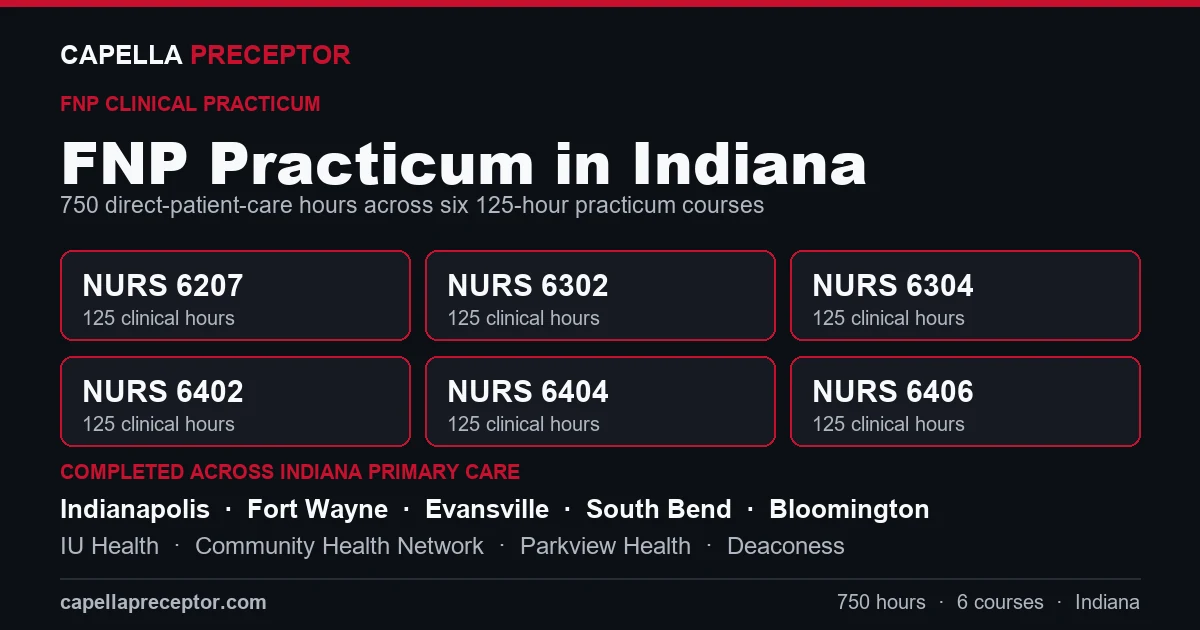
The Capella MSN Family Nurse Practitioner specialization requires a minimum of 750 practicum hours, spread across six clinical practicum courses that each carry 125 hours, with the coursework online and the clinical work done in your local community (Capella, MSN-FNP courses). Indiana does not change that number. There is no state-specific hour count, no Indiana add-on hours, and no separate Indiana practicum sequence. Your FNP hour and course requirements are identical to an FNP student in any other state.
What Indiana does change is the who and the where. Your preceptor must hold an active Indiana license, your site sits inside Indiana's reduced-practice regulatory framework, and the board's license records are what a Capella reviewer can check. So the work in Indiana is not finding more hours. It is finding a qualified, Indiana-licensed preceptor whose panel covers the FNP lifespan, then clearing Capella's approval. That is the combination this page is about.
Because the hours are tied to specific courses and span adult, pediatric, and women's health, an Indiana preceptor whose panel skews to one population can leave you short on another. In a reduced-practice state where the strongest preceptors are often already committed to in-state school cohorts, lining up that lifespan coverage early matters more than it does in a state with a deeper preceptor pool.
What is Indiana's NP practice authority, and why does it matter for FNP students?
The American Association of Nurse Practitioners classifies Indiana as a reduced practice state (AANP, State Practice Environment). In AANP's framework, reduced practice means state law limits at least one element of NP practice and requires a career-long collaborative relationship with another provider for the NP to practice fully. That is the middle tier, between full practice (independent) and restricted (career-long supervision).
For Indiana specifically, the practical effect lands on prescribing. Under 848 IAC 5-1-1, an APRN who wants prescriptive authority must hold a written collaborative practice agreement with an Indiana-licensed practitioner that sets out how the two will cooperate, coordinate, and consult (848 IAC 5-1-1, Indiana Administrative Code). The same rule carries a concrete number that is unusual to spell out: the APRN must submit prescribing documentation to the collaborating practitioner within seven days, including at least a five percent random sample of charts and medications prescribed. The Indiana Professional Licensing Agency also randomly audits between one and ten percent of these agreements before December 31 of each even-numbered year (Indiana PLA, Collaborative Practice Agreement Checklist).
Read this if you are a student, not yet a licensed NP: the collaborative agreement, the 5% chart sampling, and the biennial audit are post-graduation prescribing rules. They apply once you hold an Indiana APRN license and prescribe. They are not what governs your Capella practicum. During school you log supervised hours under a qualified preceptor, so the reduced-practice classification shapes your future Indiana career more than your clinical rotation. Knowing it now means the collaborative agreement is not a surprise the month you graduate.
One thing to track, because it is moving. House Bill 1129 in the 2026 session proposed removing the collaborative practice agreement requirement and moving Indiana toward independent APRN practice, but it went inactive and did not become law, so the agreement requirement remains in effect (Indiana General Assembly, 2026 bills). Confirm the current rule on the board's own pages before you rely on it, because the classification can change between cohorts.
Who can precept a Capella FNP student in Indiana?
A preceptor for an Indiana FNP rotation has to satisfy two layers at once: the state's licensure expectations and Capella's site-approval standard. Indiana nursing programs set a consistent bar for who may supervise a graduate NP student, and a Capella reviewer applies the same logic when approving your site. In practice an FNP preceptor in Indiana should:
- Hold an active, unencumbered Indiana license appropriate to the FNP population, an NP, a physician, or in some courses a clinician matched to that course's patient group.
- Carry experience in the role and specialty, commonly at least a year of practice in the area where they will supervise (Indiana University School of Nursing, preceptor standards).
- Be currently practicing in the clinical setting in which they precept, with employer support to host a graduate student.
- Match the population the FNP course requires, since a single panel rarely covers adults, children, and women's health on its own.
The Indiana license matters at site-approval time. The state board verifies licenses through the public license lookup at mylicense.in.gov, and a preceptor whose credential does not hold up there will not clear Capella's review. Every preceptor we place is checked against Indiana records first, so you are not logging FNP hours under a credential that fails at approval.
Where do FNP students actually rotate in Indiana?
The FNP is a primary care, lifespan role, so the hours belong in outpatient family medicine, internal medicine, pediatric, and women's health settings rather than inpatient or specialty units. Indiana has real density for that work in its larger systems, and thinner options as you move into rural counties, which is where the virtual route earns its place.
- Indianapolis and the metro. The deepest primary care and outpatient volume in the state sits here, through systems such as IU Health and Community Health Network, plus Carmel, Fishers, and Greenwood for family and adult-gerontology hours.
- Fort Wayne and the northeast. Parkview Health anchors a strong base of primary care and outpatient clinics, useful for adult-gerontology and the two AGPC practicum courses.
- Evansville and the southwest. Deaconess and its multispecialty clinic cover the Tri-State region for students near the Kentucky and Illinois borders.
- South Bend, Bloomington, Lafayette, and the rural counties. Local options thin out here, and several Indiana counties carry primary care shortage designations, so a virtual or blended plan often keeps these students on schedule.
A practical FNP note for Indiana: a busy family medicine clinic can sometimes carry adult, pediatric, and women's health in one panel, but many Indiana students still split across two or three sites to satisfy the pediatric (NURS6402) and reproductive health (NURS6404) courses. Plan that spread before NURS6402 opens, not after the clock starts.
Why is finding an FNP preceptor in Indiana harder than it sounds?
Here is the part most FNP students learn late. Capella does not assign you a preceptor or a site. The university states that "learners are responsible for finding an appropriate preceptor to oversee the practicum experience," and that practicum is completed in your local community (Capella, MSN-NP program). Capella offers support resources, but the outreach, the yes from a clinic, and the paperwork that follows are on you.
In Indiana that is genuinely harder for an online FNP student than the policy makes it sound. The established preceptors in IU Health, Parkview, Deaconess, and Community Health Network are frequently committed to students from the in-state schools their clinics already partner with, and a cold email from an online learner rarely jumps that line. Layer on the lifespan requirement, where you may need two or three sites for one degree, and the search becomes a scheduling problem across multiple clinics, not a single ask. We carry standing relationships across these Indiana systems, so you start from a warm introduction rather than a blank inbox, and we sequence the pediatric and women's health sites before their courses open.
What has to clear before your Indiana FNP hours count?
Once you have a preceptor and a site, there is a clearance process before a single hour counts, and it runs the same whether you rotate in Indianapolis or a small town downstate. Capella manages practicum application, site and preceptor approval, hour logging, and evaluations through its practicum management system, which we track in our workflow as CORE ELMS (Capella, CORE ELMS). The non-negotiables for an Indiana FNP placement:
- Site and preceptor approval submitted and cleared in CORE ELMS, with the preceptor's Indiana license verified, before you begin.
- A signed affiliation agreement between Capella and your Indiana clinical site, executed before practicum starts.
- Background and health-records compliance cleared through Capella's vendor, CastleBranch on the myCB platform; confirm the current requirement with your program.
- Hours logged and approved in CORE ELMS by your preceptor, course by course, with the 750-hour total met across all six FNP courses.
A reduced-practice classification does not add a step here; the affiliation agreement and CORE ELMS approval are program requirements, not state ones. The Indiana-specific piece is simply that the preceptor's credential must be a current Indiana license that survives the board's public lookup. For the wider state picture, see our Capella preceptor in Indiana overview, which covers every NP track, not just FNP.
Indiana FNP FAQ
How many practicum hours does the Capella FNP require in Indiana?
The same as everywhere else: a minimum of 750 practicum hours across six clinical courses that each carry 125 hours. Indiana state law does not change the Capella hour count. What Indiana adds is its own preceptor licensure and prescribing rules layered on top of Capella's site-approval process.
Does Indiana's reduced-practice status affect my FNP practicum?
Not the hours themselves. Indiana's reduced-practice classification and the written collaborative practice agreement under 848 IAC 5-1-1 govern how a licensed NP prescribes after graduation, not how a student logs supervised hours. For your practicum, what matters is a qualified Indiana-licensed preceptor, a practicum site Capella clears, and a signed affiliation agreement in CORE ELMS.
Who can precept a Capella FNP student in Indiana?
A preceptor should hold an active, unencumbered Indiana license appropriate to the FNP population, typically an NP, physician, or in some courses a clinician matched to the course's patient group, with experience in the role and current practice in the setting. Capella reviews and approves the preceptor and site before hours begin.
Which Indiana cities and health systems do you place FNP students in?
Indianapolis and the surrounding metro (Carmel, Fishers, Greenwood), Fort Wayne, Evansville, South Bend, Bloomington, and Lafayette, in family medicine, internal medicine, pediatric, and women's health settings, with a virtual option for rural and shortage-area counties statewide.
How fast can I get an FNP preceptor in Indiana?
We match a verified, Indiana-licensed FNP preceptor within 7 days, with no payment until you are matched.
Sources
- Capella University, MSN-FNP courses (750 hours, six 125-hour practicum courses)
- Capella University, MSN-NP program (learner secures the preceptor)
- AANP, State Practice Environment (Indiana reduced practice)
- 848 IAC 5-1-1, Indiana Administrative Code (collaborative agreement, 5% chart sampling)
- Indiana PLA, Collaborative Practice Agreement Checklist (biennial audit)
- Indiana General Assembly, 2026 bills (HB 1129 status)
How Capella Preceptor helps Indiana FNP students
You have the full picture now: 750 hours across six lifespan courses, a reduced-practice board with a collaborative-agreement prescribing rule that applies after graduation, and a Capella practicum that leaves the preceptor search to you. That search is where Indiana FNP students lose weeks, because the strong preceptors are spoken for and one degree may need two or three sites. We close it, securing a verified, Indiana-licensed FNP preceptor whose panel covers adults, children, and women's health, preparing every CORE ELMS form and affiliation agreement, and keeping your hours logged and submitted on schedule. See pricing for the flat placement fee.
- Verified Indiana-licensed FNP preceptor matched in 7 days, no payment until matched
- Lifespan coverage planned across sites so pediatric and women's health hours are not left to chance
- In-person across Indianapolis, Fort Wayne, and Evansville, or fully virtual for rural counties
Get an FNP preceptor in Indiana
Free 15-minute consult. No payment until matched. We map your full 750-hour FNP plan across Indiana.
Get my free consult →