Capella FNP Preceptor in Kansas
A Capella MSN-FNP student in Kansas needs a preceptor who can cover 750 primary-care hours across the lifespan, and Kansas is one of the few states where the board's own number matches: a 2025 Kansas State Board of Nursing rule now sets 750 practice hours per clinical track for new advanced practice students. Kansas is also a full practice authority state, and its board regulation defines exactly who may precept you. Capella still leaves the search to you. This page maps Capella and Kansas together, then shows how we secure the placement.
Last updated: June 28, 2026 · Reviewed by the Capella Preceptor placement team
Who can serve as an FNP preceptor in Kansas?
Kansas is unusual in writing the preceptor definition straight into board regulation, and that is the first thing a Capella FNP student here should know. Under the Kansas State Board of Nursing rules that took effect in 2025, a preceptor is "an advanced practice registered nurse or a physician supervising a student in the clinical setting" who is "not employed as nursing faculty," and each preceptor "shall be licensed in the state in which the preceptor is currently practicing" (Kansas Secretary of State, KSBN permanent regulations, K.A.R. 60-17-101 and 60-17-104). For the Capella FNP, whose 750 hours cover primary care across the lifespan, that points to a family medicine or primary care NP or physician who actively sees adults, children, and women's health, not a single-population specialist.
Two further Kansas-specific details matter. First, every preceptor must complete a preceptor orientation covering the pedagogical side of the student-preceptor relationship and the course, which is a real onboarding step we factor into the timeline. Second, the rule opens a door past 750 hours: "any practice hours over 750 may be precepted with a licensed interdisciplinary professional with a health science degree at a master's level or above" (KSBN regulations, K.A.R. 60-17-105). The first 750 still need an APRN or physician, which is exactly the band the Capella FNP lives in, so we screen every proposed preceptor against that license type before we put a name forward.
Does Kansas require 750 clinical hours like Capella does?
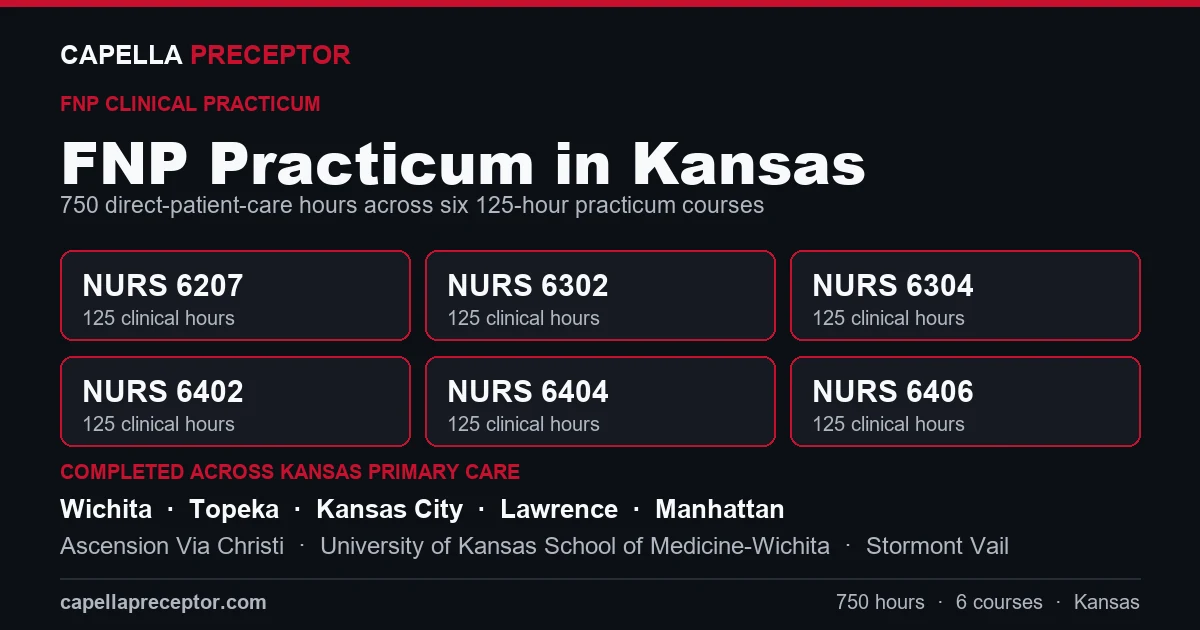
Yes, and Kansas is one of the cleaner states to plan around because the two numbers match. The Capella MSN Family Nurse Practitioner specialization requires a minimum of 750 practicum hours spread across six clinical courses at 125 hours each, in primary care across the lifespan (Capella, MSN-FNP courses). Kansas board rules, in effect since February 2025, set a parallel floor: at least 750 practice hours per clinical track for any student who starts an advanced practice program on or after March 1, 2025, an increase from the prior 500 (KSBN regulations, K.A.R. 60-17-105). The table below shows where each figure comes from.
The practical effect is that a Kansas FNP student satisfies the state hour floor and Capella's requirement with the same 750 hours, so there is no second, higher target to chase. What still has to be planned is the mix: Capella counts hours by course while the FNP role is family across the lifespan, so you want a preceptor or set of sites that genuinely reaches adults, pediatrics, and women's health rather than one clinic that fills the number but skips a population. We map the spread to the six courses before day one so no course clock runs out waiting on a missing rotation.
Is Kansas a full practice authority state, and does that change the FNP practicum?
Kansas is a full practice authority state for nurse practitioners (AANP, State Practice Environment). Full practice means a licensed Kansas APRN can evaluate patients, order and interpret tests, and initiate and manage treatments, including prescribing, under the exclusive licensure authority of the state board of nursing. Kansas reached this status recently: Governor Laura Kelly signed House Bill 2279, which took effect July 1, 2022 and removed physician supervision, collaboration, and the "responsible physician" concept from the statute entirely (AANP, Kansas Law Strengthens Patient Access to Health Care; Kansas Medical Society, APRN FAQ on the 2022 changes).
For a student in practicum, full practice authority shapes the environment you train in rather than a document you sign during clinical hours. It widens your preceptor pool in a useful way: because experienced Kansas APRNs no longer need a written collaborative agreement, more primary care here is NP-owned and NP-led, which means more clinicians who can supervise an FNP learner without a physician co-signature slowing the affiliation paperwork. One nuance to keep separate: a newly licensed Kansas APRN must still complete a 4,000-hour transition to practice, and during that window a collaborative agreement with a physician or full-practice APRN is required (Kansas Medical Society, APRN FAQ). That rule governs your own future license after graduation, not your Capella practicum, so do not confuse it with your student hours.
Which Kansas settings work for FNP primary-care hours?
The FNP is a primary-care credential, so the hours live in outpatient family medicine, internal medicine, pediatric, and women's health settings, not inpatient or single-specialty units. Kansas has real density in the northeast corner and the Wichita metro, thinning out toward the west. Verifiable primary-care anchors include the Ascension Via Christi family medicine clinics in Wichita, the University of Kansas School of Medicine-Wichita family medicine sites such as Smoky Hill and Wesley, and Stormont Vail in Topeka (Ascension Via Christi, Wichita family medicine; KU School of Medicine-Wichita, family medicine patient care). Alongside those, federally qualified community health centers and independent family practices carry primary care into smaller communities.
The state's largest city, with deep family medicine, internal medicine, pediatric, and women's health networks for assembling lifespan coverage in one metro.
Overland Park, Olathe, and Lenexa, plus Kansas City, Kansas, carry large multi-specialty groups strong for the adult and reproductive practicum courses.
The capital and the university communities hold primary care and family practices that regularly host nursing learners.
Salina, Hutchinson, Garden City, and Dodge City, where local supply is thinner and a virtual preceptorship often keeps you on pace, every hour logged in CORE ELMS.
A single full-scope family medicine practice can sometimes cover most of the lifespan, but many Kansas FNP students rotate across two or three sites to reach the pediatric and women's health courses. We match that coverage to the six practicum courses rather than to one clinic, so a preceptor with an adult-heavy panel never leaves you short on the pediatric block.
Why is finding an FNP preceptor in Kansas hard, and who is responsible?
This is the part that stalls most Kansas FNP students. Capella states plainly that "learners are responsible for finding an appropriate preceptor to oversee the practicum experience," and that practicum is completed in your local community (Capella, MSN-FNP courses). Capella offers support resources, but it does not assign the preceptor or the site. Add the Kansas board rules on top, a preceptor who is an APRN or physician, licensed and currently practicing in Kansas, who has completed a preceptor orientation, and whose panel actually covers the family lifespan, and the realistic pool in a given town shrinks, especially once you leave Wichita and the Kansas City metro for central and western counties.
We do that search instead. We source a preceptor who meets Capella's published requirements, confirm an active, unencumbered Kansas APRN or physician license, check that the practice and population focus fit your FNP courses, and line up a site willing to execute Capella's affiliation paperwork. We never claim a preceptor is "endorsed by Capella," because only Capella approves a placement; we prepare a compliant, verifiable match and submit it for Capella's own review. You can verify any Kansas license yourself through the Board's portal (KSBN, License Status Verification).
What clears before FNP practicum starts in Kansas?
Securing the preceptor is the first half. Before you log a single hour at a Kansas site, Capella's clearance workflow has to run. Practicum application, site and preceptor approval, and hour logging all happen in Capella's practicum management system, which we track in our workflow as CORE ELMS. A signed affiliation agreement between Capella and the Kansas site, plus third-party background and health-records compliance such as CastleBranch, must be in place before practicum begins (Capella, MSN-FNP program).
- Submit the Kansas site and preceptor in CORE ELMS for Capella's review and approval.
- Confirm preceptor licensure against the Kansas State Board of Nursing: an active, unencumbered APRN or physician, currently practicing in Kansas, with the preceptor orientation done.
- Execute the affiliation agreement between Capella and your Kansas clinical site before day one.
- Clear compliance through the third-party background and health-records vendor (such as CastleBranch); confirm the current vendor with your program.
- Log and submit hours in CORE ELMS per course, where your Kansas preceptor approves what you record before each course closes.
Because a Kansas APRN practices independently, your preceptor can be an NP-owned clinic rather than a physician practice, which sometimes makes the affiliation agreement quicker to execute than in states that still require physician oversight. If a board-specific question about your own situation is unclear, the Kansas State Board of Nursing is the authority to ask; we point students to KSBN directly rather than guessing at a regulation, then handle the placement logistics around whatever the board confirms. For the broader picture, see our Capella FNP page for the full course and hours breakdown and our Kansas placement page for the state board and metro detail.
Virtual or in person for Kansas FNP students?
Both satisfy Capella when the preceptor and site are approved, and the choice usually comes down to geography. Kansas spans a dense northeast corner and a wide rural west, so the right format depends on where you live. If you are in or near Wichita, the Kansas City metro, Topeka, Lawrence, or Manhattan, an in-person family medicine placement is straightforward and we match you locally. If you are in Garden City, Dodge City, or a rural county where the nearest qualified family practice is an hour away, a virtual preceptorship lets you complete supervised hours without the commute, with everything still logged in CORE ELMS. For the FNP specifically, the deciding factor is often population coverage rather than distance: we make sure whichever path you take still reaches pediatrics and women's health, not just adult primary care.
Hands-on FNP hours at an approved Kansas family practice, strongest in Wichita, the Kansas City metro, Topeka, Lawrence, and Manhattan where lifespan coverage is easiest to assemble.
Supervised telehealth-based hours that keep central, western, and rural Kansas FNP students on schedule, fully tracked in CORE ELMS.
Many Kansas students blend the two, anchoring some hours locally and using virtual sessions to stay on pace when a clinic's schedule tightens. Read more about each route on the virtual and in-person service pages.
Kansas FNP FAQ
Who can serve as an FNP preceptor in Kansas?
Kansas board regulation defines a preceptor as an APRN or a physician who supervises a student in the clinical setting and is not employed as nursing faculty, licensed in the state where they practice and having completed a preceptor orientation. For hours beyond the first 750, a master's-level interdisciplinary professional may also precept. For the Capella FNP that points to a family medicine or primary care APRN or physician across the lifespan.
Does Kansas require 750 clinical hours like Capella does?
Yes. Capella requires a minimum of 750 practicum hours across six 125-hour courses. Kansas board rules in effect since February 2025 set at least 750 practice hours per clinical track for students who start an advanced practice program on or after March 1, 2025, up from 500, so the same hours satisfy both.
Is Kansas a full practice authority state, and does that change the FNP practicum?
Kansas is full practice authority. House Bill 2279 took effect July 1, 2022 and removed physician supervision and collaboration from the statute, so a licensed Kansas APRN practices independently. That governs how you work after graduation, not your student practicum; your preceptor and site still clear Capella's approval before any hour counts.
Where can a Capella FNP student be placed for primary care in Kansas?
In family medicine, internal medicine, pediatric, and women's health settings statewide. Verifiable systems include Ascension Via Christi family medicine in Wichita, the KU School of Medicine-Wichita family medicine clinics such as Smoky Hill and Wesley, and Stormont Vail in Topeka, plus community health centers and independent family practices, with virtual placement for rural and western counties.
Sources
- Capella University, MSN Family Nurse Practitioner courses (750 hours, six courses)
- Kansas Secretary of State, KSBN permanent regulations K.A.R. 60-17-101 to 60-17-109 (preceptor definition, 750 hours, orientation; effective February 7, 2025)
- AANP, State Practice Environment (Kansas full practice authority)
- AANP, Kansas Law Strengthens Patient Access to Health Care (House Bill 2279)
- Kansas Medical Society, APRN FAQ on the 2022 statute changes (4,000-hour transition)
- Kansas State Board of Nursing, License Status Verification
How Capella Preceptor helps Kansas FNP students
You now have the full picture: 750 FNP hours across six lifespan courses, a full-practice state whose 2025 board rule sets the same 750-hour floor and defines who can precept you, real family-medicine sites from Wichita to Topeka, and a placement Capella leaves entirely to you. That last part is where students lose months. We secure a preceptor who meets Capella's published requirements and the Kansas board rules, prepare every CORE ELMS form and affiliation agreement, and keep your hours logged on schedule.
- Verified Kansas FNP preceptor matched in 7 days, no payment until matched
- Licensure checked against KSBN; population focus matched to your six FNP courses
- Every CORE ELMS form and affiliation agreement handled, in person or virtual
Get a Capella FNP preceptor in Kansas
Free 15-minute consult. No payment until matched. We map your entire FNP practicum plan, in person or virtual.
Get my free consult →