Home / MSN-FNP / FNP Preceptor in Maryland
FNP · MarylandCapella FNP preceptor and practicum placement in Maryland
The Capella MSN-FNP needs 750 practicum hours across six clinical courses, in primary care across the lifespan, and Capella leaves the preceptor to you. Maryland makes that easier on one axis: it is a full practice authority state, so a willing NP here is not blocked by a physician collaboration agreement, and Maryland even gives uncompensated preceptors in shortage areas a state tax credit. The work is matching that to a clinic with open capacity. That is what we do.
Last updated: June 28, 2026 · Reviewed by the Capella Preceptor placement team
What the Capella FNP needs, and what Maryland changes
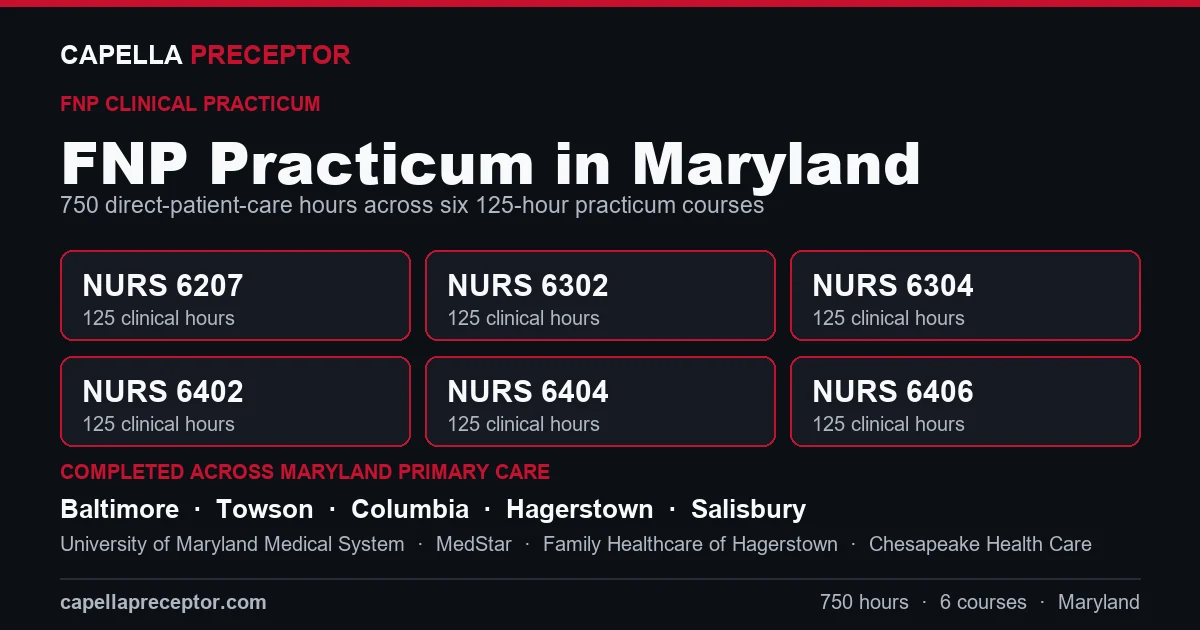
Start with the part Maryland does not touch. The Capella FNP practicum is 750 hours minimum, spread across six practicum courses at 125 hours each, and those hours must cover the full family lifespan: adult-gerontology, pediatrics, and reproductive or women's health (Capella, MSN-FNP courses). State law cannot shorten that number or change the population mix. Our full FNP requirements page walks the course-by-course breakdown.
What Maryland changes is the preceptor side. The American Association of Nurse Practitioners places Maryland in its full practice category, the most autonomous of the three (AANP, Maryland). In a reduced or restricted state, the clinician you want to precept you must hold a written collaboration or supervision agreement with a physician just to practice, which shrinks the pool willing to add a student. Maryland removed that barrier, so for an FNP placement here the limiting factor is clinic capacity, not a supervisory contract. Our broader Maryland placement page covers the statewide picture across all specialties.
Why is Maryland a full practice state, and does it help my FNP preceptor?
Maryland reached full practice through the Nurse Practitioner Full Practice Authority Act of 2015, which repealed the old attestation and physician collaboration-agreement requirement that had gated NP licensure (Nurse.com, Maryland full practice law). Authority now sits entirely with the Maryland Board of Nursing (MBON), which certifies NPs as advanced practice registered nurses and must approve a graduate NP program before a learner can be certified from it (Maryland Board of Nursing, Nurse Practitioner).
For your FNP preceptor, the practical effect is simple. A Maryland family-medicine NP or physician who agrees to teach you does not have to first sign or amend a supervisory contract to do it. That is a real difference from a neighboring restricted state like Virginia, where supervision rules narrow who can take a student. Keep one distinction straight: full practice authority describes what a licensed NP can do in Maryland. It does not override Capella's practicum rules. You still propose the site, get faculty approval, clear compliance, and log every hour through the university system.
Does Maryland's preceptor tax credit help me land an FNP placement?
This is the Maryland-specific lever most students never use, and it is genuinely worth raising when you ask a clinic to take you on. Maryland runs an Income Tax Credit for Preceptors in Areas with Health Care Workforce Shortages. A clinician who serves without compensation as a preceptor for NP students in a designated shortage area can claim a state income tax credit of $1,000 per qualifying rotation, for at least three rotations, capped at $10,000 per preceptor per tax year (Maryland Department of Health, Preceptor Tax Credit criteria).
A 2025 change (House Bill 19) trimmed the hours each qualifying rotation must run, so always confirm the current rotation length on the Maryland Department of Health page before you cite a number to a preceptor. The point for an FNP student is the recruiting angle: when a family practice in a shortage area hesitates, the existence of a state tax credit for unpaid precepting is a concrete reason for them to say yes. The two qualifying conditions that matter are that the precepting is uncompensated and the site sits in a designated shortage area (HPSA, medically underserved area, or a state or federal rural area).
Where do Capella FNP students find preceptors across Maryland?
Maryland packs heavy clinical density into a small state, but it is uneven, and the FNP lifespan requirement means you need a panel (or a set of sites) that covers adults, children, and women's health. We recruit across the whole state rather than the Baltimore core alone, and we name where the real capacity sits.
Baltimore City, Towson, and Columbia, the deepest pool of family medicine, internal medicine, and pediatric sites for the adult and pediatric practicum courses. Large systems such as the University of Maryland Medical System and MedStar anchor primary care here.
Montgomery and Prince George's counties, including Silver Spring, Rockville, and Bowie. Strong for family practice and women's health, which helps cover the reproductive health practicum.
Hagerstown, Frederick, and Cumberland. Community health centers such as Family Healthcare of Hagerstown serve a designated shortage region, where the preceptor tax credit most often applies.
Salisbury, Easton, and the Lower Shore, served by federally qualified health centers like Chesapeake Health Care across Wicomico, Worcester, and Somerset counties. Local seats are scarcer, so our virtual FNP option keeps you on schedule.
Maryland is also short on primary care capacity overall. A state needs assessment found it would take hundreds of additional primary care practitioners to clear its shortage-area designations, which is exactly why Western, Southern, and Eastern Shore counties carry shortage status (Maryland Department of Health, Primary Care Needs Assessment). For you that cuts both ways: more sites qualify for the tax credit, but fewer have open student capacity, so starting the search early matters more than in a saturated metro.
Is the Maryland mentor the same as my Capella preceptor?
No, and confusing the two is a common Maryland-specific mistake. The 2015 law added one transitional rule: a newly certified NP, someone never certified in Maryland or any other state, must name a mentor (an experienced Maryland NP or physician) available for advice and consultation for the first 18 months after certification (AANP, Maryland). That mentorship is about a new graduate's own early practice as a licensed clinician. It happens after you finish school.
Your Capella preceptor is different. The preceptor oversees your clinical hours while you are still a student, in CORE ELMS, under an affiliation agreement. The 18-month mentor requirement does not apply to your practicum, and you do not need a mentor named to start clinical hours. When you read Maryland NP guidance, hold those two roles apart so you do not chase a requirement that belongs to a later stage.
What does Capella require before Maryland FNP hours count?
Securing the preceptor is step one. Before a single Maryland clinical hour is recorded, Capella runs an approval workflow, and skipping any part means hours that do not count. The mechanics are the same statewide; the Maryland board only verifies the clinician's credential, not your placement paperwork.
- Propose the site and preceptor in Capella's practicum system, tracked in our workflow as CORE ELMS, so faculty can approve the Maryland placement.
- Execute an affiliation agreement between Capella and the Maryland site before practicum begins.
- Clear third-party compliance (background check and health records through a vendor such as CastleBranch), then add anything the individual Maryland site requires.
- Verify the preceptor's Maryland credential. We confirm an active RN license or NP certificate on the MBON public license lookup before we present a preceptor to you.
- Log and submit hours in CORE ELMS, where your preceptor approves each FNP entry across all six practicum courses.
Maryland also funds an APRN Preceptor Development Program, a set of free online modules that trains clinicians in the precepting role. It is one more reason a Maryland NP can feel prepared to take a student, and a useful thing to mention to a hesitant first-time preceptor.
In-person or virtual FNP practicum in Maryland
Most Maryland FNP students want a local, in-person placement, and along the Baltimore-to-DC corridor that is usually realistic across all three populations. The picture changes on the Eastern Shore and out toward Western Maryland, where family practices with open student capacity are scarcer. There a virtual FNP preceptorship, supervised telehealth and case-based primary care with hours documented in CORE ELMS, keeps the program on schedule instead of waiting a semester for a nearby opening. We tell you honestly which path fits your county and which courses still need coverage during the consult.
Best where density is high (Baltimore, Montgomery, Prince George's, Anne Arundel). Hands-on family-practice, pediatric, and women's health hours at vetted local Maryland sites.
A fit for the Lower Shore, Western Maryland, or a tight timeline. Compliant, faculty-recognized, and tracked in CORE ELMS, with primary care across the lifespan.
Maryland FNP FAQ
How many hours does the Capella FNP practicum require in Maryland?
The hour count comes from Capella, not Maryland. The MSN-FNP requires a minimum of 750 practicum hours across six courses that each carry 125 hours. Maryland law does not add or cut those hours; it only removes the collaboration agreement a preceptor would otherwise need in a reduced or restricted state.
Does a Maryland FNP preceptor need a collaboration agreement with a physician?
No. Maryland is a full practice authority state. Since the 2015 Full Practice Authority Act, a certified NP practices under the sole authority of the Maryland Board of Nursing with no required collaboration or attestation agreement, so a practicing NP can precept you without a supervisory contract.
Can a Maryland preceptor get a tax credit for precepting me?
Often, yes. Maryland gives clinicians who serve without compensation as a preceptor in a designated shortage area a state income tax credit of 1,000 dollars per qualifying rotation, up to 10,000 dollars a year, for at least three rotations. It is a real reason a Maryland clinic can say yes. Confirm the current rotation hours on the Maryland Department of Health page.
What is the difference between a Maryland mentor and a Capella preceptor?
They are different roles at different stages. Maryland requires a brand-new NP, on first certification, to name a mentor available for 18 months after licensure. The Capella preceptor oversees your clinical hours while you are still a student. The 18-month mentor rule does not apply to your practicum.
Where can I find an FNP preceptor on the Maryland Eastern Shore?
The Eastern Shore is a designated primary care shortage area, so local capacity is thinner than along the Baltimore-to-DC corridor. We recruit at Lower Shore federally qualified health centers and family practices, and we offer a compliant virtual FNP preceptorship with hours logged in CORE ELMS when a nearby in-person seat is not available in time.
Sources
- Capella University, MSN Family Nurse Practitioner courses (750 hours, six 125-hour courses)
- American Association of Nurse Practitioners, Maryland (full practice, 18-month mentor)
- Maryland Department of Health, Preceptor Tax Credit qualifying criteria
- Maryland Board of Nursing, Advanced Practice / Nurse Practitioner
- Maryland Nursing Support Program, APRN Preceptor Development Program
- Capella University, MSN-NP program (learner secures the preceptor)
How Capella Preceptor helps Maryland FNP students
You now know the lay of the land: 750 FNP hours across six courses, Maryland full practice authority that widens your preceptor pool, a state tax credit that gives clinics a reason to say yes, and a Capella process that still leaves the placement entirely to you. That last gap is where students lose a term. We close it. We match you with a verified, Capella-compliant Maryland FNP preceptor whose panel covers the populations your courses require, prepare every CORE ELMS form and affiliation agreement, and keep your hours logged and submitted on time, from Baltimore to the Eastern Shore.
- Verified Maryland FNP preceptor matched in 7 days, no payment until matched
- Every CORE ELMS form, affiliation agreement, and compliance step handled
- Primary care across the lifespan, in person across the metros or fully virtual for rural Maryland
Get a Capella FNP preceptor in Maryland
Free 15-minute consult. No payment until matched. We map your entire Maryland FNP practicum plan.
Get my free consult →