Home / MSN-FNP / FNP Preceptor in Minnesota
FNP · MinnesotaCapella FNP Preceptor in Minnesota
Your Capella MSN-FNP needs 750 practicum hours of primary care across the lifespan, and you secure the preceptor yourself. In Minnesota that search runs into one helpful fact and one timely change: Minnesota is a full practice authority state, and on August 1, 2026 it repeals the old 2,080-hour transition-to-practice rule, so the family nurse practitioners who can precept you here work without a standing physician contract. We match a verified, MN-licensed FNP preceptor in 7 days, no payment until you are matched.
Last updated: June 28, 2026 · Reviewed by the Capella Preceptor placement team
What the Capella FNP practicum requires before Minnesota even enters the picture
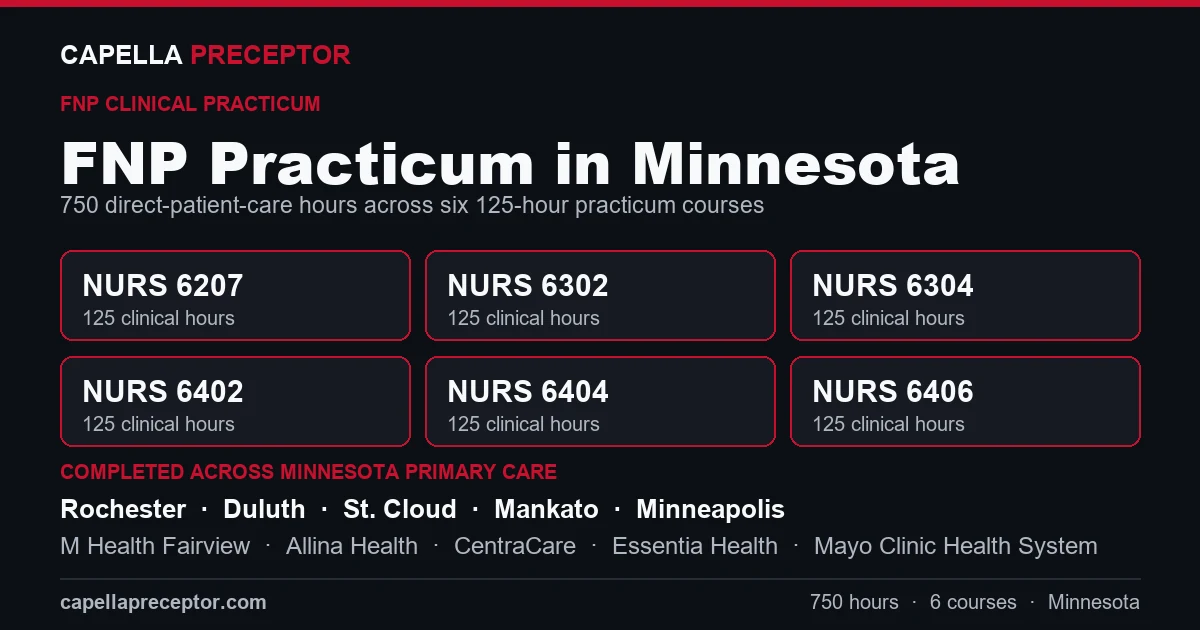
Start with the number, because it governs the whole plan. The Capella MSN Family Nurse Practitioner specialization requires a minimum of 750 practicum hours, and those hours are split across six clinical practicum courses at 125 hours each, not earned in one block (Capella, MSN-FNP courses). The FNP is a primary care role across the lifespan, so the course sequence spreads those hours over adult and older-adult primary care, pediatrics, and reproductive or women's health. A Minnesota preceptor whose panel is heavily skewed to one population can leave you short on another, so the population mix matters as much as the location.
The piece that surprises most FNP students is who finds the preceptor. Capella states that "learners are responsible for finding an appropriate preceptor to oversee the practicum experience," and it recommends placement in your local community rather than assigning a site (Capella, MSN-NP program). The full FNP requirements, course codes, and approved settings live on our Capella FNP page; this page is the Minnesota layer on top of it.
Why does full practice authority help an FNP find a preceptor in Minnesota?
The American Association of Nurse Practitioners classifies Minnesota as a full practice state (AANP, Minnesota). In a full practice state, licensure law lets a nurse practitioner evaluate patients, diagnose, order and interpret diagnostic tests, and start and manage treatment, including prescribing, under the sole authority of the state board of nursing. There is no requirement for a standing physician contract just to keep seeing patients.
For an FNP student that is practical good news. Minnesota nurse practitioners frequently own or run their own primary care clinics and carry their own family-medicine panels, which is exactly the across-the-lifespan setting your 750 hours need. A qualified MN nurse practitioner can agree to precept you without first clearing it through a supervising physician, so the yes tends to come from the clinician directly. Full practice authority does not change anything Capella asks of you, but it widens the pool of people who can say yes to a family-care student.
What is the August 2026 transition-to-practice change, and does it affect my FNP practicum?
This is the Minnesota detail that is genuinely new for 2026. Nurse practitioners in Minnesota are licensed as Advanced Practice Registered Nurses who hold national certification as a Certified Nurse Practitioner, so a preceptor's credentials read as "APRN, CNP," issued by the Minnesota Board of Nursing. Until now, a CNP who began practicing after July 1, 2014 had to complete at least 2,080 hours within a collaborative agreement in a hospital or integrated clinical setting before practicing fully independently (Minn. Stat. 148.211).
That requirement is being repealed. Effective August 1, 2026, Minnesota removes the 2,080-hour postgraduate collaborative-practice period for new APRNs, through the Transition-to-Practice Repeal Act (Minnesota Legislature, HF1794; codified at 2026 Chapter 115, Article 11, Section 1). The change is supported by the AANP on behalf of Minnesota nurse practitioners.
What it means for you as a Capella FNP student. You are not a licensed CNP yet, so neither the old 2,080-hour rule nor its repeal gates your practicum directly. What it changes is the kind of clinician who can precept you: newer Minnesota NPs reach full independent practice sooner, so more of them run their own family-care panels and can take a student on their own authority. It is useful context for who can say yes, not a hoop you personally jump through.
Where do FNP students complete primary care hours in Minnesota?
The FNP setting that fits best is outpatient family medicine and primary care, because one family-medicine panel can often cover adults, children, and women's health in a single site. Minnesota has real density of that in its metros and a handful of regional hubs, anchored by large integrated systems. Confirm any specific clinic and preceptor directly; system names below indicate where qualified primary care happens, not a placement we control.
Minneapolis, Saint Paul, and suburbs, served by M Health Fairview, Allina Health, and HealthPartners and Park Nicollet family-medicine clinics.
A dense medical corridor anchored by Mayo Clinic and Mayo Clinic Health System, strong for adult and family primary care hours.
CentraCare primary care along the I-94 corridor, good for family medicine and the two adult-gerontology practicum courses.
Essentia Health and Aspirus St. Luke's clinics serving the Arrowhead and the North Shore.
Community family-medicine clinics serving south-central Minnesota and the surrounding rural counties.
Moorhead, Bemidji, Brainerd, Willmar, and lake country, where local sites are thin and a virtual option often fits.
There is a real distribution problem behind that last box. Minnesota designates a large share of its 87 counties as primary care health professional shortage areas, and only about 8 percent of the health care workforce practices in the roughly 15 percent of the population that lives rural (Minnesota Department of Health, shortage designations). For an FNP student in Greater Minnesota that means the nearest qualified family-medicine clinician may already be committed to a student from a nearby program. For the broader picture of placement geography statewide, see our Minnesota placement page.
What has to clear before you log an FNP hour in Minnesota?
Finding a willing family-medicine preceptor is step one. Before a single hour counts, two clearance tracks run in parallel: Capella's own practicum workflow, and a Minnesota-specific background study most clinical sites require. Capella manages practicum application, site and preceptor approval, hour tracking, and evaluations through its practicum system, which we track in our workflow as CORE ELMS (Capella, CORE ELMS).
- Propose the Minnesota site and FNP preceptor in CORE ELMS for review and approval, with the preceptor's APRN, CNP license verified against the Minnesota Board of Nursing record.
- Get an affiliation agreement signed between Capella and the clinical site before practicum begins. This is where Minnesota placements most often stall.
- Clear the Minnesota DHS background study through NETStudy 2.0 under Minnesota Statutes chapter 245C, which most MN health systems require of students, in addition to Capella's CastleBranch compliance. The DHS study can take a month or more, so start it early.
- Log and submit hours in CORE ELMS per course, where your preceptor approves what you record, until all 750 hours are documented.
The double background-check reality is easy to miss. A student who clears CastleBranch for Capella but has not started the Minnesota DHS study can still be turned away at the clinic door, because the site, not the university, requires it. We chase the affiliation-agreement signature and flag the DHS study at the start so neither sits in an inbox while your term clock runs. For the affiliation agreement specifically, see our agreement guide.
In-person or virtual for an FNP student in Minnesota?
Minnesota's geography pulls FNP students two ways. In the Twin Cities, Rochester, Duluth, and St. Cloud there is genuine density of family-medicine and primary care clinics, so an in-person placement near home is usually realistic once you find a preceptor who is not already full. The harder case is the FNP student on the Iron Range, in the prairie counties, or up in lake country, where the nearest qualified family-care site can be an hour away and the few local clinicians may be committed elsewhere.
That is where a virtual preceptorship earns its place for the FNP track specifically. Remote supervision lets a student in Greater Minnesota train under a verified family nurse practitioner without relocating for a term, with every hour still logged and approved in CORE ELMS and the population spread planned across the six courses. We match in person when it fits and offer virtual when distance would otherwise put you behind. Read more on virtual preceptorship and in-person placement.
Minnesota FNP FAQ
How many FNP practicum hours do I complete in Minnesota for Capella?
A minimum of 750 hours across six clinical courses that each carry 125 hours, in primary care across the lifespan. The hour count is the same in Minnesota as anywhere; what changes by state is the board rules your preceptor practices under and where the qualified primary care sites are.
Is Minnesota a full practice authority state for FNP preceptors?
Yes. The AANP classifies Minnesota as a full practice state, so a licensed nurse practitioner can evaluate, diagnose, order tests, and prescribe under the Minnesota Board of Nursing without a standing physician supervision contract. That widens your FNP preceptor pool, because NPs here run their own primary care panels and can take a student on their own authority.
Did Minnesota change its APRN collaborative-agreement rule?
Yes. Effective August 1, 2026, Minnesota repeals the requirement that a new nurse practitioner complete at least 2,080 hours within a collaborative agreement before independent practice (HF1794, the Transition-to-Practice Repeal Act). As a Capella student you were never gated by that rule, but it changes how the NPs who precept you are licensed and structured.
What background check do I need for a Minnesota FNP clinical placement?
Most Minnesota clinical sites require a Minnesota Department of Human Services background study through NETStudy 2.0, under Minnesota Statutes chapter 245C, in addition to Capella's own CastleBranch compliance. The DHS study can take a month or more, so it is started early. We track both so neither holds up your start date.
Which Minnesota cities and health systems can host FNP hours?
Family medicine and primary care across the Twin Cities, Rochester, Duluth, St. Cloud, and Mankato, plus systems such as M Health Fairview, Allina Health, HealthPartners and Park Nicollet, CentraCare, Essentia Health, and Mayo Clinic Health System. Outside the metro, primary care shortage areas make local sites scarce, which is where a verified virtual preceptorship keeps your hours on track.
Sources
- Capella University, MSN Family Nurse Practitioner courses (750 hours, six 125-hour courses)
- Capella University, MSN-NP program (student secures the preceptor)
- AANP, Minnesota state practice environment (full practice)
- Minnesota Statutes 148.211, advanced practice registered nurse
- Minnesota Legislature, HF1794 (Transition-to-Practice Repeal Act, effective Aug 1, 2026)
- Minnesota Board of Nursing, APRN (CNP) licensure general information
- Minnesota Department of Health, health professional shortage designations
- Capella University, CORE ELMS practicum management
How Capella Preceptor helps FNP students in Minnesota
You now know the lay of the land: the Capella FNP needs 750 primary-care hours across six courses, Minnesota grants NPs full practice authority and drops the 2,080-hour APRN rule on August 1, 2026, your preceptor is licensed as an APRN, CNP, most sites add a Minnesota DHS background study, and Capella still leaves the placement entirely to you. We close that gap. We secure a verified, MN-licensed FNP preceptor whose family-care panel matches your course populations, prepare every CORE ELMS form, push the affiliation agreement to signature, flag the DHS study early, and keep your hours logged and submitted on time.
- Verified Minnesota FNP preceptor matched in 7 days, in person or virtual
- Every CORE ELMS form, affiliation agreement, CastleBranch, and Minnesota DHS step handled
- No payment until you are matched, with your exact quote at the free consult. See pricing.
Get a Capella FNP preceptor in Minnesota
Free 15-minute consult. No payment until matched. We map your full 750-hour FNP plan, MN board rules included.
Get my free consult →