Finding a Capella FNP Preceptor in Mississippi
A Capella MSN-FNP student in Mississippi needs the same 750 practicum hours across six 125-hour courses as everywhere else, in primary care across the lifespan, and Capella expects you to secure the preceptor yourself. What is different here is the ground: Mississippi is a reduced-practice state, its preceptors work under a board-filed collaborative agreement and a 75-mile collaboration rule, and 49 of its counties are primary-care shortage areas. This page maps the FNP requirement onto those Mississippi specifics, then how we place you.
Last updated: June 28, 2026 · Reviewed by the Capella Preceptor placement team
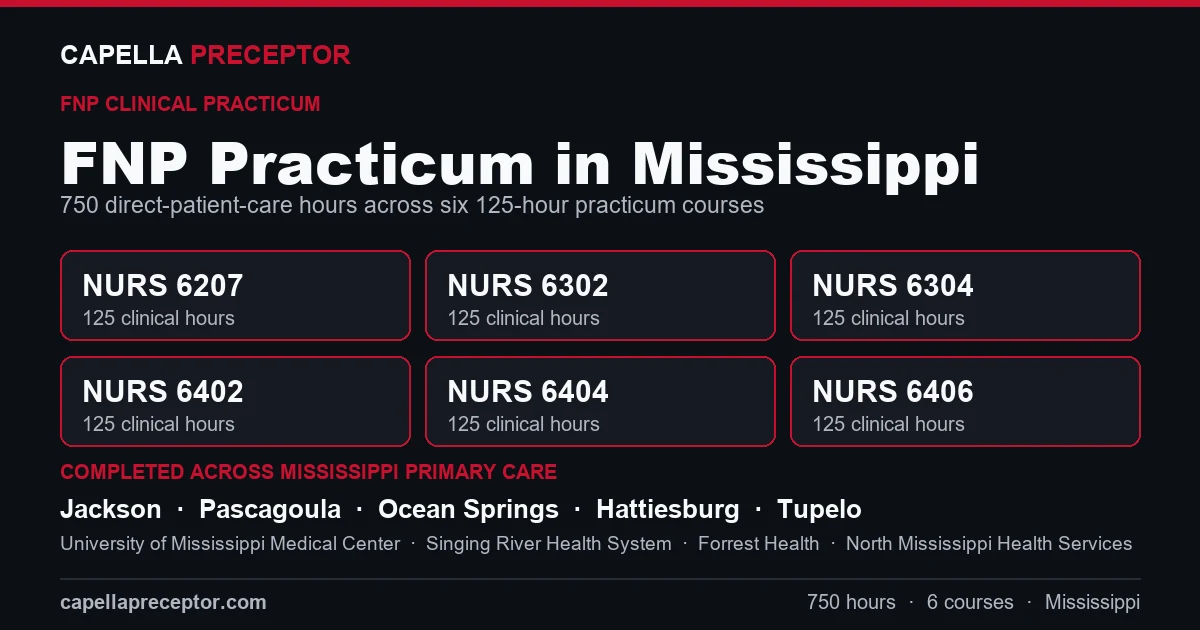
What does the Capella FNP require in Mississippi?
The number does not move by state. The Capella MSN Family Nurse Practitioner specialization requires a minimum of 750 practicum hours, spread across six clinical practicum courses that each carry 125 hours (Capella, MSN-FNP courses). The coursework stays online; the practicum is completed in your own Mississippi community (Capella, MSN-NP program). What changes in Mississippi is not the hour count but the kind of preceptor available to supply those hours and the board rules that preceptor works under.
Because the FNP is a family, primary-care role, your 750 hours have to span the lifespan rather than a single age group. Two of the six courses are adult-gerontology primary care, one is pediatric primary care, one is reproductive and women's health, plus a core practicum and a transition-to-practice course. A Mississippi preceptor whose panel is heavily one population can leave you short on another, which is the single most common reason a Capella FNP student in a thin local market loses a term. The full course-and-population breakdown lives on our Capella FNP page; this page is about getting it done in Mississippi.
FlexPath learners see the same sequence with NURS-FPX codes. Always confirm the exact numbering on your own Capella program map, because the enrollment date governs which version you follow.
How does Mississippi's reduced practice authority shape an FNP placement?
The American Association of Nurse Practitioners classifies Mississippi as a reduced practice state (AANP, Mississippi). Reduced practice means state law limits at least one element of nurse practitioner practice and requires a career-long collaborative relationship with a physician. For a practicing FNP in Mississippi, that is concrete: you cannot deliver care on your own license alone, and a physician collaboration sits behind your work.
For you as a Capella FNP student, the reduced-practice rule matters in one indirect but important way. It does not govern how you log practicum hours, because during your practicum you work under an approved preceptor who oversees and signs off on your hours; you do not file a collaborative agreement of your own. But it shapes the supply of preceptors. Every working FNP you might want as a preceptor is already operating inside a collaborative arrangement and a chart-review obligation, so their time and panel are accounted for. That is part of why Mississippi family-medicine clinics say no to students more often than students expect, and why starting the search early matters more here than in a full-practice state.
What are the Mississippi board rules behind your FNP preceptor?
Two boards share oversight in Mississippi, and it helps to know which does what. The Mississippi Board of Nursing (MSBN, 713 Pear Orchard Road, Ridgeland) certifies the APRN: it requires national certification in your population focus plus a graduate nursing degree, and it recognizes the "family/individual across the life span" focus that is exactly the FNP role (Mississippi Board of Nursing, APRN licensure). The board is also explicit that an NP "may not begin work until you have an approved practice site, collaborating physician of compatible practice and a collaborative agreement."
The physician-side collaboration rules sit with the Mississippi State Board of Medical Licensure in Part 2630, and they carry three numbers worth knowing because they define what your preceptor lives with day to day (Mississippi State Board of Medical Licensure, Part 2630 collaboration rules):
- The 75-mile rule. A clinic more than 75 miles from the collaborating physician's primary office is a "free standing clinic" and triggers extra board review for that physician-NP relationship. It is why qualified preceptors thin out fast in the Delta and other rural counties far from a physician's main office.
- Monthly chart review. The collaborating physician reviews a random sample of 10 percent or 20 charts, whichever is fewer, of the NP's patients each month. Your preceptor already carries this load, which shapes how much capacity is left for a learner.
- Quarterly face-to-face meeting between the NP and the collaborating physician for quality assurance, plus a 90-day grace period to find a new collaborator if one is lost. These keep a practice stable, which is good for a student who needs a preceptor who will be there across all six courses.
None of these are things you file as a student. They describe the world your Mississippi preceptor works in, and understanding them is how you have a credible conversation with a busy clinic rather than a cold ask. You can confirm any Mississippi nurse, APRN, or collaborating-physician status through the MSBN and through Nursys, the national license verification system (Nursys). We run that verification on every preceptor before we present them.
Why is finding an FNP preceptor in Mississippi genuinely hard?
This is the part Capella leaves to you and the part Mississippi makes harder than average. Capella states plainly that "learners are responsible for finding an appropriate preceptor to oversee the practicum experience," and that practicum is completed in your local community (Capella, MSN-NP program). In a state with a deep primary-care shortage, that sentence translates into weeks of cold outreach. Mississippi has 49 counties designated as primary-care Health Professional Shortage Areas (NE Mississippi AHEC, HPSA overview). The same clinics you would ask to precept you are the ones already stretched, so a polite "no" is common and is rarely about you.
There is a second FNP-specific wrinkle. Because your 750 hours must cover adults, children, and women's health, a single rural family-medicine office may not see enough pediatric or prenatal volume to satisfy those courses. Students who plan for one preceptor and discover mid-program that the panel cannot supply pediatrics or reproductive health then scramble for a second site while a course clock runs. The fix is to plan the population coverage before the first hour, not after.
Where do Capella FNP students actually get placed in Mississippi?
We place across the state, not in one corner of it, and we lean on Mississippi's real primary-care footprint. These are large, verifiable systems and clinic networks where family-medicine and primary-care rotations exist; the named sites are reference points for where lifespan coverage is realistic, not claims of a standing agreement.
Jackson, Madison, Ridgeland, Clinton, and Brandon, the largest concentration of family-medicine and women's-health clinics in the state and home to the University of Mississippi Medical Center.
Pascagoula, Ocean Springs, Biloxi, and Gulfport, where Singing River Health System runs all-ages primary-care clinics that fit adult and pediatric FNP hours.
Hattiesburg and Laurel, anchored by the Forrest Health network, for family practice and women's health.
Tupelo, Oxford, and Southaven, where North Mississippi Health Services operates a wide primary-care clinic network across the region.
Meridian, Starkville, and Columbus for primary care, pediatrics, and women's-health rotations.
Greenville, Cleveland, and Greenwood, the thinnest market, where the 75-mile rule bites and we often pair a local site with virtual hours.
Mississippi's 21 federally qualified health centers are worth flagging too: as FQHCs they are excluded from the 75-mile free-standing-clinic definition, and they see exactly the broad, all-ages primary-care population an FNP needs. Your preceptor can be a board-certified FNP, a family-medicine or internal-medicine physician, or another clinician whose scope fits your Capella course, provided the site and preceptor clear approval in CORE ELMS.
What clears before your first FNP hour in Mississippi?
Identifying a preceptor is step one of several. Capella tracks practicum application, site and preceptor approval, hour logging, and evaluations through its practicum management system, CORE ELMS. A signed affiliation agreement between Capella and the Mississippi site, plus third-party compliance, must be in place before you log an hour.
- Submit the Mississippi site and preceptor in CORE ELMS for Capella review and approval.
- Execute an affiliation agreement between Capella and the Mississippi clinic before practicum begins.
- Clear compliance through a third-party background-check and health-records vendor such as CastleBranch; confirm the current vendor with your program.
- Log hours by course in CORE ELMS, where your Mississippi preceptor approves what you record, and keep a buffer for the final transition-to-practice course.
In person or virtual for a Mississippi FNP student?
Mississippi is largely rural, and outside the Jackson metro and the Gulf Coast a student can spend months calling family-medicine clinics that have no room for a learner. That is where the in-person versus virtual choice matters for the FNP specifically, because you still need lifespan coverage either way.
A local Mississippi family-medicine site and preceptor, ideal when you are near Jackson, the coast, Hattiesburg, or Tupelo and want hands-on adult, pediatric, and women's-health contact close to home.
A live, supervised remote option for students in the Delta and other shortage counties, with hours tracked in CORE ELMS so a thin local market does not stall the 750-hour timeline.
Mississippi FNP FAQ
How many practicum hours does the Capella FNP need in Mississippi?
The same 750 hours required everywhere. The Capella MSN-FNP requires a minimum of 750 practicum hours across six clinical courses that each carry 125 hours. Mississippi does not add or subtract hours; what changes by state is the board environment your preceptor works under, not the Capella hour count.
Does the Mississippi collaborative-agreement rule affect my FNP practicum?
Not directly. Mississippi is a reduced-practice state, so a working nurse practitioner must hold a board-filed collaborative agreement with a physician for each practice site. That rule governs the preceptor's own license, not your student hours. As a Capella FNP student you log supervised practicum hours under an approved preceptor; you do not file a collaborative agreement of your own.
Can an FNP be my Capella preceptor in Mississippi?
Often yes. A board-certified family nurse practitioner, a family-medicine or internal-medicine physician, or another clinician whose scope matches your course can precept you in Mississippi, provided the site and preceptor are approved in CORE ELMS. Because the FNP is a primary-care credential, the preceptor's panel should span adults, children, and women's health across your 750 hours. We verify the Mississippi license and certification before we match you.
What is the 75-mile rule and does it touch a student?
Under the Mississippi collaboration rules, a clinic more than 75 miles from the collaborating physician's primary office is treated as a free-standing clinic and triggers extra board review for that physician-NP relationship. It is a practice-side rule for licensed NPs, not a student-practicum rule, but it explains why qualified rural preceptors in the Delta and other thin-coverage areas can be harder to find.
Where do you place Capella FNP students in Mississippi?
Across the Jackson metro, the Gulf Coast around Pascagoula and Ocean Springs, Hattiesburg and the Pine Belt, Tupelo and north Mississippi, Meridian, Starkville, and the Delta. Where local family-medicine sites are scarce we use a supervised virtual practicum so a quiet rural market does not stall your timeline, with hours tracked in CORE ELMS.
Sources
- Capella University, MSN-FNP courses (750 hours, six 125-hour practicum courses)
- Capella University, MSN-NP program (learner secures the preceptor locally)
- AANP, Mississippi state practice environment (reduced practice)
- Mississippi Board of Nursing, APRN licensure and recognized population foci
- Mississippi State Board of Medical Licensure, Part 2630 collaboration rules (75-mile, chart review, quarterly meeting)
- NE Mississippi AHEC, Health Professional Shortage Areas (49 primary-care counties)
- Nursys, national nurse license verification
How Capella Preceptor helps FNP students in Mississippi
You now have the full picture: a fixed 750-hour, lifespan FNP requirement, a reduced-practice board, a 75-mile collaboration rule, 49 shortage counties, and a placement Capella expects you to arrange yourself. We close that gap. We secure a verified, Capella-compliant FNP preceptor in Mississippi whose panel covers the adult, pediatric, and women's-health hours your six courses require, prepare every CORE ELMS form and affiliation agreement, and keep your hours logged and submitted on schedule, in person or virtual.
- Verified Mississippi FNP preceptor matched in 7 days, no payment until matched
- A panel that covers adult, pediatric, and women's-health hours across all six courses
- Coverage from Jackson and the Gulf Coast to the Delta, in person or fully virtual
Get a Capella FNP preceptor in Mississippi
Free 15-minute consult. No payment until matched. We map your entire 750-hour practicum plan, lifespan coverage and all. See pricing or start a conversation.
Get my free consult →