Home / MSN-FNP / FNP Preceptor in Missouri
FNP · MissouriCapella FNP Preceptor and Practicum in Missouri
The Capella MSN-FNP needs 750 practicum hours across six clinical courses, and you secure the preceptor yourself. In Missouri that preceptor works under a written collaborative practice arrangement with a physician, because Missouri is a restricted practice state. This page covers what that means for an FNP placement here, the current Missouri board rules that govern who can sign off on your hours, and how we secure a verified Missouri preceptor in 7 days with no payment until you are matched.
Last updated: June 28, 2026 · Reviewed by the Capella Preceptor placement team
What does a Capella FNP practicum require, and how does Missouri change it?
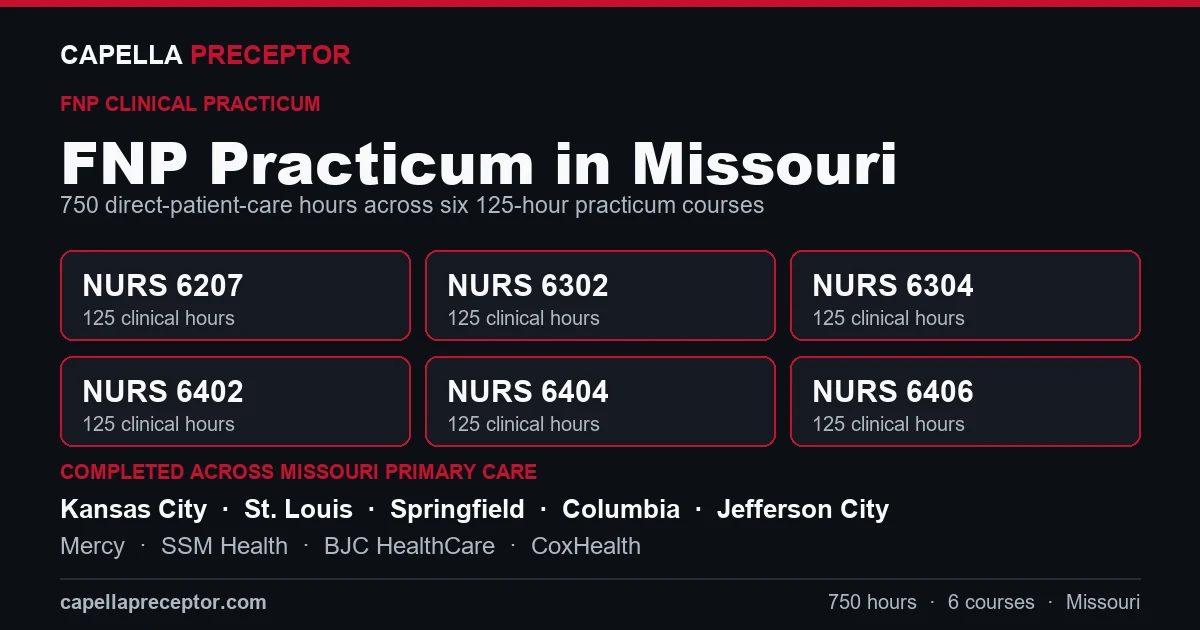
The Capella requirement is the same wherever you live: a minimum of 750 practicum hours spread across six FNP clinical courses, each carrying 125 hours, with the coursework online and the practicum done in your local community (Capella, MSN-FNP courses). Those hours span the lifespan, so you need adult-gerontology, pediatric, and reproductive or women's health visits, which the full Capella FNP guide breaks down course by course.
Missouri does not change that hour count or the CORE ELMS workflow. What it changes is who can serve as your preceptor and what their clinic must have on file. A family medicine site that would clear in a full-practice state still has to satisfy a Missouri collaborative practice arrangement before it can host you, which is why an out-of-state checklist leaves you short here.
The short version for Missouri FNP students. Same 750 hours, same six courses, same CORE ELMS forms. Different gate on the preceptor: they must hold a Missouri APRN Document of Recognition and practice under a current written collaborative practice arrangement with a physician. A solo cash clinic with no collaborating physician on file generally will not qualify.
Why is Missouri a restricted practice state, and what does that mean for your preceptor?
The American Association of Nurse Practitioners classifies Missouri as a restricted practice state, its most limited category (AANP, State Practice Environment). A Missouri nurse practitioner cannot evaluate, diagnose, and prescribe on their own license. State law requires career-long collaboration with a physician through a written agreement that spells out what the NP may do.
For an FNP student that has a concrete effect. The NP precepting you is themselves practicing under physician collaboration, so when you join a Missouri family medicine clinic you are stepping into a supervised structure, not a freestanding practice. Your preceptor still teaches you full-scope primary care across the lifespan, but the site behind them has to be compliant, so we confirm the oversight arrangement, not just the license, before we hand you a match.
What Missouri board rules actually govern an FNP preceptor relationship?
Licensing for advanced practice nurses runs through the Missouri State Board of Nursing, inside the Division of Professional Registration (Missouri State Board of Nursing, advanced practice and collaborative practice). To work as an APRN, a nurse holds an RN license plus a Document of Recognition, and before performing physician-delegated medical acts must enter a written collaborative practice arrangement. The mechanics of that arrangement, set in 20 CSR 2200-4.200, shape what your preceptor's clinic has to do while you are there.
These figures come straight from the Missouri rule (20 CSR 2200-4.200, Collaborative Practice). None of them change your Capella requirement, but together they explain why finding an approvable FNP site here takes more screening than in a full-practice state. A clinic that does not run this oversight loop cannot take you.
Did Missouri's mileage rule change, and does that help FNP students?
Yes, and it works in your favor. Missouri used to require the collaborating physician and APRN to practice within a set distance by road, the long-standing geographic proximity or mileage rule. That requirement was repealed under SB807, and as of August 28, 2024 any rule enforcing a mileage limit between a collaborating physician and nurse is unenforceable (Missouri Senate, SB807).
For a Capella FNP student that quietly widens the field. A rural family medicine NP whose collaborating physician sits in a different town is no longer blocked by distance from taking a student, so sites in the Ozarks, northern Missouri, and the southeast that used to be hard to clear are easier to staff. It is a recent change, so confirm the current arrangement with any site, but the direction is more options, not fewer.
Where do Capella FNP students find clinical sites in Missouri?
Capella does not assign you a preceptor. The university is explicit that learners secure their own preceptor and clinical site locally (Capella, MSN-NP program). For FNP that is harder than for a single-population track, because your six courses need adult, pediatric, and women's health visits, so a site has to be broad enough to cover the lifespan or you stack two or three placements.
Missouri has the clinical depth to do it. Large integrated systems such as Mercy, SSM Health, BJC HealthCare, and CoxHealth run extensive primary care and family medicine networks statewide, and the state's federally qualified health centers, including Swope Health in Kansas City and Compass Health in mid-Missouri, carry the kind of broad family panels that fit the FNP lifespan requirement. We confirm the collaborative practice arrangement at any of these site types before a placement counts.
Deep family medicine, pediatrics, and women's health volume; strong for covering the full FNP lifespan in one region.
Large primary care networks across the metro and St. Charles, good for the two adult-gerontology FNP courses.
CoxHealth and Mercy family medicine in the southwest, with virtual coverage where compliant sites are sparse.
University-town and central Missouri primary care, plus mid-Missouri community health centers.
Rural and small-metro family practice, now easier to clear since the mileage rule was repealed.
Southwest and southeast primary care hubs for full-scope family medicine hours.
What does the FNP clearance workflow look like in Missouri?
Once you have a Missouri preceptor, the clearance steps are the standard Capella workflow, but every step has to line up with a compliant Missouri site. Your practicum application, the site and preceptor approval, and your hour logging all run through Capella's practicum management system, which we track as CORE ELMS. No hour counts until a signed affiliation agreement between Capella and the site is in place and you have cleared third-party compliance such as CastleBranch.
- Confirm the Missouri arrangement first. Verify the preceptor's APRN Document of Recognition and the clinic's collaborative practice arrangement before you propose the site.
- Submit the Missouri site and preceptor into CORE ELMS so Capella can review and approve the placement.
- Execute the affiliation agreement between Capella and the clinic before your first practicum day.
- Clear compliance through the program's background-check and health-records vendor, such as CastleBranch.
- Log and submit your 750 hours in CORE ELMS, course by course, for preceptor approval before each course closes.
A note specific to Missouri prescribing settings: if your preceptor prescribes controlled substances, the state expects that NP to have completed a documented controlled-substance preceptorial requirement and to hold both BNDD and DEA registration for delegated controlled-substance prescribing (Missouri State Board of Nursing, controlled substance prescriptive authority). That is about your preceptor's own authority, not your student status, but it is one more reason a Missouri site has to be vetted, not assumed.
In-person or virtual FNP practicum for Missouri students
Both work, and the right one depends on where you live. Training on site at a Kansas City or St. Louis family medicine practice gives you daily hands-on volume and a preceptor you can shadow across the full FNP lifespan. A virtual preceptorship fits a rural county where a compliant NP-physician site is hard to reach nearby. Either way your hours route through CORE ELMS for approval, and the Missouri collaborative practice requirement still applies to your preceptor regardless of format.
Best near Kansas City, St. Louis, Springfield, or Columbia, where one broad family panel can often cover adult, pediatric, and women's health hours.
Best for the Ozarks and rural northern or southeastern counties where compliant sites are scarce; keeps your six FNP courses on schedule.
Missouri FNP FAQ
Can a nurse practitioner precept a Capella FNP student in Missouri?
Yes. A Missouri NP can serve as your FNP preceptor as long as they hold an active Missouri APRN Document of Recognition and practice under a current written collaborative practice arrangement with a physician. Because Missouri is a restricted practice state, the NP precepting you is themselves working under physician collaboration, so the whole clinic relationship has to be compliant, not just the preceptor's license.
Does Missouri's restricted status change my Capella FNP hours?
No. You still need a minimum of 750 practicum hours across six FNP courses at 125 hours each, logged in CORE ELMS. Missouri's collaborative practice rules do not change the hour count. They narrow which sites qualify, because your preceptor must have a compliant collaborative arrangement on file.
Is there still a mileage rule between the NP and physician in Missouri?
No. Missouri repealed the geographic proximity requirement under SB807. As of August 28, 2024, any rule enforcing a mileage limit between the collaborating physician and APRN is unenforceable, which widens the pool of compliant Missouri sites that can host an FNP student.
What chart review does a Missouri FNP preceptor's collaborating physician do?
Under 20 CSR 2200-4.200, the collaborating physician reviews a minimum of 10 percent of the APRN's documented health care services, and at least 20 percent of cases where a controlled substance was prescribed, with documentation submitted for review at least every 14 days.
Can I do my Capella FNP practicum virtually in Missouri?
Yes, where a local compliant family medicine site is hard to find, especially in the Ozarks and rural northern or southeastern counties. Hours are still logged and approved in CORE ELMS, and the preceptor still meets Missouri APRN licensure and collaborative practice requirements.
Sources
- Capella University, MSN Family Nurse Practitioner courses (750 hours, six courses)
- Capella University, MSN-NP program (learner secures the preceptor)
- AANP, State Practice Environment (Missouri restricted)
- Missouri State Board of Nursing, advanced practice and collaborative practice
- 20 CSR 2200-4.200, Collaborative Practice (10% and 20% chart review, every 14 days, 8-year retention)
- Missouri Senate, SB807 (geographic proximity rule repealed, effective August 28, 2024)
- Missouri State Board of Nursing, controlled substance prescriptive authority
How Capella Preceptor helps FNP students in Missouri
In a restricted state, the slow part is finding a family medicine site whose NP and collaborating physician are both compliant, can cover the FNP lifespan, and will take a student. That is the exact problem we solve. We secure a verified Missouri preceptor whose panel covers adult, pediatric, and women's health, confirm the collaborative practice arrangement and license, prepare every CORE ELMS form, and keep your 750 hours logged and submitted on schedule. We do not claim Capella affiliation; we place preceptors who meet Capella's published requirements and submit them for Capella's own approval.
- Verified Missouri FNP preceptor matched in 7 days, in person or virtual
- Collaborative practice arrangement and APRN license checked before you start
- No payment until you are matched; we map your whole 750-hour practicum plan
Keep reading: the Capella FNP requirements guide for the full course-by-course hour breakdown, or the Missouri practicum and preceptors overview for every Capella program in the state.
Get a Capella FNP preceptor in Missouri
Free 15-minute consult. No payment until matched. We map your entire 750-hour FNP practicum plan.
Get my free consult →