Capella FNP Preceptor in Montana: 750 Hours in a Full-Practice State
The Capella MSN-FNP requires 750 practicum hours across six 125-hour courses, spanning the whole lifespan, and Capella leaves finding the preceptor to you. Montana makes the clinical side easier in one way and harder in another: it is a full practice authority state, so a nurse practitioner here can precept you without a physician on the contract, but it is also one of the most rural states in the country, so qualified sites are spread thin. This page maps both, then how we secure the placement.
Last updated: June 28, 2026 · Reviewed by the Capella Preceptor placement team
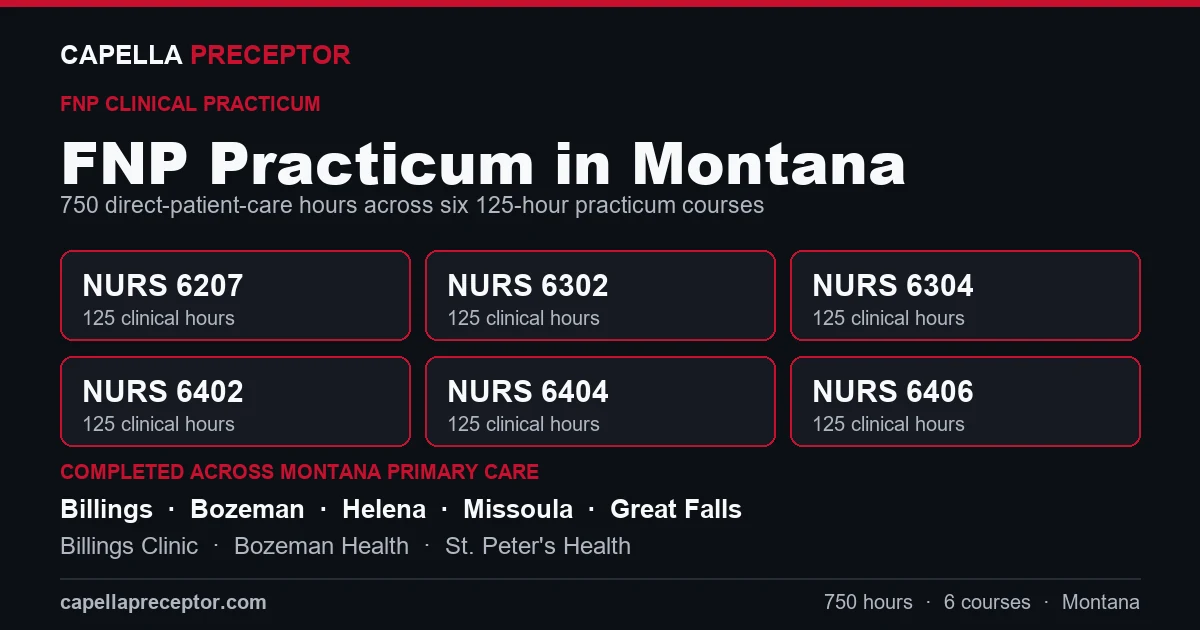
What the Capella FNP practicum looks like in Montana
The number you owe does not change with your zip code. The Capella MSN Family Nurse Practitioner specialization requires a minimum of 750 practicum hours, split across six clinical courses that each carry 125 hours, and the coursework stays online while the practicum happens in your local community (Capella, MSN-FNP courses). Because the FNP is a family role, those hours have to span the lifespan: adult-gerontology, pediatrics, and reproductive or women's health. The full course-by-course breakdown lives on our FNP program page; this page is about doing that 750-hour sequence specifically in Montana.
In Montana the practical question is rarely "what counts" and almost always "where." A single family medicine panel in Billings or Bozeman can carry most of the lifespan, but a student in an eastern or central county may sit hours from the nearest pediatric or women's health rotation. That is why FNP placement here is a geography problem before it is a paperwork problem, and why so many Montana students stall mid-sequence when their original site cannot supply pediatric or reproductive hours.
What does full practice authority in Montana mean for an FNP preceptorship?
The American Association of Nurse Practitioners classifies Montana as a full practice state (AANP, State Practice Environment). On licensure, a Montana nurse practitioner may evaluate patients, diagnose, order and interpret tests, and start and manage treatment, including prescribing, under the exclusive licensure authority of the state board of nursing. There is no required career-long physician supervision and no standing collaborative agreement attached to the role.
For lining up an FNP preceptor, that detail does real work. A full-practice NP does not need a separate supervisory contract with a physician just to take on a student, which removes one of the most common reasons a busy practice says no to a learner. Many rural Montana clinics are NP-led outright, and a working family nurse practitioner who runs their own panel can precept you directly across the adult, pediatric, and women's health courses, provided they meet Capella's published preceptor requirements. In a reduced or restricted state, that same NP often has to route a student through a collaborating physician first; in Montana they do not, which genuinely widens the field of qualified FNP sites outside the larger cities.
What the Montana Board of Nursing expects
Advanced practice nurses in the state are licensed and regulated by the Montana Board of Nursing, which sits within the Department of Labor and Industry, Business Standards Division (Montana Board of Nursing). Montana licenses the role you are training for as a Certified Nurse Practitioner (CNP), one of four APRN roles alongside the certified nurse midwife, certified registered nurse anesthetist, and clinical nurse specialist (Montana Board of Nursing, APRN). A few board points are worth knowing while you arrange an FNP placement, even though they govern your future license rather than your student practicum directly:
- National certification first, then licensure. The board issues CNP licensure on proof of national certification in your population focus (for FNP, a family certification through AANP or ANCC), with an official graduate transcript sent directly from Capella (Montana Board of Nursing, APRN).
- Prescriptive authority is a documented step, not a supervision contract. Montana grants prescriptive authority through its own application: recent graduates show a graduate advanced pharmacology course plus evidence of supervised clinical practice that integrates pharmacologic intervention, and the role carries 12 pharmacology-specific continuing education hours every two years to maintain it (Montana Board of Nursing, prescriptive authority). Your 750 FNP hours under a precepting prescriber are part of how you build toward that.
- Verify a prospective preceptor's license. Use the board's online license lookup (or Nursys) to confirm a candidate holds an active Montana RN and APRN credential in good standing before you commit any hours to them (Montana Board of Nursing, license information). We verify this for every preceptor we put in front of you.
Where a specific rule touches your situation, confirm it directly with the board's Helena office rather than relying on a summary. The board renews APRN licensure on a two-year cycle ending December 31 of even-numbered years, so timing your graduation and first license around that calendar is worth a quick check.
Where do Capella FNP students find clinical sites in Montana?
Here is the part Capella leaves entirely to the student. Capella states that "learners are responsible for finding an appropriate preceptor to oversee the practicum experience," and the university does not assign one (Capella, MSN-NP program). In a low-population state, that often means cold-calling family practices across a wide region and waiting weeks for a maybe, then repeating it for the pediatric and women's health courses. We take that off your plate. The state's larger health systems and its network of community health centers are the realistic anchors for FNP hours:
The state's largest medical hub. Systems like Billings Clinic run primary care across the lifespan with high outpatient volume.
A fast-growing area; Bozeman Health family medicine and other practices give broad family primary care exposure.
The capital, home to St. Peter's Health, where NPs and PAs work alongside physicians, and to the Board of Nursing office.
University and mining-town hubs with community health centers serving family medicine and behavioral health.
North-central and Flathead Valley clinics serving wide surrounding counties, plus NP-led rural practices.
Montana's federally qualified health centers (mapped by the Montana Primary Care Association) are strong full-lifespan FNP sites in underserved areas.
There is a real reason the community-health-center route matters in Montana: most of the state is designated as a primary care shortage area, and rural and frontier counties lean heavily on nurse practitioners to keep clinics open (Montana DPHHS, shortage area designations). That shortage is exactly why qualified preceptors are stretched and hard to book on your own, and exactly why full practice authority puts so many NP-led clinics within reach once someone does the outreach.
If you live in a remote county where in-person family medicine is genuinely scarce, we do not force a four-hour commute. We arrange a fully virtual FNP preceptorship instead. Our offer is the same statewide: a verified Montana preceptor matched within 7 days, and no payment until you are matched.
Clearing the practicum once you have a Montana site
Full practice authority does not exempt you from Capella's clearance workflow. Once a preceptor and site are identified, the same steps apply here as anywhere: propose the placement, get it approved, sign the affiliation agreement, clear compliance, and log hours. Capella manages all of this through its practicum management system, which we track in our workflow as CORE ELMS.
For the FNP specifically, the affiliation step is where multi-site plans get complicated: if you cover pediatrics or women's health at a second Montana clinic, that site needs its own signed agreement too. Lining those up in parallel, rather than one at a time mid-course, is the single biggest thing that keeps an FNP student on schedule here.
In-person or virtual: which fits your part of Montana?
Montana's geography makes this a genuine decision, not a formality. Both paths satisfy Capella's requirements when the site and preceptor are approved; the right one depends on where you are and which of the six FNP courses you are working through.
Best when you are near Billings, Bozeman, Helena, Missoula, Great Falls, Butte, or Kalispell. You get hands-on family primary care volume and a local preceptor who can sign across multiple courses.
Best for frontier counties where in-person family practices are scarce. A verified NP precepts you remotely, hours log in CORE ELMS, and you stay on the FNP course sequence without relocating.
FNP-in-Montana FAQ
Does the Capella FNP let me precept under a nurse practitioner in Montana?
Yes. Montana is a full practice authority state, so a Certified Nurse Practitioner here can practice and precept independently, with no physician on the contract. A working FNP or other CNP who meets Capella's published preceptor requirements can serve as your preceptor for the family primary care courses, which widens the pool at NP-led and rural clinics.
How many FNP practicum hours do I complete in Montana?
A minimum of 750 hours across six clinical courses of 125 hours each, spanning adult-gerontology, pediatric, and reproductive or women's health. The total is the same as anywhere; what changes in Montana is the local supply of sites, which is why placement is the hard part.
Does Capella assign an FNP preceptor to students in Montana?
No. Capella states learners are responsible for finding an appropriate preceptor, and practicum is completed in the student's local community. Capella does not assign one. We secure a verified Montana FNP preceptor for you, with no payment until you are matched.
Can I complete my Capella FNP practicum in rural or frontier Montana?
Yes. We place students in Billings, Missoula, Great Falls, Bozeman, Helena, Butte, and Kalispell, and where a county has few in-person family practices we arrange a fully virtual FNP preceptorship so hours still log in CORE ELMS on schedule.
Sources
- Capella University, MSN Family Nurse Practitioner courses (750 hours, six 125-hour courses)
- Capella University, MSN-NP program (learner secures the preceptor)
- AANP, State Practice Environment (Montana full practice)
- Montana Board of Nursing, APRN licensure (CNP role)
- Montana Board of Nursing, prescriptive authority (pharmacology + CE)
- Montana DPHHS, primary care shortage area designations
How Capella Preceptor helps FNP students in Montana
Montana gives you full practice authority and a wide field of NP-led, family-focused clinics. The catch is reach: finding and confirming an FNP preceptor whose panel covers adults, children, and women's health, across a large, rural state, is the part that stalls students for months. We do that work statewide and carry the paperwork through to approval.
- Verified, Montana-licensed FNP preceptor matched within 7 days, no payment until matched
- Coverage planned across all six FNP courses, in person across Billings, Bozeman and more, or fully virtual for frontier counties
- Every CORE ELMS form, affiliation agreement, and compliance step handled, for all 750 hours
Related: Capella FNP requirements and course codes · Capella preceptor placement in Montana
Get a Capella FNP preceptor in Montana
Free 15-minute consult. No payment until matched. We map all 750 hours and your full Montana practicum plan.
Get my free consult →