Home / MSN-FNP / FNP Preceptor in New Hampshire
FNP · New HampshireCapella FNP Preceptor in New Hampshire
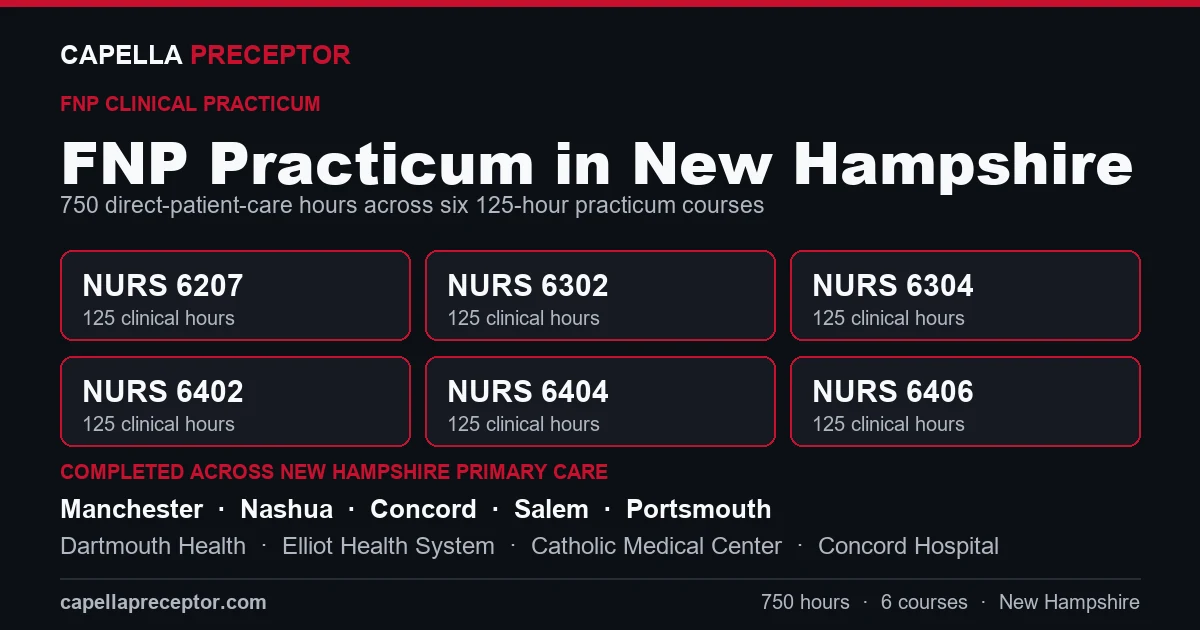
A Capella MSN-FNP practicum is 750 hours across six 125-hour courses, in primary care across the lifespan, and Capella leaves it to you to find the preceptor. In New Hampshire, that preceptor practices under full practice authority, so a nurse practitioner can precept you independently with no collaborating physician and no supervisory contract. This page maps the FNP requirement against New Hampshire's actual board rules, where the clinical settings are, and how we secure a verified FNP preceptor for you in 7 days with no payment until you are matched.
Last updated: June 28, 2026 · Reviewed by the Capella Preceptor placement team
What a Capella FNP needs, and what New Hampshire adds to it
Two things have to line up for a New Hampshire FNP placement, and they come from different rulebooks. The hour requirement is Capella's: a minimum of 750 practicum hours across six clinical courses, each carrying 125 hours (Capella, MSN-FNP courses). Who can supervise those hours, and under what authority, is New Hampshire's: the state grants nurse practitioners full practice authority, so the preceptor you train under is operating with no physician oversight at all. Most pages cover one or the other. This one fits them together, because a placement that satisfies one but ignores the other does not count.
The short version: the 750 hours and the six course codes are identical whether you do them in New Hampshire, Texas, or anywhere else. What New Hampshire changes is the practical reality of lining up the preceptor, which is genuinely easier here than in a restricted state, and the specific board your preceptor answers to. The broader program detail lives on the FNP page and the broader state rules on the New Hampshire page; this page is the place where the two meet.
Does a New Hampshire FNP preceptor need a collaborating physician?
No. New Hampshire is a full practice authority state, one of the earliest to adopt it, and the American Association of Nurse Practitioners lists it as full practice (AANP, State Practice Environment). The state's Nurse Practice Act, RSA 326-B:11, gives an APRN, which is how a nurse practitioner is licensed here, plenary authority to possess, compound, prescribe, administer, dispense, and distribute controlled and non-controlled drugs within the scope of practice, under the sole authority of the Board of Nursing (NH OPLC, Scope of Practice). There is no statutory collaborating physician, no written supervisory agreement, and no career-long delegation.
For an FNP student that is not a technicality, it is the difference between a fast yes and a slow maybe. In a restricted state, a nurse practitioner who wants to precept you may first need a physician's blessing under their own collaboration contract, which adds a gatekeeper and a delay. In New Hampshire an FNP-licensed preceptor decides on their own whether to take you on. You also get to watch the full arc you are training for: a New Hampshire FNP assesses, diagnoses, orders and reads the workup, and writes the prescription, including controlled substances with a valid DEA registration, without checking with anyone. That is precisely the autonomous primary care role you step into after you are certified.
The FNP practicum: 750 hours across six courses
The FNP is a family, primary care credential, so the 750 hours must span the lifespan rather than sit in one age group. The courses make the expected mix explicit, and because each course carries its own hours, you log and have them approved before that course closes. You cannot bank a large block early and coast, which is why a New Hampshire preceptor who can commit across the whole sequence matters more for FNP than for a shorter track.
FlexPath learners see the same sequence as NURS-FPX codes; the 125-hour requirement per course is the same in both formats. Always confirm the exact codes on your own program map, because enrollment date governs which version you follow. Because the spread crosses adult, pediatric, and women's health, a single New Hampshire family medicine practice can sometimes cover most of it, but many students rotate across two or three sites to reach pediatrics and reproductive health, which is a planning problem to solve before day one, not mid-program.
Who licenses your FNP preceptor in New Hampshire
Your preceptor is licensed by the New Hampshire Board of Nursing, which operates under the state Office of Professional Licensure and Certification, or OPLC (NH OPLC, Board of Nursing). A New Hampshire nurse practitioner holds the APRN license category, and the board sets real bars that work in your favor when you vet a preceptor. To stay licensed, a New Hampshire APRN must practice at least 400 hours over the four years before renewal and complete continuing education in the specialty, including pharmacology hours, every cycle (NH OPLC, APRN applications). A preceptor who clears those is, by definition, currently and actively practicing in their field.
We run an OPLC and Nursys license check on every preceptor we propose, so you never train under a name without an active New Hampshire APRN license behind it. For a specific rule on FNP scope or prescriptive authority, the board itself is the right source rather than a secondhand summary.
Where FNP clinical hours actually happen in New Hampshire
FNP hours are earned in outpatient, primary care settings, and New Hampshire's care map shapes where they are realistic to find. The densest cluster of family medicine, pediatrics, and women's health is in the southern tier, anchored by Manchester and Nashua, where systems such as Dartmouth Health, Elliot Health System and Southern New Hampshire Health, now combined as SolutionHealth, Catholic Medical Center, and Concord Hospital run primary care networks. The state also has a strong federally qualified health center layer, including community health centers like Amoskeag Health in Manchester and Lamprey Health Care on the seacoast, which are natural FNP primary care sites across the lifespan.
Manchester, Nashua, Salem, and Concord hold the densest primary care, the closest single-site fit to the FNP's full lifespan scope.
New Hampshire's federally qualified health centers serve broad, mixed-age panels that map well to the adult, pediatric, and women's health courses.
Dedicated pediatric clinics and OB/GYN practices for the NURS6402 and NURS6404 courses when one family practice cannot cover them.
Rural primary care around the Dartmouth Health region, where in-person sites are sparser and a virtual preceptor often fills the gap.
New Hampshire's rural areas, the North Country and Carroll County in particular, are recognized primary care shortage zones with older populations and thinner provider coverage (NH DHHS, Primary Care Office). That is exactly where FNPs extend access, and exactly where finding an in-person preceptor on your own is hardest, so it is where our virtual option earns its place.
Who finds the FNP preceptor: Capella or you?
You do, and this is the part that surprises most FNP students. Capella does not assign you a preceptor or a clinical site. The university states plainly that learners are responsible for finding an appropriate preceptor to oversee the practicum, completed in your local community (Capella, MSN-NP program). Capella provides support resources and approves the placement you propose, but securing it is on you. New Hampshire's full practice authority makes a preceptor easier to engage, since no physician has to sign off, but it does not produce one for you, and a cold-call search around work and family can run for months while a course clock ticks.
That is the gap we close. We maintain relationships with FNP-qualified clinicians across New Hampshire, match you to one whose patient panel fits the specific course you are in, verify the New Hampshire APRN license, and handle the approval paperwork end to end.
Clearing the placement before hours count
Independent practice authority does not remove Capella's own clearance steps. Once you identify a New Hampshire FNP preceptor and site, the same workflow runs before a single hour is logged, and it goes through Capella's practicum system, which we track as CORE ELMS.
- Propose the New Hampshire site and FNP preceptor in CORE ELMS for Capella review and approval.
- Execute an affiliation agreement between Capella and the New Hampshire site before the start date.
- Clear compliance through a third-party background-check and health-records vendor such as CastleBranch; confirm the current vendor with your program.
- Log and submit hours in CORE ELMS per course, where your preceptor approves what you record before each course closes.
The common stall point is not the first course. It is discovering mid-program that the original New Hampshire site cannot supply pediatric or women's health hours, then scrambling for a second preceptor while a clock runs. Plan the lifespan coverage at the start, and the New Hampshire piece becomes logistics rather than a crisis.
In-person or virtual for New Hampshire FNP students
New Hampshire's geography splits cleanly for FNP placement. From Nashua up through Manchester and Concord, plus the seacoast around Portsmouth and Dover, there are enough family practices that an in-person FNP match near home is usually realistic. The North Country and the rural Upper Valley are a different story, where the nearest suitable clinic with capacity for a student may be a long drive. That is where a virtual preceptorship over secure video, with hours logged in CORE ELMS, keeps you on schedule. Always confirm that telehealth-based hours satisfy your specific Capella FNP course before you commit to them; we tell you up front whether virtual fits your situation.
FAQ
Does a New Hampshire FNP preceptor need a collaborating physician?
No. New Hampshire is a full practice authority state. Under RSA 326-B:11 an APRN, which is how a nurse practitioner is licensed here, has plenary authority to prescribe, administer, and dispense controlled and non-controlled drugs within scope, with no required collaborating physician or supervisory agreement. An FNP preceptor can take you on without a physician's sign-off.
How many practicum hours does the Capella FNP require in New Hampshire?
A minimum of 750 practicum hours, the same nationwide, spread across six 125-hour courses: NURS6207, NURS6302, NURS6304, NURS6402, NURS6404, and NURS6406. New Hampshire law changes who can precept and how, not the Capella hour count.
Who finds my FNP preceptor in New Hampshire, Capella or me?
You do. Capella states learners are responsible for finding an appropriate preceptor to oversee the practicum, completed in your local community. Capella reviews and approves the site and preceptor through CORE ELMS but does not assign them. We close that gap by matching you to a New Hampshire FNP preceptor and handling the paperwork.
Can a New Hampshire FNP student do the practicum virtually?
Often yes, depending on your course and specialty. The southern tier around Manchester, Nashua, and Concord usually supports an in-person match near home, while the North Country and rural Upper Valley are where a virtual preceptor over secure video keeps you on schedule. Confirm telehealth-based hours against your specific Capella course first.
Sources
- Capella University, MSN-FNP courses (750 hours, six 125-hour practicum courses)
- Capella University, MSN-NP program (learner secures the preceptor, local community)
- AANP, State Practice Environment (New Hampshire listed as full practice)
- New Hampshire OPLC, Scope of Practice (RSA 326-B:11, plenary APRN authority)
- New Hampshire OPLC, APRN applications and licensure (practice-hour and CE requirements)
- New Hampshire DHHS, Primary Care Office (rural primary care shortage areas)
How Capella Preceptor helps with FNP placement in New Hampshire
You now have both halves: 750 hours across six FNP courses, and a New Hampshire FNP preceptor who can precept independently under full practice authority, with the placement still left to you. That last point is where students stall. We secure a verified, New Hampshire-licensed, Capella-compliant FNP preceptor whose patient mix covers the lifespan your courses require, prepare every CORE ELMS form and affiliation agreement, and keep your hours logged and submitted on schedule.
- Verified New Hampshire FNP preceptor matched in 7 days, primary care across the lifespan, in person or virtual
- OPLC and Nursys license check on every preceptor, plus every CORE ELMS form and affiliation agreement handled
- No payment until you are matched, with your exact quote in a free consult
Get an FNP preceptor in New Hampshire
Free 15-minute consult. No payment until matched. We map your entire FNP practicum plan across all 750 hours.
Get my free consult →