Capella FNP preceptor in New Jersey: hours, board rules, and how to get placed.
The Capella MSN-FNP needs 750 practicum hours of primary care across the lifespan, and you secure the preceptor yourself. In New Jersey that preceptor works under a reduced-practice framework that a March 30, 2026 law has begun to loosen for family primary care. Here is what New Jersey FNP students need to line up, then how we secure the placement.
Last updated: June 28, 2026 · Reviewed by the Capella Preceptor placement team
What the Capella FNP requires, and why New Jersey changes the picture
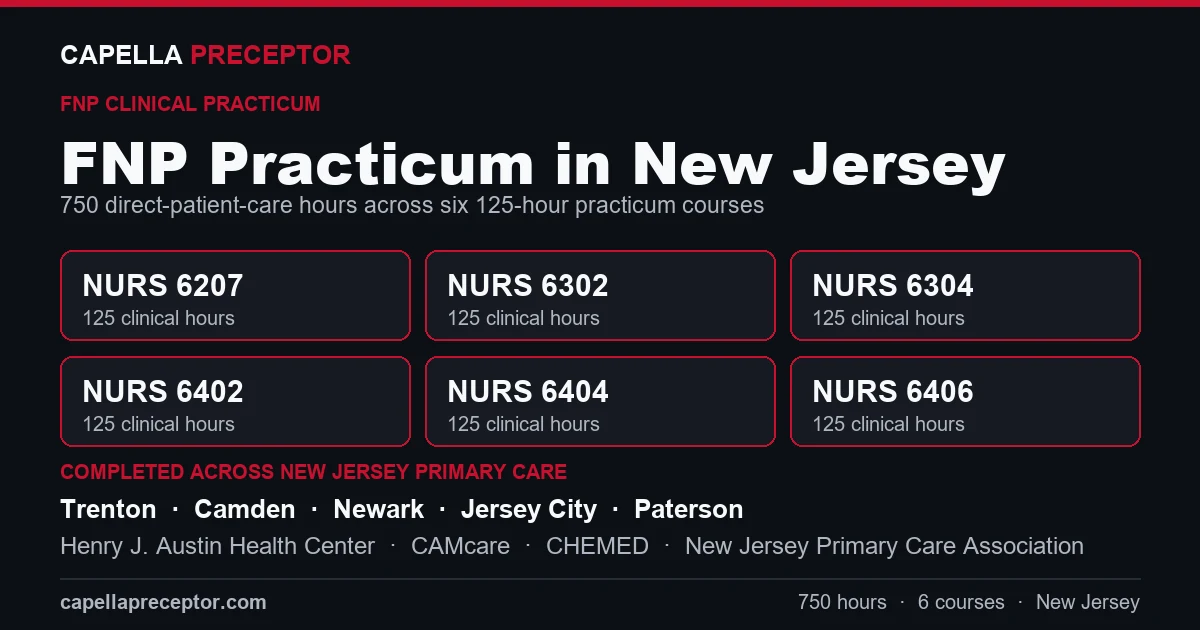
The Capella MSN Family Nurse Practitioner specialization requires a minimum of 750 practicum hours, spread across six clinical courses that each carry 125 hours, with the coursework online and the practicum completed in your local community (Capella, MSN-FNP courses). Because the FNP is a family role, those hours have to span the lifespan: adult-gerontology, pediatric, and reproductive or women's health primary care. The full course-by-course breakdown lives on our Capella FNP page; this page is about doing those hours in New Jersey.
New Jersey changes two things. First, it is one of the most crowded clinical markets in the country, so an unaffiliated FNP placement is harder to win than the 750-hour number suggests. Second, the rules your preceptor practices under are in active transition after a 2026 law, which is worth understanding even though, as a student, you are not the one prescribing yet. Both points are covered below, alongside the broader New Jersey placement page that handles every Capella program in the state.
Does a New Jersey FNP preceptor practice independently?
The American Association of Nurse Practitioners classifies New Jersey as a reduced-practice state (AANP, State Practice Environment). In a reduced state, at least one element of nurse practitioner practice is limited by a required collaborative relationship. In New Jersey that element has been prescribing: an advanced practice nurse holds prescriptive authority but was required to maintain a written, signed, annually reviewed joint protocol with a collaborating physician licensed in New Jersey before prescribing a medication or device (NJ Board of Nursing, APN Certification).
That framework loosened in 2026. On March 30, 2026, Governor Mikie Sherrill signed S2996/A4052, which lets qualifying APNs in primary and behavioral health practice and prescribe without a joint protocol (State of New Jersey, Office of the Governor). The eligibility detail matters for FNP students specifically: independent practice is limited to APNs whose population focus is family or individual across the lifespan, adult-gerontology, pediatrics, women's health, or behavioral health, and who have logged more than 5,000 hours of active advanced practice in that focus. The family-across-the-lifespan focus is exactly the FNP scope, so a seasoned New Jersey FNP is squarely in the group the law was written for. It is still not blanket full authority: legal analysts note the carve-out excludes general obstetrics and elective cosmetic services and keeps continuing-education and malpractice-coverage requirements in place (McCarter & English, on S2996).
For someone still in practicum, the practical takeaway is much narrower than the policy headline. You are not prescribing yet, so the state's category label matters far less than your preceptor's own credential. What we screen for is that the preceptor holds an active New Jersey APN certification whose population focus covers family primary care, so their day-to-day scope matches the patients your Capella courses require.
What the New Jersey Board of Nursing requires of an FNP preceptor
Advanced practice in New Jersey is regulated by the New Jersey Board of Nursing, within the Division of Consumer Affairs under the Department of Law and Public Safety (NJ Board of Nursing). To hold APN certification, a nurse must be a registered nurse, complete an accredited master's-level NP program that includes a graduate-level three-credit pharmacology course taken within five years of applying, and pass a board-approved national certification exam (NJ Board of Nursing, APN Certification). A New Jersey FNP preceptor will therefore typically hold a family or primary-care certification such as FNP-BC or FNP-C carried over into the New Jersey APN credential.
You can confirm any preceptor's credential yourself. The Division of Consumer Affairs runs a public license-verification portal where you look up a New Jersey RN or APN by name or license number and see the status and expiration (NJ Division of Consumer Affairs, license verification). We verify every preceptor through that system and document it for your Capella site-approval file, but the check is open to you too.
Where FNP students do their hours in New Jersey
The FNP populations map onto specific New Jersey settings. The closest single-site fit is a family medicine practice that sees adults, children, and women's health in one panel; many students instead rotate across two or three sites to cover pediatrics and reproductive health. A practical and often overlooked option is New Jersey's safety-net network: the New Jersey Primary Care Association represents 24 federally qualified health centers running 137 sites statewide (New Jersey Primary Care Association), and these community clinics deliver exactly the broad, full-lifespan family primary care the FNP track requires.
Newark, Jersey City, Paterson, and Elizabeth: high-volume family medicine and community health centers covering adult and pediatric primary care.
Edison, New Brunswick, and the Princeton area for outpatient family and adult-gerontology primary care placements.
Henry J. Austin Health Center in Trenton and CAMcare in Camden, federally qualified centers with full-lifespan family panels.
The Lakewood area (including CHEMED), Toms River, and Atlantic City, with virtual coverage where local sites are sparse.
Inpatient and specialty-only rotations are a poor fit because the FNP is a primary-care credential. Confirm any nonstandard New Jersey site with your Capella faculty before you commit hours to it.
Why an FNP preceptor is hard to find in New Jersey
Capella does not assign you a preceptor or a site. The university states the learner is responsible for securing an appropriate preceptor and recommends practicum in your own community (Capella, MSN-NP program). In New Jersey that responsibility is heavier than it sounds. The state is small and dense, and its own FNP-producing programs are competing for the same family-practice sites you are: Rutgers, Seton Hall, Fairleigh Dickinson, and the large hospital systems all place cohorts of NP students every term, so unaffiliated primary-care slots get claimed early. New Jersey nursing advisors openly note that the concentration of programs means students must lock in preceptors early, and that southern and northwestern New Jersey placements are the hardest to arrange (Family Nurse Practitioner programs, New Jersey).
There is a second New Jersey-specific wrinkle. A busy family-practice provider who could precept you may, depending on their hours and population focus, now be eligible to drop their physician joint protocol under the 2026 law. That is good for the provider, but it does not add preceptor capacity, and the same providers still field requests from every nearby program. The practical answer is the same one Capella's own guidance implies: line up coverage well before your first practicum course opens.
Clearing a New Jersey FNP placement at Capella
Lining up the preceptor is only step one. Your New Jersey FNP placement also has to pass through Capella's clearance pipeline before any hour counts, and that pipeline runs in the university's practicum management system, which we track in our workflow as CORE ELMS. Three gates stand between a willing preceptor and your first logged visit:
- Credential review in CORE ELMS. You submit the New Jersey FNP site and preceptor, and Capella vets the license and population focus before it clears the match.
- An executed affiliation agreement. The site and Capella have to sign an affiliation agreement before day one. New Jersey hospital systems push these through legal review, which eats weeks, so a solo family practice or an FQHC often clears faster than a large network.
- Compliance clearance. Your background check, drug screen, and health records have to come back clear through CastleBranch on the myCB platform before your start date.
The hours themselves do not change by state: 750 across the six FNP practicum courses, each carrying 125 hours, with your preceptor approving the hours you log. What changes in New Jersey is the difficulty of the search and the lead time on the paperwork, which is precisely where students lose weeks.
In-person or virtual FNP hours for New Jersey students
New Jersey is compact and densely populated, so most FNP students can land an in-person family-practice site within commuting distance, which is usually the better experience: live patient flow, direct preceptor feedback, and a population mix that covers adult, pediatric, and women's health in one panel.
The virtual option exists for the cases in-person cannot cover, which in New Jersey tend to be the rural southern and northwestern counties where sites are scarce, or a working nurse on shifts no nearby clinic can accommodate. Eligible hours run through a verified virtual preceptorship and log in CORE ELMS the same way. Confirm with your Capella faculty which FNP courses permit virtual hours, since that varies by course.
New Jersey FNP FAQ
Does a New Jersey FNP preceptor need a joint protocol with a physician?
It depends on the preceptor. New Jersey is a reduced-practice state, so an APN historically needed a written joint protocol with a collaborating New Jersey physician before prescribing. A March 30, 2026 law (S2996/A4052) lets qualifying APNs in primary care, including the family-across-the-lifespan focus that matches the FNP, practice and prescribe without a joint protocol once they exceed 5,000 hours of active advanced practice. As a student you are not prescribing yet, so what matters is that your preceptor holds an active New Jersey APN certification whose population focus covers family primary care.
How many FNP practicum hours does Capella require in New Jersey?
A minimum of 750 practicum hours across six clinical courses at 125 hours each, the same nationwide. In New Jersey those hours must still span the FNP lifespan: adult-gerontology, pediatric, and reproductive or women's health primary care, completed at an approved New Jersey site under an on-site preceptor.
Where can I do FNP clinical hours in New Jersey?
Family medicine, internal medicine, pediatric, and women's health clinics across New Jersey, including the state's 24 federally qualified health centers and their 137 sites, such as Henry J. Austin in Trenton, CAMcare in Camden, and centers in Newark, Jersey City, Paterson, and the Lakewood area. A fully virtual option covers thinly served southern and northwestern counties.
Does Capella find my FNP preceptor in New Jersey?
No. Capella states learners are responsible for finding an appropriate preceptor and recommends completing practicum in your own community. In New Jersey's dense market, where Rutgers, Seton Hall, and Fairleigh Dickinson cohorts compete for the same family-practice sites, unaffiliated FNP slots fill early, which is why securing coverage in advance matters.
Sources
- Capella University, MSN Family Nurse Practitioner courses (750 hours, six 125-hour courses)
- New Jersey Board of Nursing, Advanced Practice Nurse Certification
- AANP, State Practice Environment (reduced-practice classification)
- State of New Jersey, Office of the Governor, on S2996/A4052 (March 30, 2026)
- McCarter & English, analysis of S2996 (5,000-hour threshold and carve-outs)
- New Jersey Primary Care Association (24 FQHCs, 137 sites)
- Capella University, MSN-NP program (learner responsibility for the preceptor)
How Capella Preceptor helps New Jersey FNP students
You now know the New Jersey FNP landscape: 750 primary-care hours across the lifespan, a reduced-practice board framework loosening for qualifying family APNs, a crowded market where in-state programs claim sites early, and a Capella placement the university leaves entirely to you. That last part is where students lose weeks. We secure a verified, New Jersey-licensed, Capella-compliant FNP preceptor whose family panel covers the populations your courses require, prepare every CORE ELMS form and affiliation agreement, and keep your hours logged and submitted on schedule.
- Verified New Jersey FNP preceptor matched in 7 days, in person or virtual
- Family panel matched to all 750 hours: adult-gerontology, pediatric, and women's health
- Every CORE ELMS form, New Jersey affiliation agreement, and CastleBranch step handled, no payment until matched
Get a Capella FNP preceptor in New Jersey
Free 15-minute consult. No payment until matched. We map your entire FNP practicum plan across the lifespan.
Get my free consult →