Home / MSN-FNP / FNP Preceptor in New York
FNP · New YorkCapella FNP Preceptor in New York
A Capella FNP practicum in New York requires 750 direct-patient-care hours across six 125-hour courses, under a New York-licensed, FNP-qualified preceptor whose panel spans the lifespan. New York is a full-practice-authority state, which means a licensed NP works autonomously, but that autonomy belongs to your future credential, not to you as a student, so you still need a preceptor, and Capella expects you to find that preceptor yourself. This page explains how the FNP requirement and the New York board rules meet, then how we secure the placement.
Last updated: June 28, 2026 · Reviewed by the Capella Preceptor placement team
What does a Capella FNP practicum require, and what does New York add?
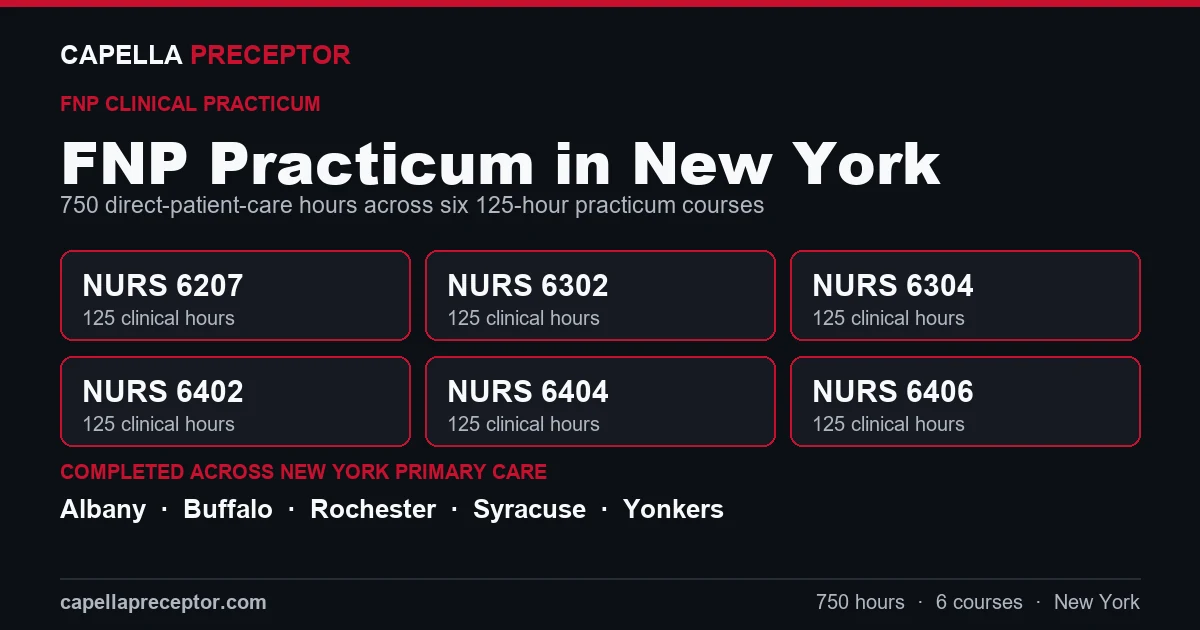
Two separate rulebooks govern an FNP student in New York, and confusing them is the most common mistake. The first is Capella's: the MSN Family Nurse Practitioner specialization requires a minimum of 750 practicum hours, spread across six clinical courses that each carry 125 hours, all in primary care across the lifespan (Capella, MSN-FNP courses). That number is what governs your degree, and it does not change because you happen to live in Albany rather than Atlanta.
The second rulebook is New York's. New York regulates who may certify as a nurse practitioner and what an approved program must contain, and the state requires NP education to be at the graduate level with a population-specific focus such as family health, adult-gerontology, pediatrics, or psychiatry (NYSED Office of the Professions, NP certification requirements). For an FNP student, the practical effect is that your future New York certificate will read "family health," and the preceptor who trains you should hold a credential that lines up with that population. We keep the two rulebooks straight for you, and the table below is the short version.
What does full practice authority mean for an FNP precepting relationship in New York?
The American Association of Nurse Practitioners classifies New York as a full practice authority state, the highest of the three tiers (AANP, State Practice Environment). Full practice means a licensed NP can evaluate patients, diagnose, order and interpret tests, manage treatment, and prescribe under the state's own licensing authority rather than under a mandated physician relationship. For your training, that matters in a specific way: a full-practice FNP preceptor in New York runs an autonomous primary care panel, so the lifespan care you need to log, well-child visits, chronic disease management in adults, routine women's health, is care that NP is already delivering independently. That is the practice you are training toward.
There is a New York-specific timing issue worth naming. That autonomy flows from the Nurse Practitioner Modernization Act, which lets NPs with more than 3,600 hours of qualifying experience practice without a written collaboration; NPs below that threshold still maintain a collaborative relationship with a physician (NYSNA, Nurse Practitioner Modernization Act). The provision that removed the written agreement carries a sunset date of July 1, 2026, and unless the Legislature makes it permanent through pending bill S2360, the older collaboration rule returns (Frier Levitt, NY NP independent practice 2026; NY State Senate Bill S2360). None of this changes your obligations as a student, but it can change a prospective preceptor's own status, so confirm the current rule with the state board before you rely on it.
The student bottom line. Full practice authority is about licensed NPs, not learners. While you complete your Capella FNP practicum you are not practicing independently, so you still need a qualified, New York-licensed preceptor to supervise and verify every one of your 750 hours. Full practice authority does not remove the preceptor requirement; it describes the autonomous family-care practice your training is preparing you to do.
Who can be an FNP preceptor in New York, and how do you verify them?
Nursing is regulated differently in New York than in most states. Rather than a standalone board under a health department, the profession sits within the New York State Education Department, Office of the Professions, advised by the State Board for Nursing under the Board of Regents (NYSED Office of the Professions, Nurse Practitioners). Because New York certifies NPs by population focus, an FNP preceptor who is a nurse practitioner holds both an underlying registered professional nurse license and a family-health NP certificate. For Capella's FNP practicum, a preceptor is typically a board-certified Family Nurse Practitioner, a physician (MD or DO), or in some courses another qualified clinician working in primary care, family practice, internal medicine, pediatrics, or women's health.
You can confirm any prospective preceptor's credentials yourself through the Office of the Professions verification search (NYSED, professional verification search). We verify this on every match, but checking the underlying RN license and the matching NP population focus is a good habit, because an adult-only or pediatrics-only panel can leave an FNP student short on the lifespan coverage the course sequence demands.
Where do FNP students actually complete primary care hours in New York?
New York looks easy on paper because it has more clinicians than almost any state, but density and access are not the same thing. New York's nurse practitioners cluster in outpatient primary care, exactly where FNP hours live, yet downstate clinics are saturated with students from a dozen local programs, and many practices have stopped taking learners. Upstate the problem inverts: the comptroller's office has flagged severe primary care shortages across rural counties, with a nurse-practitioner-to-population ratio well below the statewide figure, so willing preceptors exist but few sit within a reasonable drive (NY Office of the State Comptroller, rural health shortages). Many of those underserved counties are designated primary care Health Professional Shortage Areas, which is precisely where a willing family-medicine preceptor is most valuable and hardest to reach.
Because the FNP must cover the lifespan, a single family medicine clinic can sometimes carry most of it, but many New York students rotate across two or three sites to reach pediatrics and women's health. The settings that fit the Capella FNP populations are consistent statewide:
The closest fit to the FNP scope, often covering adults, children, and women's health in one panel. Federally qualified health centers in HPSAs are common FNP sites.
Strong for the two adult-gerontology practicum courses and chronic disease management, abundant across both metro and upstate networks.
Well-child and acute pediatric visits for the pediatric practicum, one of the harder populations to source in saturated downstate markets.
Prenatal, postpartum, and routine gynecologic visits for the reproductive health practicum, also among the most competitive specialties for placement.
We place FNP students across the whole state, not just the obvious metros:
New York City and its five boroughs, Long Island (Nassau and Suffolk), Yonkers, and the lower Hudson Valley, where large systems serve as primary care teaching sites.
Albany, Schenectady, Troy, Syracuse, Utica, and Binghamton, a mix of academic medical centers and independent family practices.
Buffalo, Rochester, Niagara Falls, and the North Country and Southern Tier, where primary care shortage areas raise the value of every family-medicine slot.
When a strong local match is scarce, the virtual option keeps you moving instead of waiting for a clinic that may never open a slot. Either way, you are not cold-calling offices and collecting rejections; we carry that part.
Why is finding an FNP preceptor in New York harder than the numbers suggest?
New York trains a large share of its own nurse practitioners, and the great majority of NP students in the state did their training in-state, which intensifies competition for the same finite set of primary care preceptors. Three specialties inside the FNP lifespan, women's health, pediatrics, and busy internal medicine, are consistently the tightest, because the same slots are wanted by FNP, AGPCNP, and PMHNP students at once. Add the structural reality that most New York NPs practice inside large health systems rather than small independent offices, and a placement often hinges on institutional onboarding and a signed agreement rather than a single clinician saying yes.
That is the difference between this page and a generic "find a preceptor" pitch. For an FNP in New York, the obstacle is rarely whether qualified preceptors exist; it is reaching a family-health preceptor with open capacity, in your region, who can commit across a 750-hour, multi-population sequence, and clearing the system's onboarding before a course clock starts. That is the specific problem we solve.
How does the Capella practicum paperwork work for a New York placement?
Once a preceptor and site are identified, a New York placement runs through the same Capella clearance every state does. Capella states that learners are responsible for finding an appropriate preceptor, and that practicum is completed in the student's local community (Capella, MSN-NP program). Practicum application, site and preceptor approval, and hour logging happen in Capella's practicum management system, which we track in our workflow as CORE ELMS. Before practicum begins, a signed affiliation agreement between Capella and the New York site has to be in place, along with third-party compliance such as a CastleBranch background check.
- Submit the New York site and FNP preceptor in CORE ELMS for Capella review and approval, with the family-health credential attached.
- Get the affiliation agreement signed between Capella and the clinical site, often the slow step at a large New York health system, before any hours are logged.
- Clear compliance through the third-party background and health-record vendor (such as CastleBranch); confirm the current vendor with your program.
- Log and submit your 750 hours in CORE ELMS for preceptor approval, per course, before each of the six practicum courses closes.
Because the hours are tied to specific courses, you cannot bank a large block early and coast later. We break the full FNP hour structure down on the FNP specialty page, and the rest of the New York board picture on the New York placement page.
Virtual or in-person FNP practicum for New York students?
In New York City the competition for in-person primary care sites is fierce, and pediatrics and women's health are the first to fill; upstate, the calculus flips to travel time across a shortage county. We offer both formats and match the format to your situation and your course population.
A local New York clinic where you see patients on site, suited to the hands-on lifespan contact the FNP courses expect and to students who want a physical home base across the sequence.
Supervised telehealth-based primary care hours with a qualified FNP preceptor, useful when local sites are saturated downstate or sparse in the North Country, with hours still tracked in CORE ELMS.
Confirm with your faculty which portion of your FNP hours, if any, your specific Capella course allows virtually, since that varies by course and population focus.
FNP in New York FAQ
How many FNP practicum hours does a Capella student need in New York?
A minimum of 750 practicum hours, across six clinical courses that each carry 125 hours, in primary care across the lifespan. That requirement is Capella's and does not change because you complete it in New York. New York's own NP program-registration standards are separate; the figure that governs your degree is Capella's 750 hours.
Does New York's full practice authority mean a Capella FNP student does not need a preceptor?
No. Full practice authority applies to licensed nurse practitioners, not to students. During your Capella FNP practicum you still need a qualified, New York-licensed preceptor whose population focus matches your courses to supervise and sign off your 750 hours.
Can my New York FNP preceptor be a nurse practitioner, or does it have to be a physician?
An FNP preceptor in New York is typically a board-certified Family Nurse Practitioner, a physician (MD or DO), or in some courses another qualified clinician matched to the patient population. New York certifies NPs by population focus, so a family-health certified NP is a natural FNP preceptor; confirm the credential matches your specific Capella course.
Is New York's NP independent practice rule changing in 2026?
The provision that lets experienced New York NPs practice without a written collaboration carries a sunset date of July 1, 2026. NPs with more than 3,600 hours of qualifying experience practice independently; below that threshold a collaborative relationship still applies. Because the law can shift, confirm the current rule with the New York State Education Department Office of the Professions. It does not change Capella's 750-hour student requirement.
Where in New York can Capella Preceptor place an FNP student?
Across New York City and its boroughs, Long Island, the Hudson Valley, the Capital Region, Buffalo, Rochester, Syracuse, and upstate and North Country counties, plus a fully virtual option where local primary care sites are saturated downstate or sparse upstate.
Sources
- Capella University, MSN-FNP courses (750 hours, six 125-hour courses)
- Capella University, MSN-NP program (learner secures preceptor)
- AANP, State Practice Environment (New York full practice authority)
- NYSED Office of the Professions, Nurse Practitioners
- NYSED Office of the Professions, NP certification requirements (population focus)
- NYSED, professional license verification search
- NYSNA, Nurse Practitioner Modernization Act (3,600 hours)
- Frier Levitt, New York NP independent practice set to expire July 2026
- NY Office of the State Comptroller, rural counties health professional shortage
How Capella Preceptor helps FNP students in New York
You now know the terrain: the Capella FNP needs 750 hours across the lifespan, New York gives NPs full practice authority but Capella still leaves the preceptor to you, and the real obstacle is reaching a family-health preceptor with capacity in a saturated downstate market or a thin upstate shortage county. We secure a verified, New York-licensed preceptor who meets Capella's published requirements in the right population, prepare every CORE ELMS form and affiliation agreement, and keep your hours logged and submitted on schedule.
- Verified New York FNP preceptor, primary care across the lifespan, matched in 7 days, no payment until matched
- Every CORE ELMS form, affiliation agreement, and CastleBranch step handled
- In-person across New York or fully virtual where local primary care sites are scarce
Get an FNP preceptor in New York
Free 15-minute consult. No payment until matched. We map your entire New York FNP practicum plan and verify your preceptor's New York license and family-health focus before you start.
Get my free consult →