Capella FNP Preceptor in North Dakota
The Capella MSN-FNP needs 750 practicum hours of primary care across the lifespan, and you are the one who secures the preceptor. North Dakota is a full practice authority state, so the legal path is clear. The real work here is the geography: enough adult, pediatric, and women's health sites to fill all six courses, across a large, thinly populated state. Here is how that comes together.
Last updated: June 28, 2026 · Reviewed by the Capella Preceptor placement team
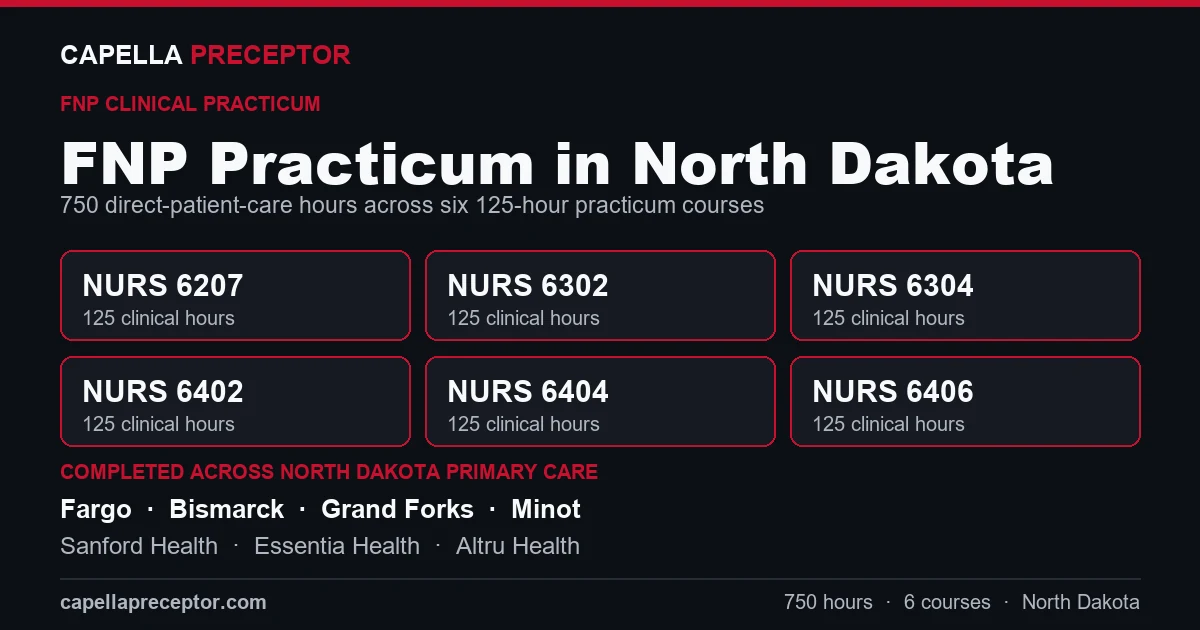
What the Capella FNP requires, and what North Dakota adds to it
The Capella MSN Family Nurse Practitioner specialization requires a minimum of 750 practicum hours, logged across six clinical courses that each carry 125 hours (Capella, MSN-FNP courses). Because the FNP is a family role, those hours have to span the lifespan: adult and older-adult primary care, pediatrics, and reproductive or women's health. The coursework is online, but the practicum is done in person in your own community, and Capella states plainly that "learners are responsible for finding an appropriate preceptor to oversee the practicum experience." That last sentence is where a North Dakota student's situation becomes specific.
North Dakota is a full practice authority state, classified that way by the American Association of Nurse Practitioners (AANP, North Dakota). A licensed North Dakota nurse practitioner can assess, diagnose, order and interpret tests, and prescribe under the sole authority of the state board. For a Capella FNP student that has one direct, practical consequence: an independently practicing NP can take you on as a preceptor without first signing a supervisory contract with a physician. You are not stacking a legal arrangement on top of a teaching arrangement. The constraint left over is logistical, not regulatory, and we cover it below. For the program-wide picture of hours and course codes, see our Capella FNP page; for the statewide board detail, see our North Dakota page.
Why full practice authority matters for who can precept you
North Dakota reached full practice status when it repealed the rule tying APRN authority to a written physician collaboration arrangement, effective October 1, 2011 (North Dakota Board of Nursing, APRN FAQs). The state was an early mover; it removed that requirement the same year as Vermont. In a reduced or restricted state, an FNP student often finds an NP willing to teach but then hits a wall because that NP must themselves practice under a collaborating physician, which complicates the chain of who can supervise a student. North Dakota does not have that wall.
In concrete terms, your FNP preceptor in North Dakota can be a family nurse practitioner running their own primary care panel, a physician in family or internal medicine, or another qualified clinician matched to the specific course population. The board's scope language describes the APRN performing "a comprehensive assessment of client" and "prescribing a therapeutic regimen of health care, including diagnosing, prescribing, administering, and dispensing drugs," which is exactly the full-scope primary care your FNP courses are built around. The credentials your preceptor must hold are the same ones the board requires of any North Dakota APRN: an active RN license, a graduate degree in the advanced role and population focus, and current national certification (North Dakota Board of Nursing, APRN licensing). Those are the credentials we verify before you log an hour.
The real North Dakota challenge: covering the full FNP lifespan
North Dakota's difficulty is not the board. It is that the FNP needs three distinct populations and the state has a small, spread-out population to draw them from. About 39 percent of North Dakotans live in nonmetro areas, and primary care capacity concentrates in four cities (Rural Health Information Hub, North Dakota). Adult primary care, which the FNP weights with two of its six practicum courses, is the easiest population to staff almost anywhere. Pediatrics and women's health are the ones that go thin fast outside the metros, and they are precisely the courses where Capella students stall mid-program.
The metros where most FNP-appropriate capacity sits, with the systems that anchor them:
The state's largest care market, anchored by Sanford Health and Essentia Health, with the broadest family medicine, pediatric, and women's health capacity for covering the whole FNP lifespan in one region.
The capital region, strong for the two adult-gerontology primary care courses and for general family medicine, with Sanford and CHI St. Alexius care sites.
A university city anchored by Altru Health System, with family medicine and outpatient sites that suit the adult and family-centered FNP courses.
North-central hub serving a wide rural catchment; good for adult primary care, with pediatric and women's health often filled regionally or virtually.
If you live in Williston, Dickinson, Devils Lake, Jamestown, Watford City, or a frontier county with no nearby clinic, that is not a dead end. Much of rural North Dakota is a federally designated primary care shortage area, which means a single local clinic rarely supplies all three FNP populations on its own. The fix is usually to anchor with a local family medicine preceptor for your adult and family hours and fill the pediatric or women's health gap through a regional match or a virtual rotation, which keeps one clinic from having to be everything.
FNP course populations mapped to North Dakota settings
Because the 750 hours are tied to named courses, you cannot bank adult hours early and hope the rest sorts itself out. Each practicum course has its own population, logged and approved before that course closes (Capella, MSN-FNP courses). Here is the FNP sequence mapped to where those hours realistically come from in North Dakota.
A single Fargo or Grand Forks family medicine panel can sometimes cover most of this, because family practice there sees children, adults, and routine gynecologic care under one roof. The further west and more rural you go, the more likely it is that pediatrics and women's health become separate placements. Plan that spread before NURS6402 and NURS6404 arrive, not when their course clocks are already running.
Verifying a North Dakota preceptor and clearing Capella before you start
Securing the preceptor is only the first half. Before a single FNP hour counts, you have a clearance sequence to work through, and it is identical for a Fargo placement and a one-provider clinic out past Williston. Capella runs practicum application, site and preceptor approval, and hour logging through its practicum management system, which we track in our workflow as CORE ELMS. One step in that sequence is specific to your state: the license verification.
- Confirm the preceptor's North Dakota license through the Board of Nursing's free Nurse Portal license lookup or the national Nursys database before you commit hours to them.
- Submit your North Dakota site and preceptor in CORE ELMS for review and approval, matched to the course population.
- Get an affiliation agreement signed between Capella and the clinical site before practicum begins. A North Dakota clinic that has never hosted a Capella student often hesitates here, and that delay is what eats a start date.
- Clear third-party compliance through Capella's background-check and health-records vendor, such as CastleBranch; confirm the current vendor with your program.
- Log and submit hours per course in CORE ELMS for your preceptor to approve before each course closes.
That license check is not something you have to take on faith. The North Dakota Board of Nursing publishes every active APRN record through its free Nurse Portal lookup, and the state also feeds Nursys, the national licensure database run by the National Council of State Boards of Nursing (North Dakota Nurse Portal license lookup). Whenever we put a preceptor in front of you, the active license and population focus are already confirmed, and you can re-check both yourself in under a minute.
In-person or virtual FNP hours for North Dakota students
Both routes work in North Dakota, and full practice authority does not change the choice. What usually decides it is where you live and which FNP population you are short on. The adult primary care courses are the most fillable in person almost anywhere in the state; pediatrics and women's health are the two most likely to need a virtual or regional assist outside the metros.
The natural choice if you live within reach of one of the four metro care markets, where a busy family medicine panel can carry the adult courses and often the pediatric and women's health ones too.
A practical fit for the western and frontier counties, and for closing a single-population gap such as the pediatric or reproductive health course. Hours are still tracked and approved in CORE ELMS.
Most rural North Dakota FNP students end up combining the two, anchoring with a nearby family medicine preceptor and filling the pediatric or women's health course virtually, so no one clinic has to supply all three populations.
North Dakota FNP FAQ
Do I need a physician collaboration agreement for a Capella FNP practicum in North Dakota?
No. North Dakota is a full practice authority state and repealed its APRN physician collaboration rule effective October 1, 2011. You still need a qualified, licensed preceptor whose patient panel matches the course population, but no statewide collaborative or supervisory contract is required to precept.
Can a North Dakota nurse practitioner be my FNP preceptor at Capella?
Yes. Because North Dakota grants full practice authority, an independently practicing NP can serve as your FNP preceptor, as can a physician. Capella requires the preceptor to be licensed and matched to the practicum course population, and the site and preceptor must be approved in CORE ELMS before hours count.
Where do FNP students find primary care preceptors in North Dakota?
FNP-appropriate primary care sites cluster in Fargo, Bismarck, Grand Forks, and Minot, anchored by systems such as Sanford Health, Essentia Health, and Altru Health System. Pediatric and women's health rotations are scarcer outside the metros, so many students combine a local family medicine preceptor with a virtual rotation to cover the full lifespan.
How many practicum hours does the Capella FNP require?
A minimum of 750 practicum hours, spread across six clinical courses that each carry 125 hours, covering adult-gerontology, pediatric, and reproductive or women's health primary care across the lifespan.
Sources
- Capella University, MSN Family Nurse Practitioner courses (750 hours, six courses)
- AANP, North Dakota state practice page (full practice)
- North Dakota Board of Nursing, APRN FAQs (collaboration rule repealed Oct 1, 2011)
- North Dakota Board of Nursing, APRN licensing and credentials
- North Dakota Nurse Portal, license lookup
- Rural Health Information Hub, North Dakota (nonmetro share, rural clinics)
How Capella Preceptor helps FNP students in North Dakota
Full practice authority means North Dakota will not stand between you and a preceptor. What still stands between most FNP students and a finished practicum is supply: three populations, six courses, and a handful of cities to source them from. We take that on, securing a verified, North Dakota-licensed preceptor who meets Capella's published requirements and whose panel fits each FNP course population, in person or virtual, then running every CORE ELMS form, affiliation agreement, and compliance step so all 750 hours start counting on schedule.
- Verified FNP preceptor matched in 7 days, no payment until matched
- Adult, pediatric, and women's health coverage across all 750 hours, metro or rural
- Every CORE ELMS form, affiliation agreement, and license check handled
Get a Capella FNP preceptor in North Dakota
Free 15-minute consult. No payment until matched. We map your entire FNP practicum plan across the lifespan.
Get my free consult →