Home / MSN-FNP / FNP Preceptor in Ohio
FNP · OhioCapella FNP Preceptor in Ohio
A Capella MSN-FNP practicum in Ohio requires 750 direct-patient-care hours, across six 125-hour courses, under a primary care preceptor who meets Capella's published requirements. Ohio is a reduced-practice state, which means a practicing nurse practitioner here keeps a standard care arrangement with a physician, though that rule governs your license after graduation, not your student hours. Here is exactly what Ohio adds to the FNP picture, who can precept you, and where the placements are.
Last updated: June 28, 2026 · Reviewed by the Capella Preceptor placement team
What a Capella FNP practicum in Ohio actually requires
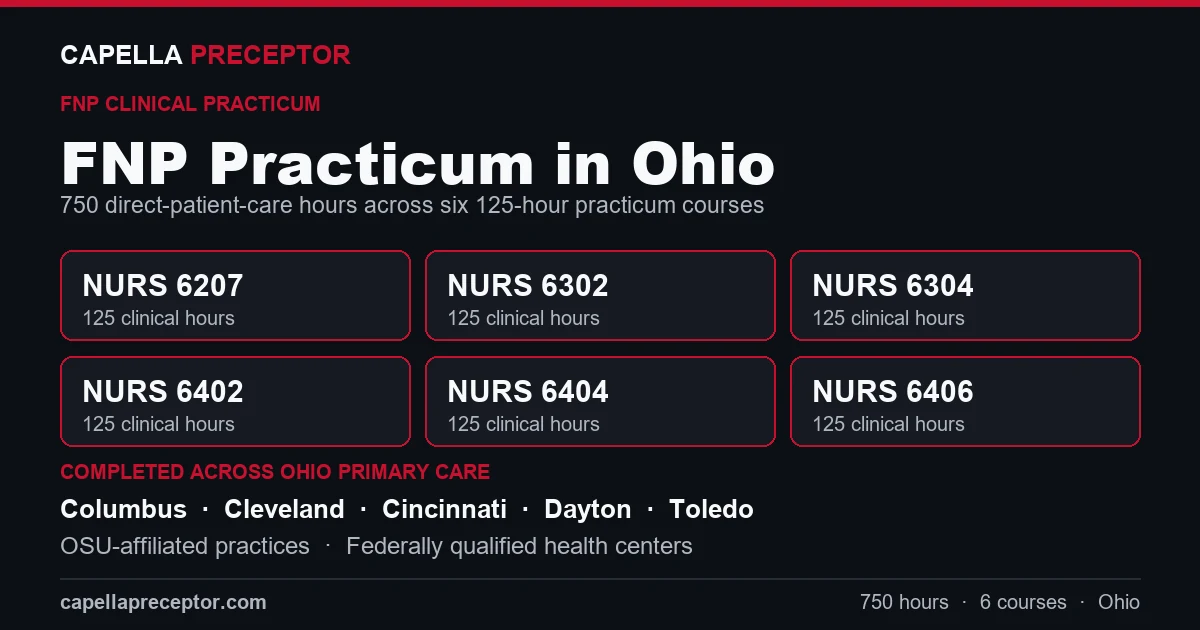
Start with the number that does not change by state. The Capella MSN Family Nurse Practitioner specialization requires a minimum of 750 practicum hours, spread across six clinical courses that each carry 125 hours (Capella, MSN-FNP courses). You complete those hours in your own Ohio community while the coursework stays online, and Capella expects you to secure the preceptor yourself: "learners are responsible for finding an appropriate preceptor to oversee the practicum experience." Ohio does not raise or lower the 750-hour requirement. What Ohio adds is a specific licensing landscape that shapes who is practicing around you and how your future scope will work, so it pays to read it correctly rather than confuse the student rules with the licensure rules.
For context, Ohio's own APRN programs are built on a graduate clinical floor of at least 500 supervised hours, with population-focused minimums layered on top (NursingLicensure.org, Ohio APRN requirements). Capella's 750 hours sits comfortably above that floor, so a Capella FNP graduate clears Ohio's clinical-hour expectation with room to spare. The work is making sure those 750 hours are logged with an FNP-appropriate preceptor and an approved site, which is the part Capella leaves to you.
What does reduced practice mean for an Ohio FNP preceptor relationship?
The American Association of Nurse Practitioners classifies Ohio as a reduced-practice state (AANP, State Practice Environment). Reduced practice sits between full practice, where a nurse practitioner evaluates, diagnoses, and prescribes without a physician agreement, and restricted practice, where a nurse practitioner needs career-long physician supervision. In Ohio, a practicing certified nurse practitioner can run most of the clinical role independently but must maintain at least one formal physician relationship to deliver part of care.
In Ohio that relationship is the standard care arrangement. Every certified nurse practitioner who is practicing and providing patient care enters a written standard care arrangement with each collaborating physician or podiatrist, who must be licensed in Ohio and practicing in the same or a similar specialty (OAAPN, Standard Care Arrangement; Ohio Revised Code 4723.431). The arrangement is not pre-approved by the board and is not filed with it; the employer keeps it on file, and the Ohio Board of Nursing may request to review it at any time.
Here is the part FNP students get wrong, so read it plainly: the standard care arrangement is a licensure rule for a practicing nurse practitioner, not a student practicum document. As a Capella FNP learner you work under your preceptor's authority and Capella's site approval, not under your own arrangement. The reduced-practice rule becomes your concern after you graduate, certify, and apply for your own prescriptive authority. Knowing Ohio is reduced still helps you read the local landscape, because nurse-practitioner-led primary care here already pairs with collaborating physicians, which often makes those clinics well-organized, multi-provider teaching sites for a family practicum.
Quick reference, Capella FNP in Ohio. Hours: 750 minimum across six 125-hour FNP courses. Practice authority: reduced. Regulator: Ohio Board of Nursing. Practicing-CNP collaboration: standard care arrangement with an Ohio physician or podiatrist in the same or similar specialty (a graduate licensure rule, not a student rule). License check: eLicense Ohio. Practicum tracking: CORE ELMS.
Who can precept your FNP hours in Ohio?
For a Capella FNP practicum, a preceptor must hold an active Ohio license, practice in a primary care setting that matches the course's patient population, and meet Capella's published preceptor requirements. In practice that means a board-certified family nurse practitioner is the most natural fit, since their panel mirrors the FNP scope. Physicians in family medicine, internal medicine, pediatrics, or women's health also precept FNP students, and several courses accept a population-matched clinician for that segment of care.
Ohio's reduced-practice rule does not narrow that pool. A nurse practitioner who precepts you is teaching, not delegating their own practice authority to you, so their standard care arrangement is irrelevant to your student status. What does matter is that the preceptor's license is current and clean, which is why we verify every clinician through eLicense Ohio, the state's public license lookup, before your first shift rather than taking it on trust. The Ohio Board of Nursing recognizes the Certified Nurse Practitioner role and issues the certificate to prescribe that lets a CNP write prescriptions, so a fully credentialed FNP preceptor in Ohio is a known, verifiable quantity (Ohio Board of Nursing, Licensing and Certification).
FNP clinical settings that work across Ohio
The FNP is a primary care credential across the lifespan, so your 750 hours have to span adult-gerontology, pediatrics, and reproductive or women's health rather than a single age group. Ohio has the clinic density to cover all three, with large primary care networks in every metro and community health centers filling the gaps between them.
Deep primary care capacity through large central-Ohio networks and OSU-affiliated practices across Dublin, Westerville, and the suburbs, strong for adult and pediatric hours.
Dense family medicine, internal medicine, and women's health options across the northeast, plus Lakewood, Parma, and Canton for in-person hours without a long commute.
Established community family-medicine groups and pediatric capacity across Hamilton and Montgomery counties for a full-lifespan FNP rotation.
Primary care and women's health practices serving northwest Ohio, useful for the reproductive-health practicum course.
Community health centers statewide carry broad family panels, often covering adults, children, and women's health in one site.
Where local capacity thins out in the southeast counties, the virtual option keeps you on schedule.
A single family medicine clinic in Ohio can sometimes cover most of the lifespan, but many FNP students rotate across two or three sites to hit pediatrics and women's health specifically. Inpatient and specialty-only rotations are generally a poor fit, because the FNP is a primary care credential; confirm any nonstandard Ohio site with your faculty before you commit hours to it. We map the population coverage to your six courses during the consult so you are not short on a segment late in the program.
The six FNP practicum courses, mapped to Ohio sites
Because the 750 hours are tied to specific courses, you cannot bank a large block early and coast. Each FNP practicum course has its own 125-hour requirement that you log and have approved before that course closes, which is why a preceptor who can commit across the sequence, or a planned set of Ohio sites, matters more for FNP than for shorter tracks.
FlexPath learners see the same sequence with matching NURS-FPX codes; the 125-hour-per-course structure is identical. Confirm the exact codes on your own program map, since Capella periodically revises numbering. For the full FNP breakdown beyond Ohio, see the Capella FNP page; for the Ohio picture across every program, see the Ohio practicum page. This page is the specific intersection of the two.
What Ohio practicum clearance involves at Capella
Once an Ohio preceptor and site are identified, the practicum runs through Capella's standard clearance pipeline, and none of it can be skipped. Capella manages the practicum application, site and preceptor approval, hour logging, and evaluations through CORE ELMS, and compliance runs through a third-party vendor.
- Propose the Ohio site and preceptor in CORE ELMS for Capella review and approval before any hours count.
- Execute an affiliation agreement between Capella and the Ohio clinical site, signed before practicum begins.
- Clear compliance through CastleBranch (background check, drug screening, and health records); confirm the current requirements with your program.
- Verify the preceptor's Ohio license on eLicense Ohio, then log and submit hours in CORE ELMS, where your Ohio preceptor approves what you record.
The most common stall for Ohio FNP students is not the first course. It is discovering mid-program that the original site cannot supply pediatric or women's health hours, then scrambling for a second preceptor while a 125-hour clock runs. Planning the population coverage and the affiliation agreements at the start is what keeps the term on track.
Why FNP students struggle to find a preceptor in Ohio
Ohio has plenty of primary care, but a paid FNP preceptor is still hard to land for three concrete reasons. First, Ohio hosts several large nurse-practitioner programs, so local clinics field a steady stream of student requests and many cap how many they take per year. Second, the FNP scope forces a lifespan spread; an adult-only internal medicine office cannot give you the pediatric or women's health courses, so you are often chasing more than one site. Third, an Ohio preceptor and site will only count once Capella approves them and the affiliation agreement is signed, so an informal "yes" from a clinician is not the finish line.
This is the gap we close. We source FNP-qualified Ohio preceptors whose primary care panels match your six courses, verify each license on eLicense Ohio, confirm the site will work for your specific Capella courses, and prepare every CORE ELMS form and affiliation agreement. Where the local pool is thin, in rural or Appalachian counties or for a hard-to-fill segment, the virtual option keeps your hours moving. For the broader self-placement playbook, the guide to finding a Capella MSN preceptor walks the full method.
Ohio FNP FAQ
How many hours does a Capella FNP practicum require in Ohio?
A minimum of 750 practicum hours, the same nationwide. Capella spreads them across six FNP practicum courses that each carry 125 hours. Ohio does not add or subtract from that count; the state rules govern licensure after you graduate, not the student hour total.
Does Ohio's reduced-practice status change who can precept my FNP practicum?
No. Ohio's reduced-practice rule and the standard care arrangement apply to a licensed, practicing certified nurse practitioner, not to a student. For practicum you need an FNP-qualified preceptor whose primary care panel matches your courses, on a site Capella clears in CORE ELMS, with a signed affiliation agreement.
Can an Ohio nurse practitioner precept a Capella FNP student?
Yes. A certified nurse practitioner licensed in Ohio who practices in primary care and meets Capella's published preceptor requirements can precept your FNP hours. Physicians in family or internal medicine and, in some courses, other population-matched clinicians also qualify. We verify every preceptor on eLicense Ohio before you start.
Which Ohio cities and health systems can host an FNP practicum?
We place across Columbus, Cleveland, Cincinnati, Dayton, Toledo, Akron, Canton, and Youngstown, plus smaller and Appalachian communities. Ohio's large primary care networks give FNP students family medicine, pediatric, and women's health capacity; where local capacity is thin, the virtual option keeps you on schedule.
Sources
- Capella University, MSN-FNP courses (750 hours, six 125-hour courses)
- Ohio Board of Nursing, Licensing and Certification
- Ohio Revised Code 4723.431, standard care arrangement
- Ohio Association of Advanced Practice Nurses, Standard Care Arrangement
- eLicense Ohio, License Look-Up
- AANP, State Practice Environment (Ohio: reduced)
Get a Capella FNP preceptor in Ohio
You now have the Ohio FNP picture: 750 hours across six courses, a primary care preceptor who meets Capella's published requirements, a reduced-practice state where the standard care arrangement is a graduate licensure rule rather than a student one, and a placement Capella leaves to you. We close that gap. We secure a verified, Capella-compliant FNP preceptor in Ohio, in person or fully virtual, prepare every CORE ELMS form and affiliation agreement, and keep your 750 hours logged and submitted on schedule.
- Verified Ohio FNP preceptor matched in 7 days, no payment until matched
- Primary care panels mapped to all six FNP courses across the lifespan
- Every CORE ELMS form, affiliation agreement, and eLicense check handled
Get placed for your Ohio FNP practicum
Free 15-minute consult. No payment until matched. We map your entire Ohio FNP plan, 750 hours, sites, preceptor, and paperwork.
Get my free consult →