Home / MSN-FNP / South Carolina
FNP × StateCapella FNP Preceptor in South Carolina
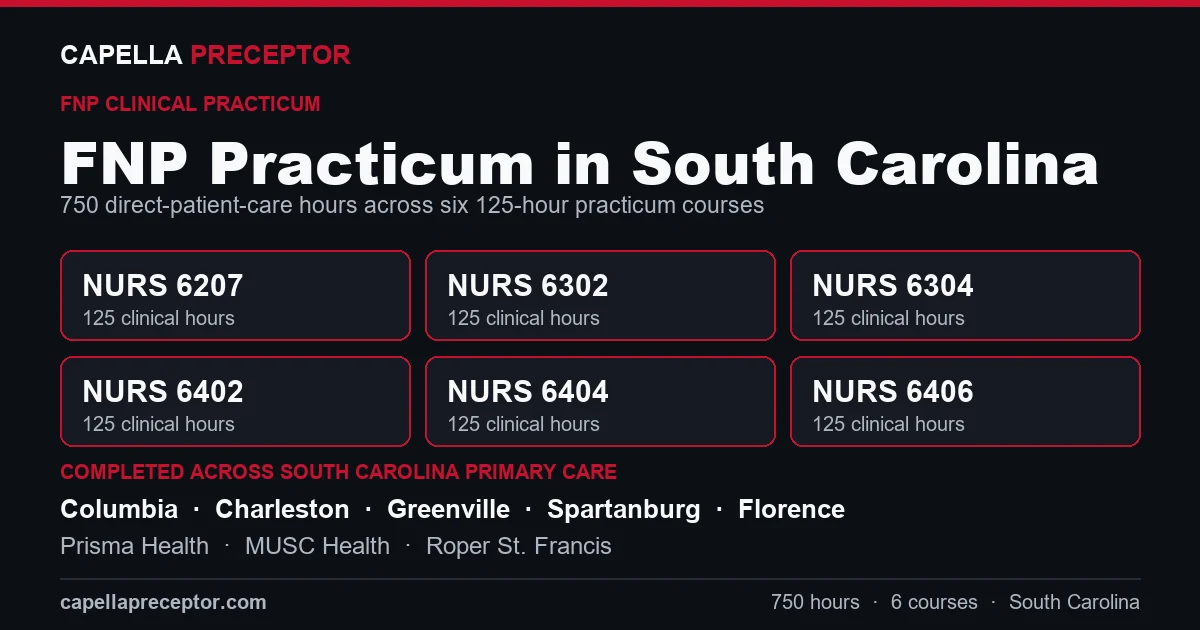
The Capella MSN-FNP requires 750 practicum hours across six clinical courses spanning primary care for adults, children, and women, and South Carolina is a restricted-practice state for nurse practitioners. Those are two separate facts that students often blur together. Capella sets the 750 hours and leaves the preceptor to you; South Carolina shapes who is licensed to supervise and the clearance steps before any hour counts. This page untangles both, then explains how we secure a verified South Carolina FNP preceptor in 7 days with no payment until you are matched.
Last updated: June 28, 2026 · Reviewed by the Capella Preceptor placement team
How many FNP hours do I need in South Carolina, and does the state change the number?
The Capella MSN-FNP requires a minimum of 750 practicum hours, spread across six clinical courses that each carry 125 hours (Capella, MSN-FNP courses). South Carolina does not raise or lower that figure. No state board sets the FNP hour count; your program does. So if you came here wondering whether a restricted-practice state means more hours, the short answer is no. The full breakdown of the six courses and their populations lives on the FNP program page, and we keep it there rather than repeat it here.
What South Carolina does change is the two things wrapped around those 750 hours: who is licensed to supervise them, and the clearance chain you complete before the first hour counts. Both come from the South Carolina Board of Nursing and the state Nurse Practice Act rather than from Capella. The rest of this page is about that overlay, because the hour count is the easy part and the South Carolina-specific reality is where FNP students actually stall.
What does restricted practice in South Carolina mean for an FNP preceptorship?
The American Association of Nurse Practitioners classifies South Carolina as a restricted practice state, the most limited of its three tiers (AANP, South Carolina state practice environment). In South Carolina a licensed nurse practitioner cannot practice independently. State law requires the NP to perform medical acts under a written practice agreement with a physician, and that same agreement governs prescribing (SC Code Title 40, Chapter 33, Section 40-33-34).
Here is the distinction that matters for you. Restricted practice describes how a fully licensed NP works after graduation. It does not mean you need a physician to precept your FNP hours. An experienced South Carolina nurse practitioner can be your preceptor; that NP simply carries their own physician practice agreement for their own practice, separate from anything to do with you. Your supervising preceptor can be an NP, a physician, or another qualified clinician matched to the FNP population, as long as that person holds an active South Carolina license and meets Capella's published preceptor requirements. You are not the one signing a practice agreement during practicum, because you are not yet a licensed NP. The state's restriction shapes the supervision side, not your hour count.
Which South Carolina Board of Nursing rules touch your FNP placement?
Nurse licensure and APRN recognition in the state run through the South Carolina Board of Nursing, under the Department of Labor, Licensing and Regulation (LLR) (South Carolina Board of Nursing, APRN information). The board is where you confirm that a prospective preceptor actually holds an active South Carolina license. Three specifics from the Nurse Practice Act are worth knowing when you vet an FNP preceptor here, because they tell you whether the clinician's supervising arrangement is current and real.
- Annual review of the practice agreement. A South Carolina NP's written practice agreement, and any amendments, must be reviewed at least annually, dated and signed by both the nurse and the physician, and made available to the board within seventy-two hours of a request (SC Code 40-33-34).
- Fifteen-business-day notice on changes. A licensee who changes practice settings or collaborating physician must notify the board within fifteen business days and provide verification of a practice agreement (SC Code 40-33-34). A preceptor who recently moved clinics should have that on file.
- Prescriptive limits sit in the agreement. When a South Carolina NP prescribes controlled substances, the authority must be listed in the practice agreement, with a five-day supply cap on Schedule II narcotics and a thirty-day supply cap on a Schedule II non-narcotic (SC Code 40-33-34). You will see this shape what your preceptor can demonstrate during your prescribing-focused hours.
When we verify a South Carolina preceptor for an FNP placement, we confirm active license status through the board rather than taking a clinic's word for it, and we check that the supervising arrangement is current. You can do the same first step yourself through LLR online license verification before you commit a single hour to any site.
South Carolina lawmakers have introduced bills that would create an optional full-practice-authority pathway for experienced APRNs, including House Bill 3580 in the 2025 to 2026 session, which would let qualifying APRNs practice without a physician agreement after additional post-licensure hours (SC Legislature, H.3580). As of mid-2026 that bill remains in committee and has not become law, so South Carolina is still a restricted-practice state. We track the status so the picture we give you is current.
Which South Carolina settings cover the FNP lifespan populations?
The FNP is a primary care credential across the lifespan, so your 750 hours have to span adult-gerontology, pediatric, and reproductive or women's health, not a single age group. That population spread is the real planning challenge in any state, and in South Carolina it shapes which clinics you target. A single family medicine practice can sometimes cover most of the mix, but many students rotate across two or three sites to hit pediatrics and women's health.
The closest fit to FNP scope, and the backbone of the two adult-gerontology courses. Large South Carolina systems such as Prisma Health in the Upstate and Midlands run family medicine practices in many communities.
Well-child and acute pediatric visits for the pediatric primary care course, often a separate site from your adult-care preceptor.
Prenatal, postpartum, contraception, and routine gynecologic visits for the reproductive health course. Charleston and Greenville have strong coverage here.
Community health centers across the Lowcountry and Pee Dee carry broad primary care panels, useful where private practices are scarce.
South Carolina's hospital landscape is anchored by systems including MUSC Health in Charleston, Prisma Health across the Upstate and Midlands, and Roper St. Francis in the Lowcountry, and the outpatient primary care practices tied to those systems are where most FNP hours actually happen. Inpatient and specialty-only rotations are a poor fit, because the FNP is a primary care role. Confirm any nonstandard site with your faculty before you commit hours to it.
Why is finding an FNP preceptor in South Carolina hard, and who is responsible?
This is the part that surprises most FNP students. Capella does not assign you a preceptor or arrange your clinical site. The university states plainly that learners are responsible for finding an appropriate preceptor to oversee the practicum, completed in your local community (see the FNP program page for the exact policy and citation). In a restricted-practice state that is a heavier lift than it sounds, for two reasons.
First, many qualified South Carolina NPs are already tied to a physician practice agreement and a full patient panel, with limited room to take on a student across a long, multi-population FNP sequence. Second, the FNP's lifespan requirement means you often need more than one preceptor, since the clinician who can give you adult primary care hours may not see pediatric or women's health patients. Stack those together and the common failure mode appears: a student lands a family medicine preceptor for the first courses, then discovers mid-program that the site cannot supply pediatric or women's health hours, and scrambles for a second preceptor while a course clock runs.
That gap is what we close. We carry an active South Carolina preceptor network and place FNP students across the state's main regions, matching preceptors to the specific populations your remaining courses require:
Columbia, Lexington, and Sumter primary care and family medicine practices.
Charleston, Mount Pleasant, North Charleston, and Summerville clinics.
Greenville, Spartanburg, Anderson, and Rock Hill near the Charlotte line.
Florence, Hartsville, and the inland northeast communities.
Myrtle Beach, Conway, and the coastal Horry county practices.
Where in-person FNP populations thin out, our virtual option keeps you on schedule.
What clearance steps do I complete before South Carolina FNP hours count?
Even after a preceptor says yes, there is a clearance workflow before you log a single hour. Capella manages practicum application, site and preceptor approval, hour tracking, and evaluations through its practicum management system, which we track in our workflow as CORE ELMS. A signed affiliation agreement between Capella and your South Carolina clinical site is part of that clearance, and so is third-party compliance screening.
- Propose your South Carolina site and preceptor in CORE ELMS so the placement can be submitted to Capella for review and approval.
- Execute an affiliation agreement between Capella and your South Carolina clinical site before practicum begins.
- Clear third-party compliance through a background-check and health-records vendor such as CastleBranch; confirm the current vendor with your program.
- Verify your preceptor's South Carolina license through LLR, then log and submit hours in CORE ELMS, where your preceptor approves what you record.
None of these steps move until a real preceptor commits, which is exactly why students stall. We line up the South Carolina FNP preceptor first, confirm the license through the board, then run the affiliation agreement and CORE ELMS paperwork so everything is signed before your start date.
In person or virtual: which fits a South Carolina FNP student?
Two FNP students in South Carolina can need very different solutions. A learner in Columbia, Charleston, or Greenville usually has enough nearby primary care, pediatric, and women's health sites for a fully in-person placement. A learner in a rural Pee Dee or Lowcountry county, or one who simply cannot find local pediatric or women's health coverage, often does better with virtual or a blend for the thin populations while keeping adult primary care in person.
A verified South Carolina FNP preceptor at a local clinic, best when you want hands-on lifespan volume and your metro has the sites for it.
Supervised telehealth-based hours that fill a thin population such as pediatrics or women's health while you keep adult care local, all tracked in CORE ELMS.
Either way the supervising preceptor is South Carolina licensed and meets Capella's published preceptor requirements. We match the format to where you live and the populations your remaining FNP courses still need, not the other way around.
South Carolina FNP FAQ
How many FNP practicum hours do I need in South Carolina, and does the state change that?
The Capella MSN-FNP requires a minimum of 750 practicum hours across six clinical courses that each carry 125 hours, and that is set by Capella, not South Carolina. The state does not raise or lower the count. What South Carolina changes is who can supervise those hours and the paperwork chain you clear before they count.
Does restricted practice mean I need a physician to precept my FNP hours?
No. Restricted practice governs how a licensed nurse practitioner works in South Carolina, not who precepts a student. An experienced South Carolina NP can precept your FNP hours; that NP separately holds a written practice agreement with a physician for their own practice. Your preceptor can be an NP, a physician, or another qualified clinician matched to the FNP population who meets Capella's published requirements.
Which South Carolina settings cover the FNP lifespan populations?
FNP hours span adult-gerontology, pediatric, and women's health primary care. In South Carolina that usually means family medicine and primary care clinics for the adult and family courses, a pediatric practice for the pediatric course, and a women's health or OB-GYN practice for the reproductive health course. Family medicine practices in Columbia, Charleston, and Greenville can cover much of the lifespan in one panel.
Does Capella assign an FNP preceptor in South Carolina?
No. Capella states learners are responsible for finding an appropriate preceptor, completed in the student's local community, and does not assign your South Carolina site. Capella Preceptor finds and verifies a South Carolina preceptor whose panel covers your FNP courses.
Can I complete my Capella FNP practicum virtually in South Carolina?
Often a blend works best. A learner in Columbia, Charleston, or Greenville usually has enough local sites for in-person hours, while a learner in a rural county may need a virtual or hybrid option for thin populations such as pediatrics or women's health. Either way the supervising preceptor is South Carolina licensed and hours are tracked in CORE ELMS.
Sources
- Capella University, MSN Family Nurse Practitioner courses (750 hours, six courses)
- AANP, South Carolina state practice environment (restricted)
- South Carolina Board of Nursing (LLR), APRN information and license verification
- South Carolina Code of Laws, Title 40 Chapter 33, Section 40-33-34 (practice agreements, review, notice, prescribing)
- South Carolina Legislature, H.3580 (2025-2026 APRN practice authority bill, in committee)
How Capella Preceptor helps with your South Carolina FNP placement
You now know the landscape: 750 FNP hours across the lifespan that the state cannot change, a restricted-practice rule that shapes supervision but not your hour count, a board that verifies the license, and a university that leaves the placement to you. We close that last gap. We match you with a verified South Carolina FNP preceptor whose panel covers your remaining courses, confirm the license through the board, and run every CORE ELMS form and affiliation agreement so your hours start on time.
- Verified South Carolina FNP preceptor matched in 7 days, in person or virtual
- Preceptors matched to your adult, pediatric, and women's health FNP courses
- Every CORE ELMS form, affiliation agreement, and CastleBranch step handled, no payment until matched
Related: Capella FNP preceptor and clinical placement · Capella preceptor and placement in South Carolina
Get a Capella FNP preceptor in South Carolina
Free 15-minute consult. No payment until matched. We map your entire FNP practicum plan across the lifespan.
Get my free consult →