Capella FNP Preceptor in Tennessee
The Capella MSN-FNP requires 750 practicum hours across six clinical courses, and you secure the preceptor yourself. Tennessee is a restricted nurse practitioner state, where NP practice is tied to a collaborating physician and a 20% chart-review rule. This page explains how those two facts meet, then how we place you.
Last updated: June 28, 2026 · Reviewed by the Capella Preceptor placement team
How does Tennessee change a Capella FNP practicum?
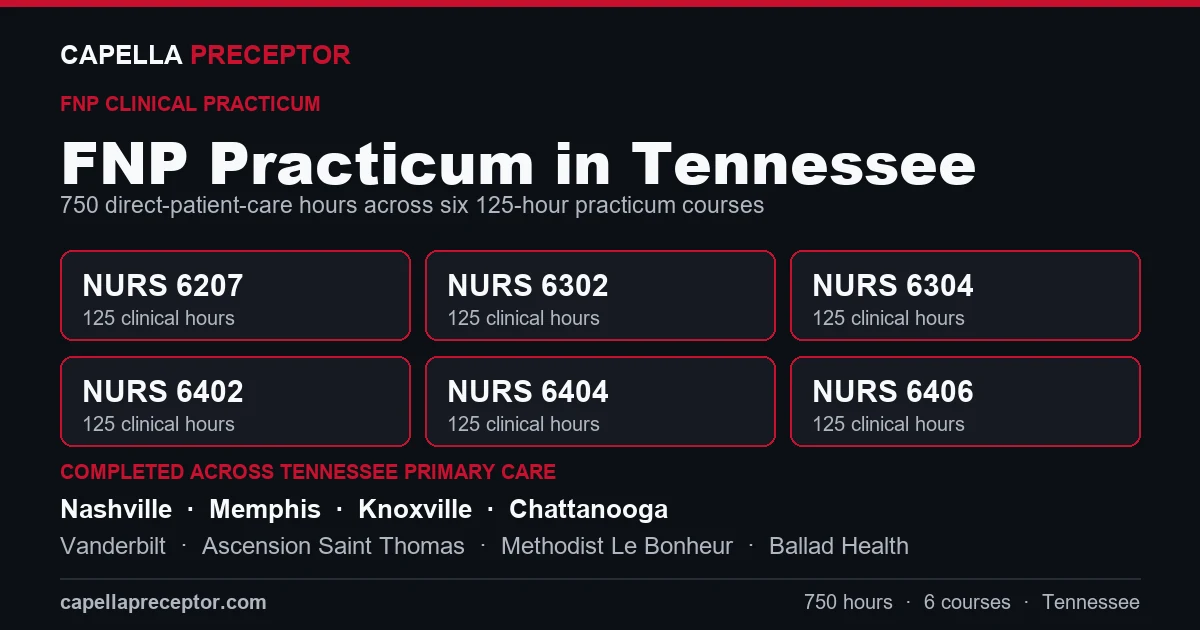
It does not change the hours. The Capella MSN-FNP requires a minimum of 750 practicum hours, spread across six clinical courses that each carry 125 hours, completed at an approved site under an on-site preceptor you are responsible for securing (Capella, MSN-FNP courses). Those numbers are the same in Nashville as they are anywhere else, and the full breakdown lives on our Capella FNP page.
What Tennessee changes is who can precept you and how that clinician is supervised. The American Association of Nurse Practitioners classifies Tennessee as a restricted practice state, the most limited of its three tiers (AANP, Tennessee state practice environment). A nurse practitioner here cannot practice independently; state law ties NP practice to a collaborating physician. That single fact ripples through every choice you make about an FNP placement in Tennessee, which is why a generic placement plan can stall in this state. Our broader Tennessee placement page covers the cross-specialty picture; this page is the FNP cell.
Who can precept an FNP student in Tennessee?
The Tennessee Board of Nursing sets a clear floor: a clinical preceptor must hold an unencumbered license to practice at or above the level for which the student is being prepared, in the jurisdiction where the precepting happens (Rules of the Tennessee Board of Nursing, Chapter 1000-01). For a Capella FNP student, that means three clinician types can serve:
- A Tennessee-licensed nurse practitioner at or above the FNP level, most cleanly an FNP whose panel spans the family lifespan. Because Tennessee is restricted, that NP works under a collaborating physician, so we confirm their collaboration is in place when we vet the site.
- A physician (MD or DO) in family medicine, internal medicine, pediatrics, or women's health. A physician preceptor sidesteps the collaboration question entirely and is common in Tennessee primary care.
- Other APRNs matched to the course population where Capella accepts them for a specific practicum, again licensed in Tennessee and at or above the level you are training for.
The practical effect of a restricted state is supply. Fewer Tennessee NPs can take a student on their own signature, and busy clinics field a steady stream of requests, so the available pool is smaller than the raw number of providers suggests. That is the gap a placement service closes.
What is Tennessee's 20% chart review rule, and does it touch me?
Tennessee formalizes NP oversight in rule, not handshake. Under the Board of Medical Examiners rule that governs supervision, a supervising physician must personally review at least twenty percent (20%) of the charts written by a certified nurse practitioner every thirty (30) days (Tenn. Comp. R. & Regs. 0880-06-.02). Supervision does not require the physician to be physically present at all times, but the physician must be available for consultation or arrange a substitute.
This rule governs your preceptor's own practice, not your student charting, so it does not add a step to your Capella requirements. It matters for two reasons. First, it is why an NP preceptor in Tennessee always sits inside a physician relationship, which is part of what we verify. Second, an NP on a temporary certificate of fitness works under tighter supervision that requires the physical presence of the supervising physician or certified nurse practitioner, so a preceptor with a temporary certificate may have less independence to take a student. We screen for the full certificate so your placement is stable across all six practicum courses.
The Tennessee certificate of fitness and your preceptor
An APRN in Tennessee who prescribes must hold a certificate of fitness from the Board of Nursing, and that prescribing APRN must have a collaborating physician who complies with the medical board's supervision rules (Tenn. Comp. R. & Regs. 1000-04-.04). Advanced practice itself is recognized in statute under the Tennessee Board of Nursing, the body that licenses RNs, recognizes APRNs, and runs the license lookup a site or program uses to confirm a clinician's standing.
For your FNP placement, the certificate of fitness is a quality signal. A preceptor who prescribes and holds an active certificate is a settled, full-scope provider whose collaboration is on file, exactly the kind of stable site that clears Capella approval without surprises. Rules are revised periodically, most recently in the 2026 board rule update, so we verify the current license and certificate status on every preceptor we propose rather than relying on a summary.
The AANP tiers in one line. Full practice means an NP evaluates, diagnoses, and prescribes under the board of nursing alone. Reduced means a regulated agreement with another health professional is required for at least one element. Restricted, Tennessee's tier, means career-long supervision, delegation, or team management by an outside health professional is required. That is the legal reason your Tennessee FNP preceptor is paired with a physician.
Where do Capella FNP students do practicum in Tennessee?
The FNP is a primary care role across the lifespan, so your 750 hours need adult and older-adult primary care, pediatrics, and reproductive or women's health, not a single age band. Tennessee's clinic density supports all of it, concentrated in the metros anchored by large systems: Vanderbilt and Ascension Saint Thomas in the Nashville and Middle Tennessee region, Methodist Le Bonheur and Baptist Memorial in Memphis and West Tennessee, the University of Tennessee Medical Center and Covenant Health around Knoxville, Erlanger in Chattanooga, and Ballad Health across the Northeast and the Tri-Cities. Most FNP placements sit in the independent family medicine, internal medicine, pediatric, and women's health practices in and around those markets rather than the flagship hospitals themselves.
The closest fit to FNP scope, covering adult and older-adult primary care and chronic disease across Middle, West, and East Tennessee.
Well-child, growth, and acute pediatric visits to satisfy the pediatric primary care practicum, strongest in the larger metros.
Prenatal, postpartum, contraception, and routine gynecologic visits for the reproductive health practicum.
A fully virtual preceptorship by video for rural counties in the Upper Cumberland, West Tennessee, or the mountains east of Knoxville where a local opening is genuinely thin.
One Tennessee-specific tailwind worth knowing: the state funds a THA Nurse Preceptor Incentive, run by the Tennessee Hospital Association and the Tennessee Center for Health Workforce Development, that pays an eligible nurse or APRN preceptor a $1,500 incentive for completing 70 or more one-on-one preceptorship hours at an approved site tied to an accredited Tennessee program (THA Nurse Preceptor Incentive). It is not a Capella program and funding is limited each cycle, but it is one more reason a Tennessee provider may say yes to a student.
FNP practicum approval, done in Tennessee
Securing the preceptor is the start. Before you log a single hour, the same Capella clearance applies wherever you practice, and a restricted state adds no shortcut around it. Capella manages practicum application, site and preceptor approval, hour logging, and evaluations through its practicum system, which we track in our workflow as CORE ELMS. We prepare each piece so a Tennessee approval does not stall on paperwork.
- Submit the Tennessee site and preceptor in CORE ELMS for Capella review and approval, with the preceptor's Tennessee license confirmed.
- Execute an affiliation agreement between Capella and the Tennessee clinical site before practicum begins.
- Clear third-party compliance through a background-check and health-records vendor such as CastleBranch; confirm the current vendor with your program.
- Log and submit hours in CORE ELMS across all six courses, where your Tennessee preceptor approves what you record before each course closes.
Because the FNP spreads 750 hours across six population-specific courses, the most common Tennessee stall is not the first course. It is discovering mid-program that one clinic cannot supply pediatric or women's health hours, then scrambling for a second preceptor while a course clock runs in a restricted-state market with limited supply. We plan the population coverage before you start.
Tennessee FNP FAQ
How many practicum hours does the Capella FNP require in Tennessee?
A minimum of 750 hours across six clinical courses at 125 hours each, the same nationwide. Tennessee does not add or subtract hours; what changes is who can precept you, because Tennessee is a restricted nurse practitioner practice state.
Can a nurse practitioner precept my Capella FNP practicum in Tennessee?
Yes. A Tennessee-licensed NP with an unencumbered license at or above the FNP level can precept you, which an FNP-level NP holds. Because Tennessee is restricted, that NP practices under a collaborating physician, and a physician (MD or DO) can also serve as your preceptor.
What is the Tennessee 20% chart review rule?
Under Tenn. Comp. R. & Regs. 0880-06-.02, a supervising physician must personally review at least 20% of the charts written by a certified nurse practitioner every 30 days. It governs your preceptor's own practice, not your student documentation, and explains why Tennessee NP practice is tied to a physician.
Does Capella assign an FNP preceptor in Tennessee?
No. Capella states learners are responsible for finding their own preceptor and site, completed in the local community. We secure a verified, Tennessee-licensed FNP preceptor for you and handle the CORE ELMS submission, affiliation agreement, and compliance steps.
Where in Tennessee can I do my Capella FNP practicum?
Family medicine, internal medicine, pediatric, and women's health clinics across Nashville, Memphis, Knoxville, Chattanooga, and the Tri-Cities, plus a fully virtual option for rural counties where local primary care openings are thin.
Sources
- Capella University, MSN-FNP courses (750 hours, six 125-hour courses)
- AANP, Tennessee state practice environment (restricted)
- Tenn. Comp. R. & Regs. 0880-06-.02, clinical supervision (20% chart review every 30 days)
- Tenn. Comp. R. & Regs. 1000-04-.04, APRN certificate of fitness
- Rules of the Tennessee Board of Nursing, Chapter 1000-01 (preceptor licensure at or above level)
- THA Nurse Preceptor Incentive, Tennessee Hospital Association
How Capella Preceptor helps in Tennessee
In a restricted state, the hard part is finding a Tennessee FNP preceptor who is available, properly authorized, and able to cover the family lifespan your six courses require, then clearing Capella approval without losing a term. We handle both. We match a verified, Tennessee-licensed preceptor in person or fully virtual, confirm the license and any required collaboration, and prepare every CORE ELMS form and compliance step so your 750 hours start on time.
- Verified, Tennessee-licensed FNP preceptor matched in 7 days, no payment until matched
- Family-lifespan coverage planned across all six practicum courses, plus every CORE ELMS form and CastleBranch step handled
- In person across Nashville, Memphis, Knoxville, and Chattanooga, or virtual for rural counties
Get a Capella FNP preceptor in Tennessee
Free 15-minute consult. No payment until matched. We map your full 750-hour FNP plan across all six courses.
Get my free consult →