Home / MSN-FNP / FNP Preceptor in Texas
FNP × TexasCapella FNP Preceptor in Texas
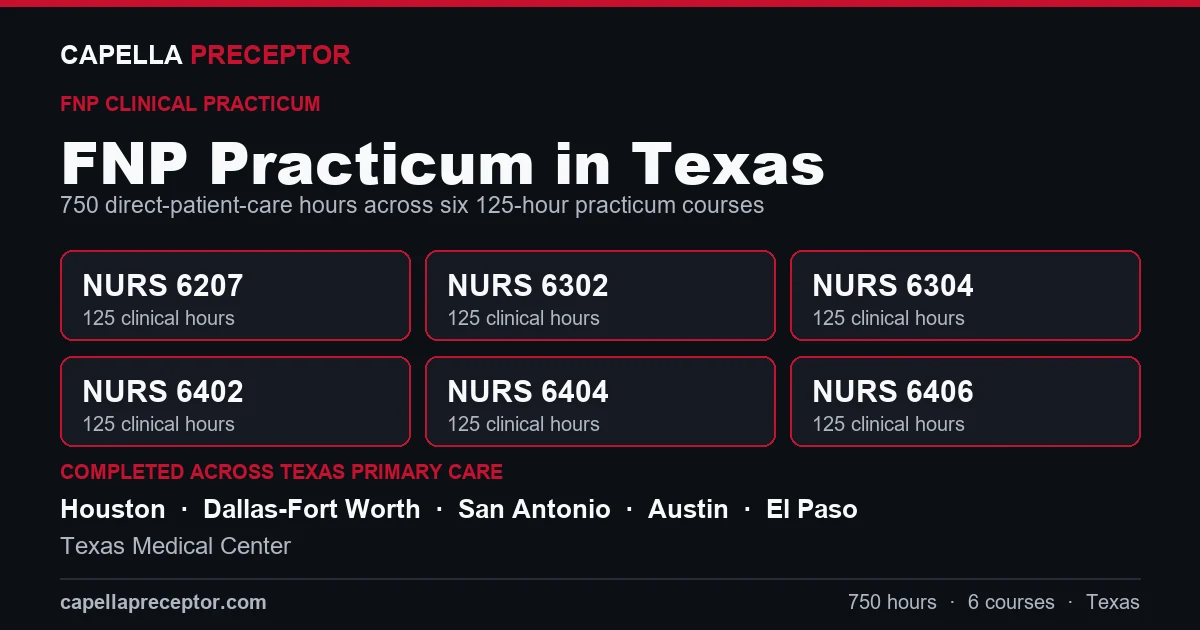
A Capella MSN-FNP practicum in Texas requires 750 direct-patient-care hours across six 125-hour courses, completed under an FNP-qualified preceptor who practices in the lifespan settings the courses demand. Texas is a restricted-practice state, which means that preceptor prescribes only under a written agreement with a delegating physician, so your practicum is supervised work signed off inside that framework. Capella leaves finding the preceptor to you. We secure a verified, Texas-licensed FNP preceptor and an approved site, in person or virtual, within 7 days, with no payment until you are matched.
Last updated: June 28, 2026 · Reviewed by the Capella Preceptor placement team
How many FNP practicum hours do you need in Texas?
The hour total is set by the program, not the state. The Capella MSN Family Nurse Practitioner specialization requires a minimum of 750 practicum hours, split across six clinical courses that each carry 125 hours (Capella, MSN-FNP courses). That number is identical whether you complete practicum in Houston or in another state. What changes in Texas is a second, lower bar underneath it: to be licensed as an APRN, the Texas Board of Nursing requires at least 500 unduplicated clinical clock hours in the role and population, for programs completed on or after January 1, 2003 (Texas Board of Nursing, APRN practice FAQ). The 750-hour Capella FNP comfortably clears that Texas floor, so finishing your Capella hours satisfies both at once. The practical work in Texas is not the count, it is finding a preceptor whose practice covers the FNP lifespan inside a restricted-practice system.
What does restricted practice mean for an FNP preceptor in Texas?
The American Association of Nurse Practitioners classifies Texas as a restricted practice state, the most limited of its three tiers (AANP, State Practice Environment). In a restricted state, the law requires career-long physician oversight for an NP to deliver at least one element of care. In Texas that element is prescribing: a nurse practitioner prescribes only under a written prescriptive authority agreement (PAA) with a delegating physician (Texas Board of Nursing, APRN practice). For your FNP practicum, that framework shapes who can precept you and how the relationship runs:
- Your FNP preceptor is supervised too. A Texas NP precepting you already works under a delegating physician, so a family medicine or primary care practice that supervises its own APRNs is usually the most comfortable place to add a student.
- The PAA carries real overhead. Under Texas Occupations Code 157.0512, the agreement must be in writing, signed by both parties, include a quality-assurance plan with chart review, and (for agreements entered on or after September 1, 2019) require the physician and NP to meet at least monthly (Texas Occupations Code 157.0512).
- Controlled-substance prescribing is capped. A delegating physician may authorize an NP to prescribe Schedule III through V controlled substances with a 90-day supply limit; Schedule II prescribing is restricted to hospital facility-based and hospice settings (NursingLicensure.org, Texas NP requirements). You will see this in how a primary care preceptor handles pain, ADHD, and controlled prescriptions during your rotation.
None of this blocks a Capella FNP practicum. It simply means the clinics that can precept you are the ones already set up for physician delegation, and the supervising physician has a say in taking a student. That negotiation, not the academic requirement, is the slow part, and it is exactly what we handle.
How many students can a Texas FNP preceptor take at once?
This is the rule most Capella students never hear until they are mid-search. The Texas Board of Nursing limits a clinical preceptor to directly supervising no more than two students at a time, and the preceptor cannot be a faculty member of the student's nursing program (Texas Board of Nursing, Education Guideline 3.8.3.a). The Board also expects a written agreement that spells out the responsibilities of the program, the preceptor, and the clinical site. For you, the two-student cap is the binding constraint: a strong family medicine preceptor in San Antonio or Fort Worth may already be precepting one or two students from a local university program, which closes the slot before you ever call. Lining up a Texas FNP preceptor early, before the academic term fills the open seats, is the difference between starting on time and losing a quarter.
What FNP clinical settings work in Texas?
The FNP is a primary care credential across the lifespan, so your 750 hours have to span adults and older adults, pediatrics, and reproductive or women's health, not a single population (Capella, MSN-FNP courses). Texas is large, and the settings that fit cluster in its metros and its medically underserved counties alike. We place students across these regions:
The Texas Medical Center plus family medicine and pediatric clinics across Harris County for lifespan coverage.
Primary care and women's health practices across Dallas, Fort Worth, Arlington, and Plano.
Bexar County family medicine and bilingual primary care that fit the FNP scope.
Travis County and the I-35 corridor, including Round Rock and San Marcos clinics.
West Texas outpatient primary care and pediatric settings, often bilingual.
McAllen, Brownsville, and Harlingen, plus the underserved counties around them.
Texas also has a real primary care shortage, with the state projected to be short roughly 3,400 primary care physicians by 2030 (Texas DSHS, shortage designations). That cuts two ways for a Capella FNP student. Many rural and HPSA-designated counties lean on nurse practitioners for primary care, which creates preceptor openings; but those same counties have fewer providers overall, so the search is thinner. Where a local in-person seat is genuinely scarce, our virtual FNP option keeps your hours moving with a verified preceptor, tracked the same way in CORE ELMS.
How do you find an FNP preceptor in Texas?
Here is the gap. Capella states that "learners are responsible for finding an appropriate preceptor to oversee the practicum experience," and recommends completing practicum in your local community (Capella, MSN-NP program). The Texas Board of Nursing licenses and disciplines APRNs and lets you verify any license for free, but it does not place students or assign preceptors (Texas Board of Nursing, license verification). So the work falls entirely on you, in a restricted state where each preceptor has a two-student cap and a supervising physician who has to agree. Once you do name a preceptor and site, there is a clearance workflow before a single Texas hour counts:
- Verify the preceptor's Texas license through the Board of Nursing tool, confirming an active FNP-qualified APRN or a physician matched to the course population, before you propose them.
- Submit the site and preceptor in CORE ELMS for Capella review and approval (Capella, CORE ELMS).
- Execute the affiliation agreement between Capella and the Texas clinic before day one.
- Clear compliance through the third-party vendor (CastleBranch) for the background check, drug screen, and health records; confirm the current requirements with your program.
- Log hours per course in CORE ELMS across all six FNP practicum courses for preceptor approval before each course closes.
Cold-calling Texas clinics for a slot that may already be filled is slow, and a course clock does not wait. We do the outreach, vetting, license verification, and the physician-delegation conversation for you, where you actually live in Texas. For the program-wide breakdown of the 750 hours and the course codes, see the full Capella FNP preceptor and placement page; for the board rules across every specialty, see our Capella preceptor in Texas page.
FNP preceptor in Texas FAQ
How many hours is the Capella FNP practicum in Texas?
A minimum of 750 practicum hours across six 125-hour clinical courses, the same total in Texas as anywhere else, because Capella sets the program requirement. Texas adds a separate licensure floor: the Texas Board of Nursing requires at least 500 unduplicated clinical clock hours in the role and population, which the 750-hour FNP clears.
Is Texas a full practice authority state for an FNP preceptor?
No. The AANP classifies Texas as a restricted practice state. A Texas NP prescribes only under a written prescriptive authority agreement with a delegating physician, so your FNP preceptor works inside a physician-delegation framework and your practicum is supervised work the preceptor signs off on.
How many students can one FNP preceptor take in Texas?
Under Texas Board of Nursing rule, a clinical preceptor directly supervises no more than two students at a time and cannot be a faculty member of the nursing program. That cap is one reason an available Texas FNP preceptor is harder to find than students expect, and why securing one early matters.
Where can a Capella FNP student find a preceptor in Texas?
Capella requires the student to secure the preceptor and site, and the Texas Board of Nursing does not place students. We match a verified, Texas-licensed FNP preceptor across Houston, Dallas-Fort Worth, San Antonio, Austin, El Paso, and the Rio Grande Valley, with a virtual option for rural counties and hours logged in CORE ELMS.
Sources
- Capella University, MSN-FNP courses (750 hours, six 125-hour courses)
- AANP, State Practice Environment (Texas restricted)
- Texas Board of Nursing, APRN practice FAQ (500 unduplicated clinical clock hours)
- Texas Board of Nursing, Education Guideline 3.8.3.a (preceptor two-student limit)
- Texas Occupations Code 157.0512, prescriptive authority agreement
- Capella University, MSN-NP program (learner secures the preceptor)
How Capella Preceptor helps FNP students in Texas
You now have the full picture: 750 FNP hours across six courses, a 500-hour Texas licensure floor underneath, a restricted-practice delegation framework, and a two-student cap that closes Texas preceptor slots fast. Capella leaves the search to you. We close that gap with a verified, Texas-licensed FNP preceptor whose panel covers the lifespan your courses require, matched in 7 days, with every CORE ELMS form and affiliation agreement prepared and your hours logged on schedule. We never claim Capella endorsement; every preceptor we propose meets Capella's published requirements and is submitted for Capella's own approval. No payment until you are matched.
- Verified Texas FNP preceptor matched in 7 days, in person or virtual
- Lifespan coverage for all six FNP practicum courses, CORE ELMS handled
- Coverage from Houston and DFW to the Rio Grande Valley
Get an FNP preceptor in Texas
Free 15-minute consult. No payment until matched. We map your entire Texas FNP practicum plan, all 750 hours.
Get my free consult →