Capella FNP Preceptor in Vermont
The Capella MSN-FNP requires 750 practicum hours across six clinical courses, in primary care across the lifespan, and you secure the preceptor yourself. Vermont is a full practice authority state, so an FNP who has finished the state's transition-to-practice period can precept you independently, with no collaborating physician in the loop. Here is how those two facts meet, and how we line up a verified Vermont FNP preceptor and site.
Last updated: June 28, 2026 · Reviewed by the Capella Preceptor placement team
What does the Capella FNP require, and what does Vermont add?
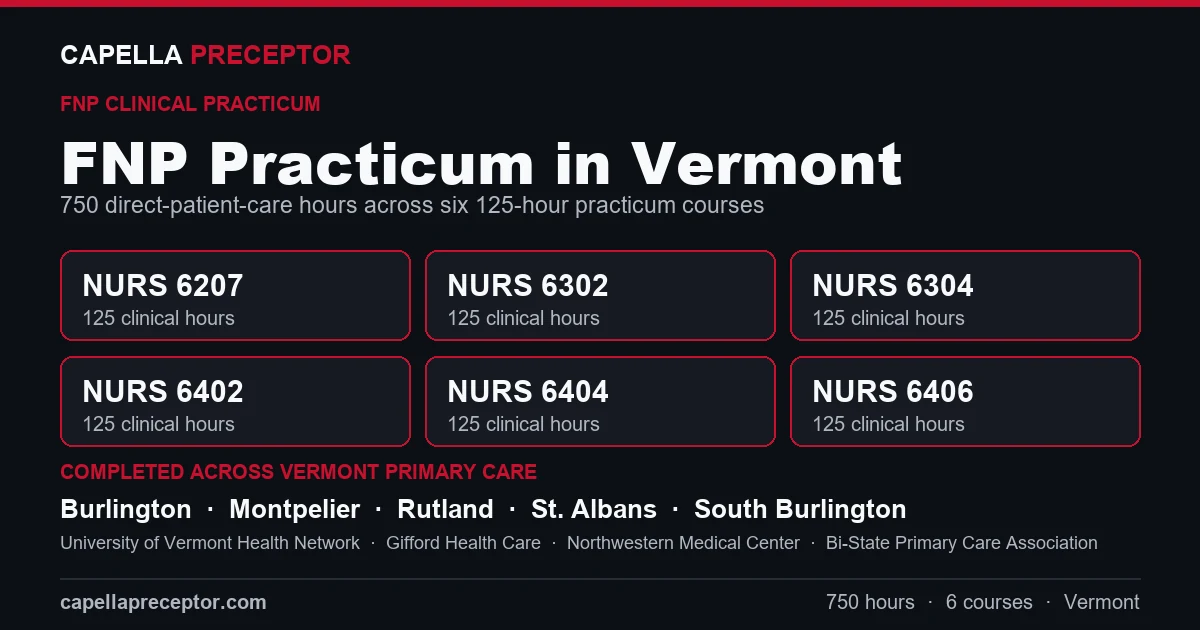
Two separate rule sets govern an FNP practicum in Vermont, and both have to be satisfied. The first is Capella's academic requirement: a minimum of 750 practicum hours spread across six clinical courses that each carry 125 hours, completed in your own local community while the coursework stays online (Capella, MSN-FNP courses). The second is Vermont's licensing context, which decides who is allowed to supervise you and how independently they can do it.
Vermont does not change your hour count or your course list. What it changes is the preceptor side of the equation. Because Vermont grants nurse practitioners full practice authority, an experienced FNP here can serve as your sole clinical supervisor without looping in a physician, which is often what makes a Vermont placement cleaner to set up than one in a restricted state. The detail worth knowing is that "experienced" has a specific meaning under Vermont law, covered below.
Does a Vermont FNP precept you independently, or under a physician?
The American Association of Nurse Practitioners classifies Vermont as a full practice authority state (AANP, Vermont). A nurse practitioner who has completed Vermont's licensing path evaluates patients, orders and interprets diagnostics, and prescribes, including controlled substances, under the sole authority of the Vermont Board of Nursing, with no standing collaborating-physician agreement once that path is complete (Scope of Practice Policy, Vermont).
There is a transition step before that independence applies, and it matters when you are choosing a preceptor. A newly licensed Vermont APRN with fewer than 24 months and 2,400 hours of active advanced practice in their first role and population focus must hold a formal agreement with a collaborating provider, and that collaborating provider has to be actively licensed, in good standing, in the same role and population focus, with at least four years of practice experience (NursingLicensure.org, Vermont NP; Vermont Statutes, Title 26 Chapter 28). A second role and population focus added later requires a shorter transition of at least 12 months and 1,600 hours. After the transition completes, the agreement falls away and the FNP practices fully independently.
For your placement, the practical takeaway is simple: a Vermont FNP who is past their transition period and holds full authority can supervise you on their own, which usually keeps scheduling and site approval straightforward. A preceptor still in transition can still teach you, but their own practice runs under a collaborating provider. We confirm a candidate preceptor's license status and authority through the state before we present them, so you know which situation you are in.
How the 750 FNP hours break down across six courses
FNP hours are not banked in one block. They are tied to six practicum courses, each with its own 125-hour requirement that your preceptor logs and approves before the course closes (Capella, MSN-FNP courses). Because the FNP is a family, primary care credential, those hours must span the lifespan rather than a single age group, so a Vermont preceptor whose panel is heavily skewed to one population can leave you short on another.
FlexPath learners see the same sequence as NURS-FPX codes; the populations and the 125-hour-per-course structure do not change. Confirm the exact codes on your own program map, because your enrollment date governs which version you follow. The full specialty breakdown lives on our Capella FNP page.
Who licenses and verifies your FNP preceptor in Vermont
Vermont nursing licensure runs through the Vermont Board of Nursing, which sits inside the Secretary of State's Office of Professional Regulation in Montpelier rather than a standalone health-department board (Vermont Secretary of State, Nursing). That office licenses RNs, LPNs, and APRNs, including nurse practitioners, and it administers the transition-to-practice and collaborating-provider rules described above.
For preceptor vetting, the board's public lookup is the anchor. You, your faculty, or we can confirm any Vermont license at no cost through the Office of Professional Regulation's Find a Professional tool (Office of Professional Regulation, Find a Professional). Capella requires a preceptor to hold an active, unencumbered license in the state where you complete your hours, so a clean Vermont verification is a baseline check on every FNP match we make.
Where FNP clinical hours actually happen in Vermont
Vermont is small and largely rural, and a handful of systems hold most of the outpatient primary care capacity, so FNP student slots fill early. The good news for a lifespan-spanning FNP is that the state leans heavily on primary care: eleven federally qualified health centers run more than 60 primary care sites statewide, the kind of family-medicine setting where adult, pediatric, and women's health visits often sit in one panel (Bi-State Primary Care Association, community health centers).
Real settings where Capella FNP hours get done in Vermont include:
Family medicine sites around Chittenden County and central Vermont, including Colchester, Hinesburg, Milton, South Burlington, and Berlin (UVM Health Network).
An FQHC network in central Vermont with family medicine, pediatrics, and internal medicine clinics in Randolph, Berlin, and the surrounding towns (Gifford Health Care).
A community hospital and its primary care practices in St. Albans, covering the northwest corner of the state (Northwestern Medical Center).
Bi-State-listed centers from Burlington and Winooski to Rutland, St. Johnsbury, and Bellows Falls, strong for the women's and pediatric hours the FNP needs.
A single Vermont family medicine clinic can sometimes cover most of the lifespan, but many students rotate across two or three sites to pick up dedicated pediatric and reproductive-health hours. In the Northeast Kingdom and other thin counties, a virtual option keeps you moving when no local slot is open.
Who finds the Vermont FNP preceptor: Capella or you?
This is the part that surprises most FNP students. Capella does not assign you a preceptor or a site. The university states plainly that "learners are responsible for finding an appropriate preceptor to oversee the practicum experience," and it recommends completing practicum in your own community (Capella, on learner preceptor responsibility). A Capella support team helps connect learners with site opportunities, and approved sites can include the Capella partner Optum, your current healthcare employer, or other approved primary care organizations, but the actual placement is on you.
In a state like Vermont, where outpatient capacity is concentrated in a few systems and student slots are limited, that responsibility is where most of the calendar gets lost. Lining up a preceptor whose panel covers adult, pediatric, and women's health, then getting them through Capella's approval, is the work that decides whether you start on time.
Clearing the placement before a single Vermont hour counts
Vermont's practice rules and Capella's clearance workflow are two different gates, and both have to line up before you log an hour. Once a preceptor and site are identified, the placement moves through Capella's practicum management system, tracked in our workflow as CORE ELMS, where the site and preceptor are submitted for approval and the preceptor approves your logged hours each course.
1. Propose the Vermont preceptor and site in CORE ELMS for approval
2. Execute the affiliation agreement between Capella and the Vermont site
3. Clear compliance through Capella's background-check and health-records vendor
4. Log hours in CORE ELMS per course for preceptor approval
Capella requires a background check through a third-party compliance vendor, completed early in the program; confirm the current vendor with your program before you start. A signed affiliation agreement between Capella and the Vermont clinical site has to be in place before practicum begins. None of these steps is unique to Vermont, but they all sit on top of finding a preceptor the state will recognize.
In-person or virtual for Vermont FNP students
Geography drives this choice more in Vermont than in dense states. If you live near Chittenden County or another hub, an in-person family medicine rotation is usually attainable and gives you the hands-on, full-lifespan exposure the FNP courses expect. If you are in a rural county where outpatient slots are scarce, a virtual preceptorship over secure video can keep you on schedule, and the hours still flow through CORE ELMS the same way.
Best near Burlington, Montpelier, Rutland, or St. Albans, where family medicine clinics and student slots are more available.
A fit for the Northeast Kingdom and other rural counties, with the same CORE ELMS tracking and preceptor approvals.
FAQ
Can any Vermont FNP precept a Capella student, or only fully independent ones?
A Vermont APRN still in the transition-to-practice period works under a collaborating provider, while an FNP who has finished it holds full practice authority and can supervise a student on their own. Either can precept you under Capella's rules as long as they hold an active, unencumbered Vermont APRN license in the family or primary care focus, but a fully independent preceptor usually makes scheduling and site approval simpler. We verify license status and authority before presenting a preceptor.
How many practicum hours does the Capella FNP require in Vermont?
The same as anywhere: a minimum of 750 practicum hours across six clinical courses that each carry 125 hours, spanning adult-gerontology, pediatric, and reproductive or women's health primary care. Vermont's practice rules do not change the hour count; they shape who can precept and how independently.
Where do Capella FNP students complete clinical hours in Vermont?
In outpatient primary care settings across the state: University of Vermont Health Network family medicine sites around Chittenden County, federally qualified health centers and community health centers that Bi-State Primary Care lists in over 60 locations, Gifford Health Care in central Vermont, and Northwestern Medical Center in St. Albans. Rural counties with thin outpatient capacity can use a virtual option.
Can a physician assistant precept a Capella FNP student in Vermont?
A qualified preceptor for an FNP practicum is generally a physician or an experienced nurse practitioner whose patient population matches the course. A PA is not the standard FNP preceptor of record. Confirm any nonstandard arrangement with your Capella faculty before committing hours.
Sources
- Capella University, MSN Family Nurse Practitioner courses (750 hours, course codes)
- AANP, Vermont (full practice authority)
- Vermont Statutes Online, Title 26 Chapter 28 (Nursing, transition to practice)
- NursingLicensure.org, Vermont nurse practitioner requirements
- Vermont Office of Professional Regulation, Find a Professional license lookup
- Bi-State Primary Care Association, Vermont community health centers
How Capella Preceptor helps in Vermont
You now know the two rule sets: Capella wants 750 FNP hours across six courses spanning the lifespan, and Vermont decides who can precept you and how independently. Putting those together, in a small state where outpatient capacity is concentrated, is where students stall. We secure a verified, Vermont-licensed FNP preceptor whose panel covers the populations your courses require, confirm their authority through the state, prepare every CORE ELMS form and affiliation agreement, and keep your hours logged and approved on schedule.
- Verified Vermont FNP preceptor matched in 7 days, in person or virtual
- License and practice authority confirmed through the Vermont Office of Professional Regulation
- Every CORE ELMS form and affiliation agreement handled, no payment until you are matched
Get a Capella FNP preceptor in Vermont
Free 15-minute consult. No payment until matched. We map your entire Vermont FNP practicum plan.
Get my free consult →