Capella FNP preceptor in Virginia
The Capella MSN-FNP requires 750 practicum hours across six courses and primary care spanning the lifespan, and Capella leaves the preceptor to you. In Virginia that search runs into a second factor: Virginia is a restricted-practice state, so a nurse practitioner with under three years of experience still works inside a physician-led patient care team. This page explains how the FNP requirements and the Virginia Board of Nursing rules meet in one placement, then how we secure it.
Last updated: June 28, 2026 · Reviewed by the Capella Preceptor placement team
How many FNP practicum hours do you need in Virginia?
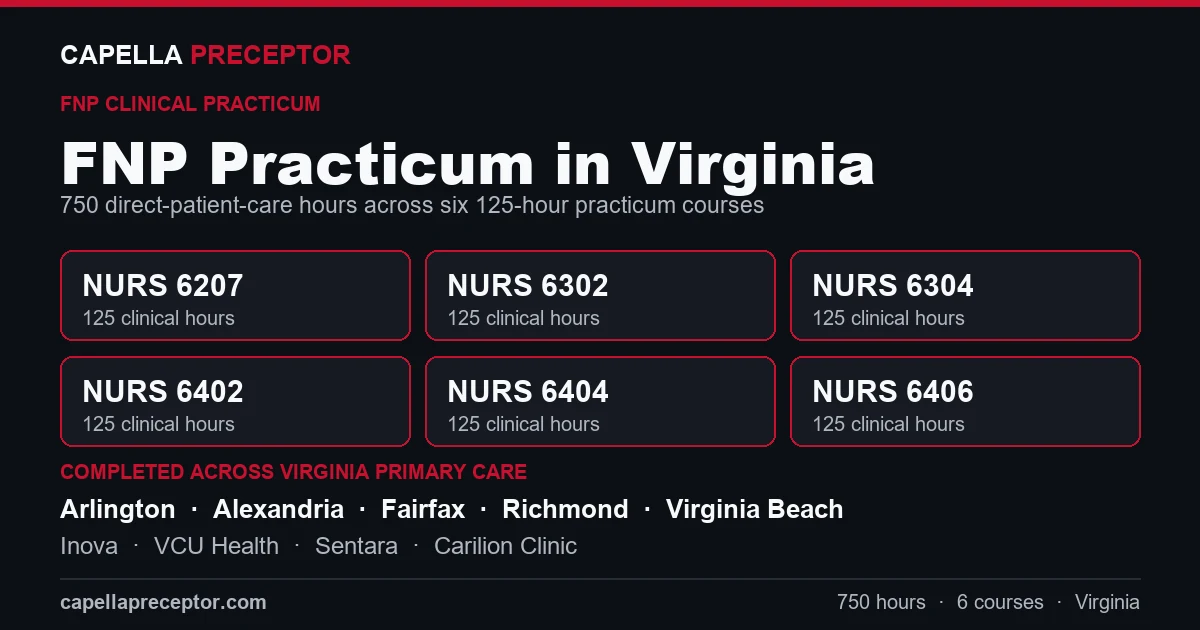
The number does not change at the state line. A Capella MSN-FNP student in Virginia needs a minimum of 750 practicum hours, the same figure required everywhere, spread across six clinical practicum courses that each carry 125 hours (Capella, MSN-FNP courses). The coursework is online; the practicum is completed in person in your own Virginia community. The fuller breakdown of the six courses lives on our Capella FNP page.
What Virginia changes is not the count but the supply. Because the FNP is a family role, those 750 hours must span the lifespan, so you need a preceptor or a set of sites covering adult and older-adult primary care, pediatrics, and reproductive or women's health. In a restricted-practice state, the pool of Virginia NPs free to commit a student across that whole sequence is narrower than the raw provider count suggests, for the reason the next section explains.
What does Virginia's restricted practice authority mean for FNP precepting?
The American Association of Nurse Practitioners places Virginia in the restricted tier on its State Practice Environment map (AANP, State Practice Environment). Restricted is the most limiting of the three tiers, meaning state law keeps a nurse practitioner from carrying out at least one element of practice independently and ties it to a physician.
In Virginia the limiting element is collaboration. Under the Code of Virginia, a nurse practitioner who has not yet reached the experience threshold must maintain a written or electronic practice agreement with a patient care team physician (Code of Virginia § 54.1-2957). As of July 1, 2024, House Bill 971 lowered that threshold from five years to three years of full-time clinical experience, defined as 5,400 hours at 1,800 hours per year (Virginia Council of Nurse Practitioners, HB 971; 18VAC90-30-86). Once an NP attests to that experience, they may apply to practice autonomously without the agreement.
Here is the part FNP students miss. This rule governs the nurse practitioner after licensure, not your practicum. As a Capella learner you work under your preceptor's supervision and your school's signed affiliation agreement, so a restricted state does not narrow your scope as a student. What it narrows is who is realistically free to precept you. A newer Virginia FNP is still inside a physician-led patient care team and may have less latitude or bandwidth to add a student, while a physician or an experienced, autonomous FNP can take you on directly. We screen for that before we match you, so the name you receive is one that can actually carry your 750 hours.
Can a physician precept your Capella FNP hours in Virginia?
Yes, and in Virginia that is often the practical answer. Capella accepts a qualified physician, nurse practitioner, or, in some courses, another clinician matched to the patient population as your on-site preceptor. Because so many Virginia family medicine and primary care sites are physician-led, the collaborating physician at a practice, or an experienced FNP working within it, is frequently the person who signs off your hours. The restriction that limits a newer NP's independence does not stop a physician from precepting a student, so a physician-led panel can be an asset for an FNP rotation rather than an obstacle.
One Virginia detail worth knowing for context: a patient care team physician may serve as the collaborating physician for no more than six nurse practitioners with prescriptive authority at once, and up to ten in the psychiatric-mental health category (Code of Virginia § 54.1-2957.01). That cap shapes how Virginia primary care teams are built, which is part of why a willing, available FNP-appropriate preceptor is a finite resource you should lock in early rather than assume.
Who regulates and verifies a Virginia FNP preceptor?
Nurse practitioners in Virginia are licensed as advanced practice registered nurses and are jointly regulated by the Virginia Board of Nursing and the Virginia Board of Medicine, both within the Department of Health Professions (Virginia Board of Nursing, APRN page). A 2023 change replaced the older umbrella title "nurse practitioner" with "advanced practice registered nurse," so current Board language uses APRN, which includes the FNP role.
Any FNP preceptor or site you propose should hold an active, unencumbered Virginia license in the population they will supervise. You can confirm a clinician's status through the Department of Health Professions License Lookup, which covers nurses, NPs, and physicians. We run that check on every preceptor we present, so the credential is confirmed before a name reaches you.
Where do FNP students find clinical sites in Virginia?
Capella is direct about this: the student secures the preceptor and the site, and the university does not assign from a roster. For a Virginia FNP that means cold-contacting family medicine, pediatric, and women's health practices and competing with learners from other programs for the same finite set of willing preceptors. The state has dense provider clusters in some regions and genuine scarcity in others, so where you live changes the difficulty.
Virginia's care is anchored by large systems whose primary care footprints map onto the FNP populations: Inova across Northern Virginia, VCU Health in the Richmond region, Sentara across Hampton Roads, and Carilion Clinic through Roanoke and Southwest Virginia (Virginia Hospital and Healthcare Association, system directory). Those systems do not place Capella students for you, but their family and outpatient clinics are the kind of sites your hours need. We hold preceptor relationships across the state and place students in person in these regions:
Arlington, Alexandria, Fairfax, Loudoun, and Prince William, the dense DC-suburb corridor with the most family and pediatric clinics per square mile in the state.
Richmond, Henrico, Chesterfield, and the Tri-Cities, a deep base of family medicine, internal medicine, and women's health practices for the adult and reproductive courses.
Virginia Beach, Norfolk, Chesapeake, Portsmouth, and Newport News, a coastal metro with strong primary care density for full-lifespan FNP coverage.
Charlottesville, Lynchburg, Roanoke, and Harrisonburg, plus the Shenandoah Valley and Southwest Virginia, where in-person FNP sites are thinner and the virtual route often fills the gap.
If you are in a rural county where a single clinic cannot cover pediatrics or women's health, the virtual route keeps your timeline intact while still meeting the lifespan spread your FNP courses require. Either way the placement is matched to the populations each course expects, not just to a nearby provider.
What clears before FNP practicum starts in Virginia?
Identifying a willing preceptor is only the first half. Before you log a single FNP hour in Virginia, the placement has to clear Capella's practicum workflow, which we track as CORE ELMS. The pieces below routinely stall Virginia students, and all are administrative rather than clinical.
- Affiliation agreement. A signed agreement between Capella and the Virginia site must be in place before practicum begins. Large systems like Inova, Sentara, VCU Health, and Carilion route these through legal review, which adds weeks if you start late. We initiate it early and chase the signatures.
- Background check and health records. Background check, immunizations, and health screening clear through Capella's compliance vendor, CastleBranch, by the end of your first billing session or quarter. Build in time for any document that needs a provider signature.
- Site and preceptor approval. You propose the FNP preceptor and site inside CORE ELMS for Capella to review and approve, the system also verifies the preceptor's license, then you log and submit your hours there for the preceptor to sign off.
Virtual or in-person for a Virginia FNP student?
Both paths keep your hours tracked in CORE ELMS and both work for the FNP in Virginia. The right one depends on where you live and which populations your local sites can cover.
Best when you are in or near Northern Virginia, Richmond, or Hampton Roads, where family, pediatric, and women's health clinics cluster. Hands-on encounters in a local practice suit the adult-gerontology and pediatric FNP courses.
Best for the Shenandoah Valley, Southwest Virginia, and other rural areas where a single site cannot cover the full lifespan. Your timeline holds even when a local FNP preceptor is scarce.
FNP in Virginia: FAQ
How many practicum hours does a Capella FNP student need in Virginia?
A minimum of 750 practicum hours, the same nationwide figure, across six courses that each carry 125 hours. The count is set by Capella, not Virginia. What Virginia changes is the supply of preceptors free to commit across the whole sequence, because it is a restricted-practice state.
Does Virginia's restricted practice authority limit my FNP practicum?
Not your scope as a student. You practice under your preceptor's supervision and a signed affiliation agreement, so the Virginia practice agreement rule applies to the NP after licensure, not to your practicum. It does shape who can precept you, since a Virginia NP under three years of experience still works within a physician-led patient care team.
Can a physician precept my Capella FNP hours in Virginia?
Yes. Capella accepts a qualified physician, nurse practitioner, or, in some courses, another clinician matched to the population. In Virginia many family medicine sites are physician-led, so a collaborating physician or an experienced FNP in that practice can serve as your preceptor when the license and population fit your course.
Which Virginia cities do you place Capella FNP students in?
Northern Virginia (Arlington, Alexandria, Fairfax, Loudoun, Prince William), Greater Richmond and the Tri-Cities, Hampton Roads (Virginia Beach, Norfolk, Chesapeake, Newport News), and the Charlottesville, Roanoke, Lynchburg, and Harrisonburg areas. Where family, pediatric, and women's health options are thin, the virtual route keeps your timeline intact.
How do I verify a Virginia FNP preceptor's license?
Use the Virginia Department of Health Professions License Lookup at dhp.virginiainteractive.org, which covers nurses, NPs, and physicians under the joint Board of Nursing and Board of Medicine. We confirm every preceptor's active, unencumbered Virginia license before the name reaches you.
Sources
- Capella University, MSN Family Nurse Practitioner courses (750 hours, six courses)
- AANP, State Practice Environment (Virginia: restricted)
- Code of Virginia § 54.1-2957, licensure and practice of APRNs
- Virginia Council of Nurse Practitioners, HB 971 (three years / 5,400 hours)
- Virginia Board of Nursing, Advanced Practice Registered Nurse
- Virginia Department of Health Professions, License Lookup
How Capella Preceptor helps Virginia FNP students
You now know the shape of it: 750 hours across the lifespan, a restricted-practice state where newer NPs work inside a physician-led team, a board that licenses NPs jointly with the Board of Medicine, and a school that leaves the placement to you. We close that gap. We secure a verified, Virginia-licensed, Capella-compliant FNP preceptor whose panel covers the family, pediatric, and women's health populations your courses require, in person across Northern Virginia, Richmond, and Hampton Roads or fully virtual statewide, and we carry the CORE ELMS paperwork, the affiliation agreement, and CastleBranch compliance from first contact to signed hours.
- Verified Virginia FNP preceptor matched in 7 days, license confirmed via DHP Lookup
- Lifespan coverage planned across all six FNP courses, affiliation agreement and CORE ELMS forms handled
- No payment until you are matched, in person or virtual, anywhere in Virginia
Get a Capella FNP preceptor in Virginia
Free 15-minute consult. No payment until matched. We map your full 750-hour FNP plan across the lifespan.
Get my free consult →